Should Baseline Checkpoint Selection Be Unified? The Key Debate for Fair Comparison
Unifying baseline checkpoint selection rules improves fairness but requires weighing baseline tuning; transparent reporting and ablation are key.
The article discusses how inconsistent checkpoint selection strategies among baseline models affect fair comparison in machine learning papers. Different official implementations use varying strategies like validation loss, accuracy, early stopping patience, or last checkpoint, which can confound performance differences and raise reviewer fairness concerns. Unified rules follow controlled variable principles but may weaken baselines tuned for specific strategies. A compromise is to unify rules in main experiments while retaining original strategy results in the appendix, and transparently report each baseline's selection strategy. When questioned, supplementing ablation experiments with unified rules is more persuasive than verbal defense. Community consensus favors unification as more rigorous but requires weighing field conventions, with the key being experimental transparency and consistency of argumentation.
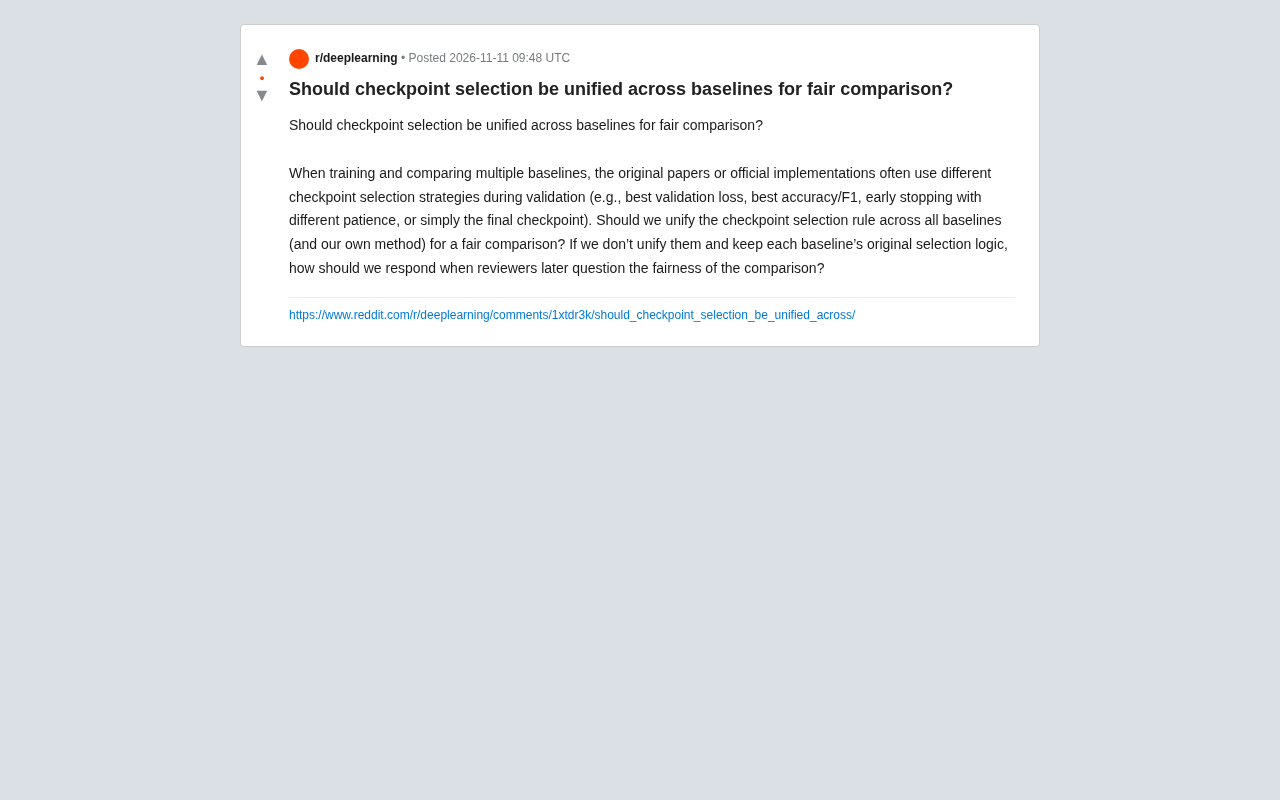
In reproducibility and comparative experiments for machine learning papers, one detail is often overlooked yet directly affects the credibility of conclusions: different baseline models often use different checkpoint selection strategies during the validation phase. A recent discussion on Reddit raised this sharp question—for fair comparison, should we unify the checkpoint selection rules for all baselines (and our own method)? If not, how should we respond to reviewers' fairness concerns?
The Root of the Problem: The "Selection Bias" Inherent in Baselines
Strategy Differences in Official Implementations
The checkpoint selection methods used during validation in original papers or official code vary widely: some take the checkpoint with the lowest validation loss, some take the checkpoint with the highest validation accuracy or F1, some use early stopping with different patience values, and others simply report the last checkpoint. These strategies are not inherently right or wrong, but their impact on final performance is not the same.
Early Stopping is a common technique to prevent overfitting: during training, a metric on the validation set (such as validation loss) is continuously monitored. When this metric stops improving for a certain number of consecutive epochs (i.e., the "patience" value), training is terminated early and rolled back to the checkpoint with the best monitored metric. The patience value directly determines where the model stops on the training curve—the larger the patience, the more likely the model continues training after the validation metric no longer improves significantly, thereby capturing possible small improvements later, but also increasing the risk of overfitting; the smaller the patience, the earlier training stops, possibly missing the best checkpoint. Therefore, even if two models have the same architecture, solely due to different early stopping patience values, the final selected checkpoints may correspond to different generalization performance. In baseline comparisons, if each baseline uses a different patience value, performance differences may partly stem from this hyperparameter setting rather than the model's own merits.
Why This Affects Comparative Conclusions
Validation loss and validation accuracy do not always change in sync, and differences in early stopping patience cause models to stop at different points on the training curve. When you compare multiple baselines in the same table, if each baseline follows its original selection logic, the performance differences may include gains or losses from the "selection strategy" rather than differences in the models' inherent capabilities. This confounding factor is precisely a common entry point for reviewers to question fairness.
The asynchrony between validation loss and validation accuracy is key to understanding this issue. Validation loss (e.g., cross-entropy) measures the difference between the model's predicted probability distribution and the true labels, while validation accuracy (or F1) measures the correctness of hard classification decisions. The two are not always monotonically in sync: the model may continue to slowly decrease validation loss while accuracy has plateaued or even slightly decreased, because loss is more sensitive to changes in prediction confidence. For example, the model may become more extreme in its predicted probabilities for some samples (loss decreases) but the classification boundary does not change (accuracy unchanged); conversely, the model may temporarily improve accuracy while loss increases. This asynchrony means that the checkpoint selected by the lowest loss criterion and the checkpoint selected by the highest accuracy criterion may be models at different stages of training, and their test performance may naturally differ. Therefore, when comparing multiple baselines, if they use different monitoring metrics, the performance differences include the factor of "selection metric."
Unifying Checkpoint Selection: Tension Between Ideal and Reality
Advantages of Unified Rules
From the perspective of experimental design, unifying checkpoint selection rules (e.g., all using the checkpoint with the lowest validation loss, or all using the same early stopping patience) can maximize variable isolation, allowing the comparison to focus on the model architecture or training method itself. This conforms to the basic principle of controlled variables and is easier to state clearly in the paper.
The Cost of Unified Rules
But unified rules are not without cost. Some baseline models' official implementations may have been tuned for their specific selection strategies, and forcing unification may cause the baseline to perform below its claimed level, triggering rebuttals that "you weakened the baseline." On the other hand, different tasks have different sensitivities to checkpoint selection metrics, and a one-size-fits-all approach may not be suitable for all scenarios.
Baseline tuning refers to a series of hyperparameter adjustments made by the original paper's authors for their own method or baseline models, including learning rate, batch size, regularization coefficients, and checkpoint selection strategies. These tunings are often determined through extensive experiments on specific datasets and tasks, aiming to make the baseline achieve its reported best performance. When reproducers forcibly unify checkpoint selection rules for fair comparison, they actually change the baseline's originally tuned configuration, potentially causing baseline performance degradation. For example, a baseline may originally use a larger early stopping patience combined with learning rate decay, thereby achieving better validation accuracy in the later stages of training; if uniformly changed to "lowest validation loss" with a smaller patience, the baseline may stop too early and fail to reach its claimed level. This risk of "weakening the baseline" is the main cost of unified rules and a point where reviewers may raise concerns. Therefore, when deciding whether to unify, one needs to weigh the tension between controlling variables and respecting the baseline's original tuning state.
Response Strategies to Reviewer Concerns
Unify in Main Experiments, Retain Original Results in Appendix
A compromise is to unify checkpoint selection rules in the main experiments while reporting results when each baseline uses its original selection strategy in the appendix. This demonstrates a controlled comparison while preserving comparability with the original papers. If reviewers question fairness, you can point out that the main experiment has controlled for this variable, and the appendix provides a more comprehensive perspective.
Ablation Study in machine learning papers is used to verify the contribution of a component or strategy to final performance. Specifically for the checkpoint selection issue, an ablation study can be designed as: keeping the model architecture and training hyperparameters fixed, only changing the checkpoint selection rule (e.g., using lowest validation loss, highest validation accuracy, fixed patience early stopping, last checkpoint, etc.), and observing the performance changes of each baseline and your own method under these rules. Through such ablation, researchers can quantify the impact of the "selection strategy" factor on comparison results: if the relative rankings of models remain stable under different rules, it indicates that the conclusions are insensitive to this factor, and fairness concerns can be effectively addressed; if rankings change significantly, further analysis of the reasons is needed and should be discussed in the paper. Ablation experiments are more persuasive than mere verbal defense because they provide empirical data allowing reviewers to judge the robustness of the conclusions themselves.
Transparent Reporting of Selection Strategies
Regardless of whether unified, the checkpoint selection strategy used by each baseline should be explicitly listed in the paper. Transparency itself is a response to fairness concerns—when readers clearly know the source of differences, they can judge the robustness of the conclusions themselves.
Consensus and Divergence from Multiple Perspectives
According to multiple researchers in the Reddit discussion, unifying checkpoint selection is in principle a more rigorous approach, but in practice one needs to weigh the baseline's original tuning state. Some argue that if reviewers question fairness, the most powerful response is to supplement a set of ablation experiments with unified selection rules rather than relying solely on verbal defense. Other researchers point out that in some fields, the community has by default accepted the practice of "each baseline following its original strategy," and forcing unification may deviate from convention. These divergences indicate that there is no universally applicable answer to this issue; the key lies in the transparency of experimental design and the consistency of argumentation.
Practical Recommendations
For researchers preparing submissions or reproducing experiments, the following approach can be followed: prioritize unifying checkpoint selection rules in the main experiments and clearly state this in the experimental setup section; for baselines with strong official implementation tuning, consider supplementing the appendix with results under the original strategy; when facing reviewer concerns, respond with additional ablation experiments rather than mere justification. Checkpoint selection may seem like an experimental detail, but it directly relates to the credibility of comparative conclusions and deserves sufficient attention in the paper.
One-line Summary
Unifying baseline checkpoint selection rules can improve comparison fairness, but one must weigh the baseline tuning state; transparent reporting and ablation experiments are key.
Paragraph Summary
The article explores the impact of inconsistent checkpoint selection strategies among baseline models on fair comparison in machine learning papers. Different baselines' official implementations use different strategies such as validation loss, accuracy, early stopping patience, or last checkpoint, which can mix into performance differences and trigger reviewers' fairness concerns. Unified rules conform to the controlled variable principle but may weaken baselines tuned for specific strategies. A compromise is to unify rules in main experiments, retain original strategy results in the appendix, and transparently report each baseline's selection strategy. When facing concerns, supplementing ablation experiments with unified rules is more persuasive than verbal defense. Community consensus holds that unification is more rigorous but requires weighing field conventions; the key lies in experimental transparency and consistency of argumentation.
Related articles

AI Writes Your Code—Do You Still Need to Learn Git? Five Reasons
AI coding agents handle Git operations automatically—is it still necessary to learn Git? Five reasons: team communication, reviewing agent PRs, monitoring code changes, fallback when AI goes down, and the joy of learning—plus how the focus of learning Git is shifting in the agent era.

Anthropic Reportedly Prices IPO at $83 Per Share, Valuing Company at $1.5 Trillion
Anthropic reportedly prices IPO at $83 per share, above the expected range, with a fully diluted valuation of $1.5 trillion. This article analyzes the signal significance of the pricing and its impact on the AI industry's financing environment.

Open-Source Code Hosting Platform Codeberg Suffers Outage, Sparking Debate in Developer Community
Open-source code hosting platform Codeberg.org suffered an outage, sparking Hacker News debate over nonprofit platform stability and open-source infrastructure dependency risks.