Show HN Submissions Surge 6x But Success Rate Stays Flat: How Products Can Stand Out in the AI Era

Show HN submissions surged 6x post-ChatGPT but success rates stayed flat, revealing AI's supply glut paradox.
Since ChatGPT's launch, Show HN submissions have grown 6x while the success rate remains virtually unchanged. AI tools have lowered the barrier to building products, causing a supply-side explosion, but community attention remains finite. The real competitive advantage has shifted from execution capability to judgment, differentiation, and distribution—making originality and genuine user value more important than ever.
An Overlooked Signal
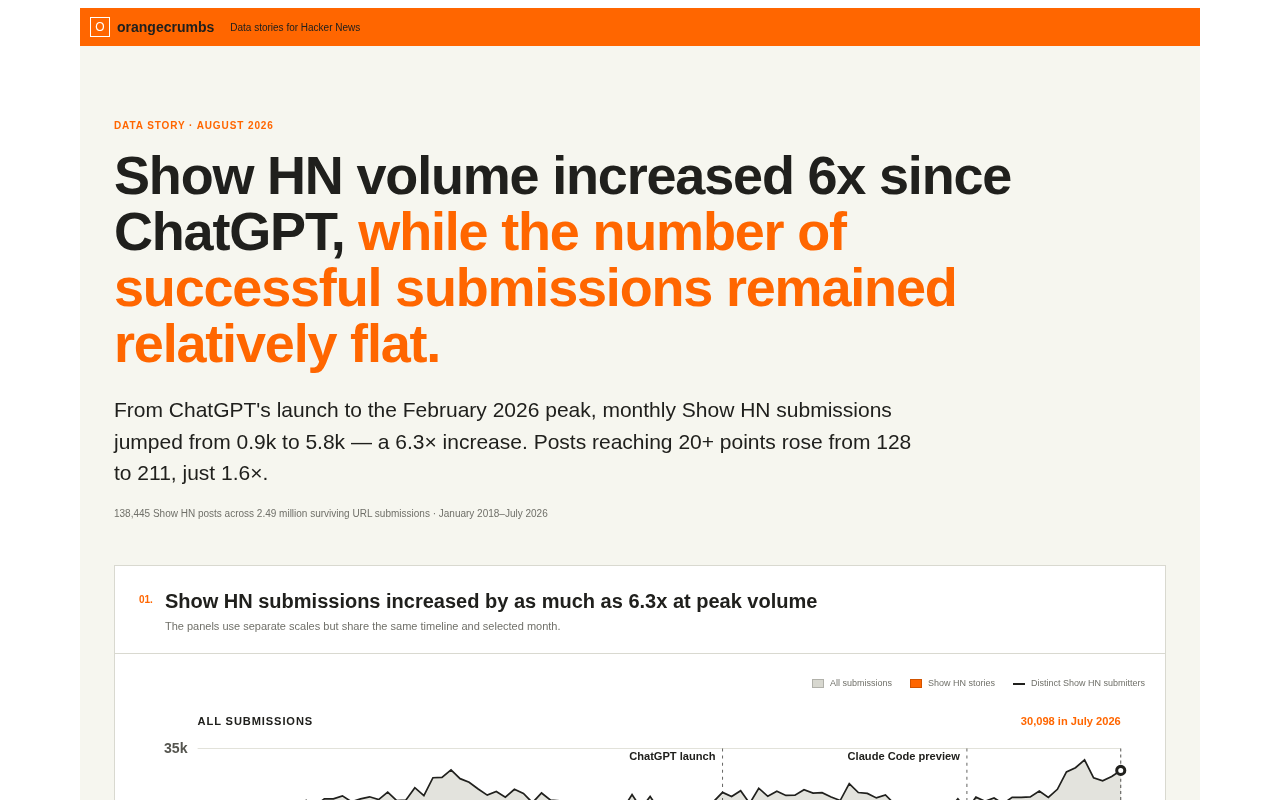
On Hacker News, a post revealed a fascinating phenomenon: since ChatGPT's launch, submissions to Show HN (a community section where developers showcase personal projects) have grown roughly 6x, yet the proportion of projects that actually gain traction and succeed has barely changed.
Show HN is a dedicated section within the Hacker News community where developers showcase projects, tools, or products they've built and seek community feedback. Hacker News, founded by Y Combinator, is one of the world's most influential tech communities, with hundreds of thousands of daily active users including Silicon Valley investors, entrepreneurs, and senior engineers. Many well-known startups (like Dropbox and Stripe) owe their early users and seed funding in part to HN community exposure. Show HN's filtering mechanism relies on community upvotes and comment engagement—highly upvoted posts appear on the front page and receive exponential traffic amplification.
This observation seems simple on the surface, but it reflects deep structural changes in the entire tech startup and product launch ecosystem under the generative AI wave. When the barrier to creating software is drastically lowered, are we inadvertently diluting every project's chance of being seen?
The Truth Behind the 6x Surge in Submissions
AI Has Made "Building Products" Unprecedentedly Easy
The explosion in Show HN submissions is no coincidence. ChatGPT and subsequent tools like Claude, GitHub Copilot, and Cursor have dramatically compressed the time from idea to working prototype. An MVP (Minimum Viable Product) that once took weeks to build can now be completed in a single weekend—or even a single evening.
From ChatGPT to specialized AI coding tools, this space has undergone rapid stratification. GitHub Copilot (officially released in 2022) embeds large language models into the IDE for line-by-line code completion; Cursor goes further by redesigning the entire development environment around AI, supporting multi-file context understanding and codebase-level refactoring. Claude (by Anthropic) is known for its long context window and precise instruction-following, making it particularly suited for complex code generation tasks. Additionally, products like Replit Agent, V0.dev, and Bolt.new allow users to describe requirements in natural language and generate deployable applications directly. Together, these tools form a complete spectrum from "assisted coding" to "autonomous building."
MVP (Minimum Viable Product) is a core concept in lean startup methodology, systematically articulated by Eric Ries in The Lean Startup. The core idea: build the smallest possible product version that can validate key hypotheses, iterate quickly based on real user feedback, rather than spending massive time building a "perfect" product before entering the market. Before AI tools, even the simplest MVP typically required weeks of frontend/backend development, database setup, and deployment configuration. AI has compressed this cycle to hours—meaning the cost of validating hypotheses approaches zero. But it also reduces the filtering effect of "sunk costs," allowing more half-baked ideas to enter the market as MVPs.
This has directly triggered a supply-side explosion:
- Lower technical barriers: Unfamiliar with a framework? AI can generate boilerplate code on the spot.
- Shorter development cycles: Debugging, documentation, and boilerplate—time-consuming tasks get automated.
- Lower psychological barriers: The "it's quick to build anyway" mindset encourages more people to ship.
The result: showcase platforms like Show HN have been flooded with new projects—a 6x increase in volume.
Why Project Success Rates Have Stagnated
Yet the core insight from the data is this: the success rate has remained relatively flat. Despite the surge in total submissions, the proportion of projects earning community recognition (high upvotes, lively discussion, real user growth) hasn't risen accordingly.
The underlying logic is worth pondering. A community's "attention" is a finite resource. The concept of the Attention Economy was proposed by Herbert Simon in 1971, who observed that "a wealth of information creates a poverty of attention." In the internet age, this insight has been developed into a complete theoretical framework. Humans have limited effective attention time per day (research suggests about 4-6 hours of deep attention), while information supply grows exponentially. Social platforms, content communities, and app stores all face the same structural contradiction: content producer growth far outpaces consumer attention growth. This intensifies the "winner-take-all" effect—the few pieces of content that gain initial attention receive even more exposure through algorithmic recommendation, while the vast majority sink permanently into the long tail.
When the denominator (total submissions) grows 6x but the numerator (high-quality, compelling projects) doesn't grow proportionally, it actually becomes harder for any individual project to stand out. AI has amplified the "quantity" of output without necessarily improving the "quality," nor has it expanded the audience's attention capacity.
The Product Competition Dilemma in an Age of Supply Explosion
From "Can I Build It" to "Is It Worth Building"
This phenomenon poses a sharp question for indie developers and entrepreneurs: when "being able to build it" is no longer a barrier, what's the real competitive dimension?
The answer is shifting from execution capability to judgment and insight:
- Problem selection: Are you solving a real and worthwhile pain point?
- Differentiated positioning: In an age when everyone has access to AI, what unique value does your project offer that others can't replicate?
- Distribution and narrative: How do you get your target users to notice you amid the information flood?
The concept of a Moat originates from Warren Buffett's investment philosophy, referring to a company's durable competitive advantage. Traditional moats include network effects, economies of scale, brand recognition, switching costs, and technology patents. But in the AI era, technical implementation as a moat is rapidly depreciating—when anyone can use AI to replicate a product's core features in a day, code itself is no longer a barrier. New moats are shifting toward: unique data assets (the flywheel effect of user behavior data), deep domain knowledge (profound understanding of specific industry workflows), community and trust (users' emotional connection to a brand), and distribution advantages (established channel relationships and user reach capabilities).
The value of technical implementation is being diluted, while judgment about markets, users, and timing becomes the new moat.
Content and Product "Inflation"
The Show HN phenomenon is actually a microcosm of a larger trend. Similar "supply inflation" is playing out across multiple domains: AI-generated blog posts, mass-produced indie apps, auto-generated open-source projects… When creation costs approach zero, what's scarce is no longer content itself, but content that can be trusted, remembered, and genuinely needed.
AI-driven supply-side inflation is producing observable effects across multiple domains. In content creation, it's estimated that a significant proportion of new internet content in 2024 is AI-generated or AI-assisted, forcing search engines like Google to adjust algorithms to identify and downrank low-quality AI content. In mobile apps, new app submissions to the App Store and Google Play have grown substantially, yet the average number of apps users install has remained unchanged for years. In open source, the rate of new repository creation on GitHub has accelerated, but the proportion of projects earning more than 100 stars continues to decline. In academia, preprint submissions on arXiv have surged, putting unprecedented pressure on peer review systems. This structural contradiction of "output explosion but constant attention" is reshaping the competitive landscape of every knowledge-intensive industry.
This also explains why many platforms are increasingly emphasizing "human touch," originality, and authentic experience—precisely the things AI cannot replicate at scale.
Practical Takeaways for Indie Developers
Don't Treat AI as the Finish Line
AI tools should be accelerators, not crutches that replace thinking. Using AI to quickly validate ideas is efficient, but if you're only building something "because it's easy to build," the output will likely drown in a sea of obscurity.
The truly valuable approach is:
- Invest the time you save into polishing core value, rather than simply chasing publication volume.
- Prioritize user feedback and iteration, ensuring the product truly fits a need.
- Invest in storytelling ability, so good projects actually get seen.
Quality Remains the Only Long-Term Barrier
Perhaps the most profound insight from this data is: democratizing technology doesn't automatically democratize success. When everyone can build a product, those who consistently win are still the few who achieve excellence in insight, execution details, and user value.
Conclusion
A 6x increase in submissions paired with stagnant success rates creates a thought-provoking contrast. It reminds us that while generative AI has indeed lowered the barrier to creation, it has also made "standing out" harder. In this age of supply explosion, the democratization of tools won't automatically make everyone successful—it only makes judgment, originality, and genuine value more precious.
For every developer leveraging AI to accelerate creation, the question is no longer "Can I build this?" but rather "Is what I've built truly worth being seen by the world?"
Related articles

GLM-5.3 Benchmark Analysis: The Globalization Journey of Chinese Large Language Models
In-depth analysis of Zhipu AI's GLM-5.3 benchmarks on Artificial Analysis, exploring third-party evaluation platforms, the GLM series evolution, and Chinese LLMs' path to global recognition.

Claude Autonomously Designs Proteins with 35% Success Rate, Far Exceeding Human Expert Performance
Anthropic's Claude achieves 35% wet-lab success rate in autonomous protein design, far surpassing the 10-15% human expert average, signaling AI's move toward real scientific productivity.

Perplexity Discover's Multilingual Support Suddenly Disappears — Why Are International Users Upset?
Perplexity Discover's multilingual news feature suddenly dropped non-English support, frustrating international users. We analyze possible causes and the broader challenges of AI product internationalization.