siliXon: Describe Your Idea in Plain English, Get a Ready-to-Order Circuit Board
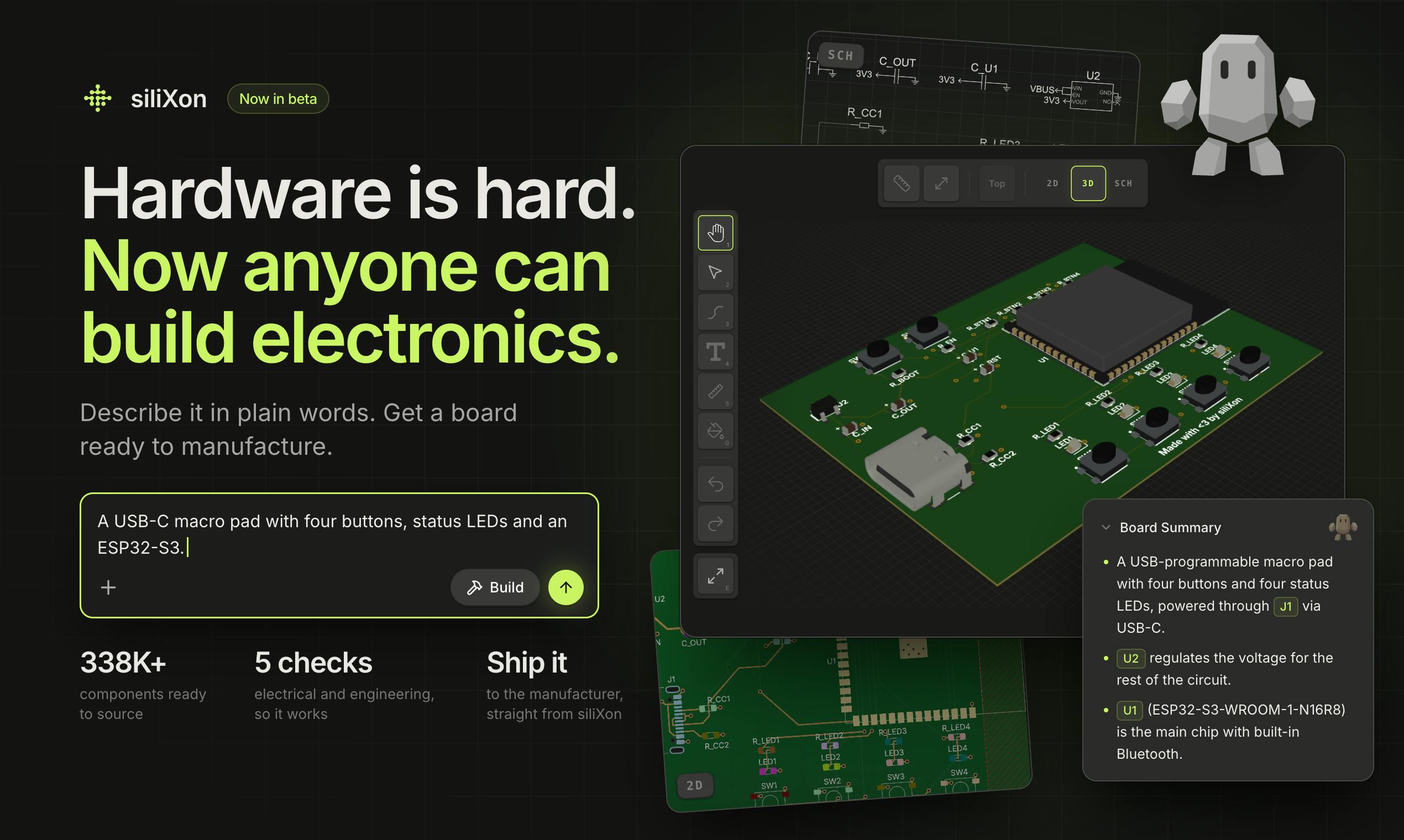
siliXon lets non-engineers generate fab-ready PCBs from plain English, still in early validation.
siliXon is a hardware generation tool on Product Hunt where users describe an electronic device in everyday English and get a fully routed, ready-to-fabricate PCB. Its core is design agent Rocky, which first asks for essential parameters like supply voltage, interface type, and size constraints, then selects real, orderable components and completes layout, schematic, and routing. The product supports hybrid 2D/3D manual editing and natural-language modifications, design files belong to the user, and every board must pass engineering checks before manufacturing. Positioned for "anyone with an idea," but with only 76 upvotes on Product Hunt, it's still in early validation. Real challenges like complex circuit reliability, multilayer routing, and EMC aren't addressed in official descriptions, leaving capability boundaries to be tested in practice.
Hardware Design Is Having Its "One-Sentence Generation" Moment
siliXon, which surfaced on Product Hunt, can be summed up in a single sentence: you describe an electronic device in everyday English, and it takes you all the way to a fully routed PCB that can be sent straight to fabrication. The official positioning on Product Hunt is refreshingly direct — built for "anyone with an idea, not only engineers" — and it emphasizes getting there "in minutes."
The product currently has 76 upvotes and 4 comments, ranking 11th for the day under the Design Tools, Hardware, and Artificial Intelligence tags. Those numbers aren't a breakout hit, but the problem it tackles is real enough: the first barrier in hardware prototyping was never the idea itself, but the steep learning curve between having an idea and holding a board that can actually be manufactured.
What Happens Between a Description and a Manufacturable PCB
Rocky: A Design Agent That Asks Follow-Up Questions
At the heart of siliXon is a design agent called Rocky. Its workflow isn't as simple as "one click, one board" — the official description makes clear that Rocky "asks what it needs to know" before it starts working. That detail is worth noting: hardware design differs from pure software generation in that if parameters like supply voltage, interface type, and size constraints are missing, the output is essentially meaningless. Asking first and generating second is the prerequisite for making that output usable.
Once the questions are answered, Rocky selects "real, purchasable" components, then handles layout, schematic drawing, and copper routing. The key word here is "purchasable" — many generative design tools stop at a pretty diagram, whereas siliXon emphasizes that its components are in-stock parts you can actually order. That distinction determines whether the output is a prototype or a toy.
PCB (Printed Circuit Board) is the physical foundation of virtually every electronic device: it connects chips, resistors, capacitors, and other components with copper traces, replacing the dense hand-wired connections of early electronics. A standard PCB typically consists of a substrate (such as FR-4 fiberglass), copper traces, a solder mask, and a silkscreen layer. Traces are the conductive paths formed after copper is etched. "Routing complete" means all electrical connections between components have been laid out according to the schematic, and Gerber files can be exported directly to a board house for fabrication.
Schematic capture and PCB routing are two distinct stages in hardware design: the schematic describes "what connects to what" — the logical connectivity — while routing determines "how those connections wind across the physical board, how wide they should be, and what they need to avoid," involving engineering constraints like trace width, layer count, vias, and clearance. The former can be generated quickly; the latter often determines whether the board can actually be manufactured — which is precisely where generative tools struggle most to replace human experience.
Dual 2D/3D Editing: Hybrid Collaboration Between Human and Agent
Generation doesn't mean you have to accept everything wholesale. siliXon lets users make manual edits in 2D and 3D views, or continue instructing Rocky in natural language. This hybrid model of "agent generates, human fine-tunes" aligns closely with how hardware engineers actually work: the tool lays down the first draft, and humans make the calls on critical spots.
The design files belong to the user — a point the official copy emphasizes separately. For teams turning hardware into a product, file ownership directly affects whether they can switch manufacturers, iterate, and commercialize later. It's not just a courtesy statement.
EDA (Electronic Design Automation) is the umbrella term for hardware design software, with representative tools including Altium Designer, Cadence Allegro, and KiCad. Traditional EDA has an extremely steep learning curve: users must understand an entire set of concepts like component footprints, netlists, and design rule checks (DRC), and interfaces often have hundreds of menus. Products like siliXon attempt to replace this prerequisite knowledge with natural language and agent collaboration, shifting the entry point from "learn the tool" to "state your requirements" — essentially transferring EDA's operational complexity from the user side to the model side.
Engineering Checks Before Anything Leaves the Factory
siliXon adds a gate of its own: every board must pass engineering checks before entering manufacturing. The existence of this rule shows the team understands that the biggest risk in generative design isn't "can't draw it" but "drew it, but it's unusable." Without checks for electrical rules and manufacturability, users would end up with a board that looks professional but can't actually be fabricated.
Engineering checks typically include two categories: DRC (Design Rule Check) and DFM (Design for Manufacturing). DRC verifies whether trace spacing, line width, and via dimensions conform to process capabilities, preventing shorts or opens; DFM examines, from the board house's perspective, whether hole diameters, copper-to-edge distances, and minimum line widths can actually be produced. There's also ERC (Electrical Rule Check), used to catch issues at the schematic level such as power, ground, and floating pins. None of these checks can be skipped — the most common failure mode in generative design is precisely something that "looks right but violates process constraints." Setting checks as a mandatory gate before manufacturing is therefore a critical step in making AI output genuinely usable.
Why This Matters
EDA tools have long been emblematic of professional software — high learning costs, dense interfaces, and steep terminology barriers. Using natural language as the entry point essentially redraws the boundary of "who can do hardware." siliXon's ambition is right there in the title: for anyone with an idea, not only engineers.
That said, at 76 upvotes, it's still in early validation. The real challenges of hardware generation — the reliability of complex circuits, multilayer board routing, electromagnetic compatibility — aren't addressed in the official description. For simple device prototypes, this path works; for more complex boards, real-world use will be needed to verify the limits of Rocky's capabilities.
For teams building hardware products, the value of tools like this isn't in replacing engineers, but in compressing the time and cost of validating an idea. Whether an idea can be realized used to take weeks and an outsourcing fee to find out. Now you might see a board's first draft in minutes.
Multilayer routing and electromagnetic compatibility (EMC) are widely recognized as the hard problems in hardware design. Multilayer boards mean signals must switch between inner layers through vias, requiring consideration of impedance matching, reference planes, and crosstalk; EMC demands that a design neither interfere with nor be interfered with by others in an electromagnetic environment, often requiring engineers to adjust trace topology and ground planes based on experience. A two-layer board can be completed with autorouting as a stopgap, but high-speed digital boards or RF boards with four or more layers still rely heavily on the judgment of senior engineers. The fact that siliXon's official copy doesn't delve into these scenarios suggests its current capability boundary is more likely to sit at low-to-medium complexity prototype boards.
Frequently Asked Questions
Who is siliXon for? The official positioning is "anyone with an idea, not only engineers" — suited for founders, product managers, and hobbyists who need to rapidly validate hardware concepts.
Can the generated circuit board be ordered directly? The official claim is that the output is a fully routed, manufacturable PCB, and it must pass engineering checks before entering manufacturing.
Who owns the design files? The official statement is clear: design files belong to the user.
Can I edit manually besides automatic generation? Yes — 2D and 3D editing are supported, and you can also instruct Rocky to make changes in natural language.
Related articles

WorkBuddy Full Tutorial: Build an AI Office Automation Agent from Scratch
A complete WorkBuddy tutorial: installation, three working modes, multimodal picture book video practice, expert team agent building, and workflow configuration for low-cost AI office automation.

WorkBuddy Agent Complete Guide: From Beginner to Automation in 7 Days
Based on Bilibili's 256-episode WorkBuddy masterclass, this systematically breaks down Tencent's AI office workbench core capabilities: Agent principles, Skill encapsulation, cross-platform connectors, scheduled automation, knowledge bases, and zero-code development, with learning path recommendations.

8 AI Accounts, 7 Failed: An Honest Review of Using AI to Get Work Done
Only 1 of 8 AI-run Bilibili accounts succeeded. We break down the real difference between "performing AI" and "using AI to get work done."