Simon Willison October Sponsors Newsletter: Monthly Insights for AI Developers
Simon Willison's October sponsors newsletter is out, focusing on the vibe game development inflection point, vulnerability trends, and LLM updates.
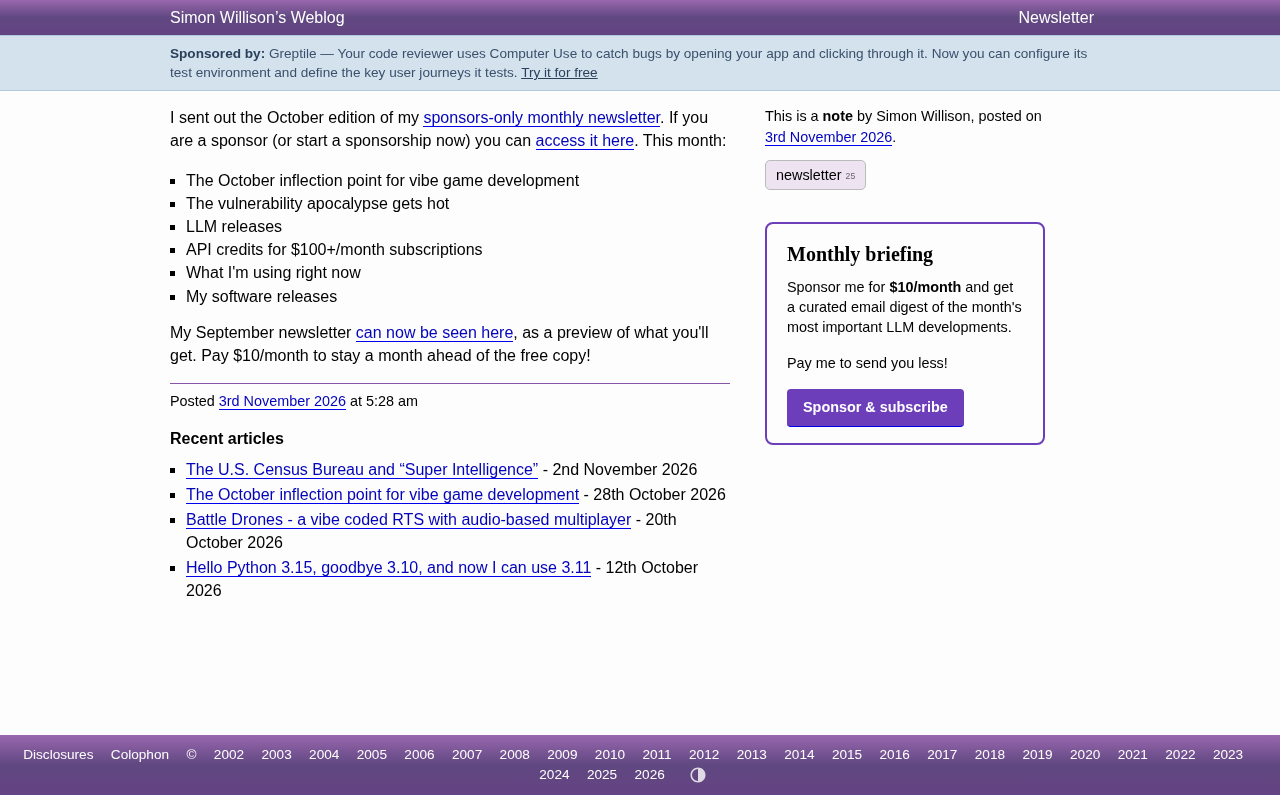
Simon Willison's sponsors-only October newsletter is now live, covering the October inflection point for vibe game development, the heating-up vulnerability apocalypse, LLM releases, API credits for $100+/month subscriptions, the tools he's using right now, and personal software releases. It continues his focus on practical AI tool use, security trends, and LLM progress. As a Django co-creator and Datasette author, Simon is known for in-depth evaluations and first-hand practice. The newsletter is $10/month, with sponsors reading a month early; the free September issue previews its style and depth.
Renowned developer Simon Willison publishes a sponsors-only newsletter every month, sharing his latest observations on AI and software development. The October issue is now live, and subscribers can read it early.
Overview of the October Issue
According to the sponsors newsletter page, the October issue covers several topics closely tied to AI development:
- The October inflection point for vibe game development
- The vulnerability apocalypse gets hot
- LLM releases
- API credits for $100+/month subscriptions
- What I'm using right now
- My software releases
These topics continue Simon's longstanding focus areas: practical applications of AI tools, security vulnerability trends, and the latest advances in large language models.
Vibe game development is a new paradigm for game creation built on generative AI tools such as large language models. Instead of writing code line by line, developers describe their intent in natural language, and the AI generates gameplay logic, art assets, or even complete prototypes. This approach dramatically lowers the barrier to game development, enabling non-professional developers to validate ideas quickly. What Simon Willison calls the "October inflection point" refers to the significant jump in usability and adoption of such tools around October 2025 — stronger model capabilities and a maturing toolchain have moved "make a game with a single sentence" from demos into real projects. This trend has also sparked discussion around creative attribution, code quality, and maintainability.
The vulnerability apocalypse is a term the security community has used in recent years to describe the simultaneous surge in the number and exploitation speed of software vulnerabilities. Its context includes: AI-assisted code generation causing code volume to balloon, automated vulnerability discovery tools (such as LLM-based fuzzing and code auditing) lowering the barrier to finding flaws, and the complexity of open-source dependency chains allowing a single defect to rapidly affect a large number of projects. Simon Willison has long tracked this trend, arguing that AI is both a source of vulnerabilities and a powerful tool for defenders to accelerate patching. The fact that this topic "gets hot" in the October issue reflects the rapidly rising weight of security issues in AI development practice.
Why Follow the Sponsors Newsletter?
Simon Willison is a co-creator of the Django framework and the author of open-source projects such as Datasette. In the AI field, he is known for in-depth evaluations and sharp insight, often trying new models at the earliest opportunity and sharing his experiences. His newsletter is more than a news roundup — it contains a wealth of personal practice and judgment.
The sponsors newsletter is published monthly at a subscription fee of $10/month. Compared with free content, sponsors get these analyses a month early and directly support his independent work.
Simon Willison's LLM command-line tool (usually referring to the llm project) is an open-source CLI tool for calling various large language models from the terminal, with support for plugin extensions, local model integration, and prompt template management. It reflects Simon's characteristic hands-on style: packaging frontier model capabilities into lightweight tools that can be used directly in daily work. The tool also often serves as the vehicle for his evaluations of new models — testing model performance through real tasks rather than relying solely on benchmark scores. Understanding this toolchain helps readers grasp the practical context of sections such as "What I'm using right now" and "My software releases" in his newsletter.
How to Get the October Issue
Currently, the October issue is available only to sponsors. If you are already a sponsor (or start sponsoring now), you can access the full text here.
As a preview, the free version of the September issue is publicly available, which gives a sense of the newsletter's typical style and depth.
The Value of Subscribing
For AI developers and technology enthusiasts, Simon's newsletter offers a way to filter out the noise. He doesn't just report the news — he pairs it with practical advice drawn from his own projects (such as the LLM command-line tool). For $10 a month, you get insights a month ahead of time and exclusive hands-on notes.
If you want to keep up with the frontier of AI development — especially to understand technology trends from the perspective of a seasoned practitioner — this newsletter is worth considering.
(This article is based on Simon Willison's RSS announcement and public information; the original text prevails for specific content.)
One-line Summary
Simon Willison's October sponsors newsletter is out, focusing on the vibe game development inflection point, vulnerability trends, and LLM updates.
Paragraph Summary
Simon Willison's sponsors-only October newsletter is now live, covering the October inflection point for vibe game development, the heating-up vulnerability apocalypse, LLM releases, API credits for $100+/month subscriptions, the tools he's using right now, and his personal software releases. The newsletter continues his characteristic focus on practical AI tool use, security vulnerability trends, and large language model progress. As a Django co-creator and the author of Datasette, Simon is known for in-depth evaluations and first-hand practice. The sponsors newsletter is published monthly at $10/month, and sponsors get to read it a month early; the free version of the September issue is public and serves as a preview of the newsletter's style and depth.
Related articles

Skykea Showdown: A Hilarious Variety Show Experience of a Minecraft Airship Building Competition
Skykea Showdown is a Minecraft airship building racing variety show. This article analyzes its two-phase build + hole race format, airship mod lift physics, secret mission design, and team confrontation dynamics—ideal for game content creators.
Did the US Midterms Vote No to AI Data Centers? A Map Reveals the Truth
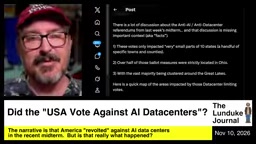
After the US midterms, media claimed voters rejected AI data centers, but a map shows restrictive votes are concentrated in a few Ohio townships, affecting less than 1% of US towns—the national anti-AI wave is exaggerated.

ApexW Optimizer Benchmark: Matches 8-bit AdamW in Unsloth with Lower Memory Usage
Developer shares benchmark of ApexW optimizer in Unsloth: ApexW 8bit has lower optimizer state memory (47.101 MB) and slightly better final loss than 8-bit AdamW, but similar speed. Needs independent reproduction.