Simon Willison's August AI Newsletter: Five Key Highlights
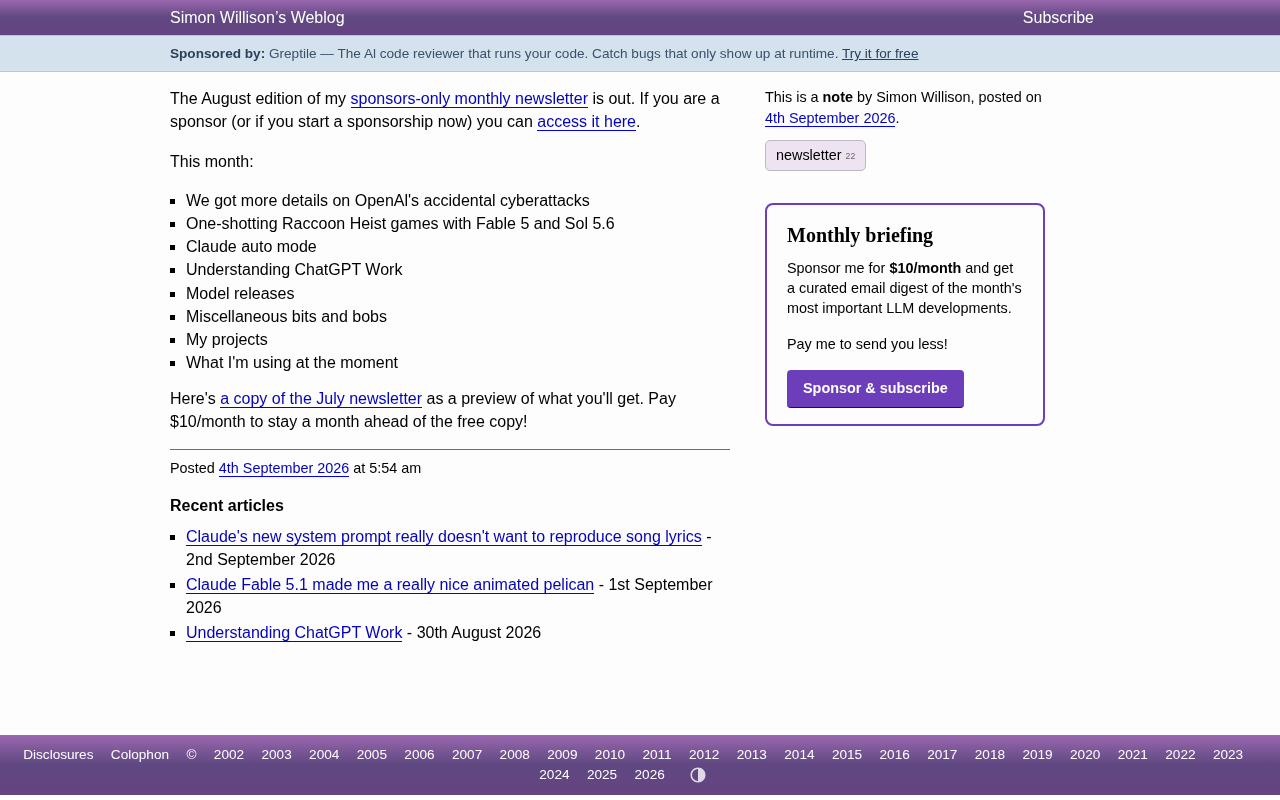
Simon Willison's August newsletter highlights AI safety incidents, one-shot game generation, and model updates.
Django co-founder Simon Willison's August AI newsletter covers five key topics: OpenAI's accidental cyberattacks revealing AI Agent safety risks, one-shot game generation testing model capabilities, Claude's auto mode for autonomous tasks, deep dive into ChatGPT's working mechanism, and monthly model release roundup.
Renowned developer and Django co-founder Simon Willison has released his August newsletter for sponsors.
Simon Willison and the Django Background: Simon Willison is one of the legendary figures in web development. In 2005, he co-created Django with Adrian Holovaty—a framework that remains one of the most popular in the Python ecosystem, widely used by Instagram, Pinterest, NASA, and others. Django is known for its "batteries-included" philosophy, powerful ORM system, and automated admin interface, dramatically lowering the barrier to web application development. In recent years, Simon has shifted his focus to AI, developing open-source projects like LLM (a command-line tool for large language models) and Datasette (a data exploration tool), while continuously publishing deep insights on AI technology on his personal blog. He has become an important voice bridging traditional software engineering and emerging AI technology.
As an influential independent observer in the AI field, Simon's newsletter has long been recognized for its keen insights into cutting-edge models, development tools, and industry trends. This article, based on his publicly available table of contents, outlines the core topics covered in this issue to help readers quickly grasp key developments in the current AI landscape.
Newsletter Structure and Subscription Model
Simon Willison employs a distinctive content distribution strategy: the newsletter is first released exclusively to GitHub Sponsors, with regular readers able to access the previous month's content for free one month later. In other words, sponsors pay $10 per month for a "one-month head start" on information.
GitHub Sponsors Mechanism: GitHub Sponsors is an open-source project funding platform launched by Microsoft-owned GitHub in 2019, allowing developers to receive direct financial support from the community. Unlike platforms such as Patreon, GitHub Sponsors is deeply integrated into developers' workflows—sponsors can donate directly on project repository pages, and GitHub initially promised not to charge platform fees. This mechanism provides a sustainable income source for open-source maintainers, changing the past difficulty of developers earning direct economic returns from their work. Simon uses this platform to establish a subscription-based content service, transforming technical insights into a sustainable creative model and exploring new business pathways for technical writing.
This "paid early access, free later" model is uncommon in technical content creation. It maintains the public value of content while providing sustainable economic incentives for in-depth analysis. July's newsletter is currently available as a public preview, serving as a reference sample for assessing the newsletter's quality.
OpenAI "Accidental Cyberattacks" Incident Analysis
The first focus of this newsletter is further disclosure of OpenAI's "accidental cyberattacks" incident. While the table of contents doesn't expand on details, this topic itself carries significant warning implications—it points to unintended security consequences that large models may trigger in practical applications.
AI Agents and Autonomous Execution Capabilities: AI Agents are AI systems capable of perceiving their environment, making autonomous decisions, and executing actions, fundamentally different from traditional "question-and-answer" dialogue models. Modern AI Agents can call APIs, operate browsers, execute code, modify files, and more, translating natural language instructions into actual system operation sequences. This capability relies on technologies like function calling and chain-of-thought, along with more complex planning and feedback loop mechanisms. However, granting AI systems more autonomy also introduces new security challenges: models may misinterpret instructions, produce unintended side effects, or even trigger behaviors resembling denial-of-service (DDoS) attacks while attempting to "optimize" tasks. This is the core risk revealed by OpenAI's "accidental cyberattacks" incident.
As AI Agent capabilities strengthen and they gain permissions to connect to networks and execute actions, behaviors "unintentionally" triggered by models while completing tasks may have real impacts on external systems. Such incidents are becoming emerging topics in AI safety research, reminding developers that comprehensive boundaries and protective mechanisms must be established when granting models more autonomy.
Generating Complete Games with AI in One Shot: One-Shot Capability Testing
An intriguing experiment in the newsletter is "One-shotting Raccoon Heist games"—using models like Claude to generate complete mini-games through one-shot prompting.
One-Shot Generation and Code Capability Assessment: One-shot generation refers to an AI model's ability to complete entire tasks in a single interaction, a key indicator for measuring model intelligence. In code generation, early models could only generate code snippets or required multiple dialogue rounds to complete functions, while modern large models can directly generate small applications with multiple files, complete logic, and runnable interfaces from a natural language description. The Raccoon Heist game experiment mentioned uses Anthropic's Claude series models. Such experiments not only test code generation accuracy but also examine the model's comprehensive understanding of complex concepts like game logic, state management, and user interaction. From a technical perspective, this requires models to have strong contextual understanding (processing long prompts), structured output capabilities (generating syntactically correct complete code), and implicit software engineering knowledge (such as module division and error handling).
"One-shotting" is an important metric for measuring large models' code generation capabilities: whether a model can produce runnable, complete programs in a single interaction directly reflects its depth of understanding complex requirements and code organization abilities. From initially only being able to generate code snippets to now building playable games in one go, this progress vividly demonstrates the leap in model programming capabilities. For readers focused on AI-assisted development, such experiments are excellent windows for evaluating model practicality.
Claude Auto Mode and In-Depth Analysis of ChatGPT's Working Mechanism
This newsletter also focuses on the latest developments from two mainstream AI models. One is "Claude auto mode," reflecting Anthropic's exploration of making models more autonomously complete multi-step tasks with reduced manual intervention.
Claude and Anthropic's Technical Approach: Claude is a large language model series developed by Anthropic, founded in 2021 by former OpenAI Research VP Dario Amodei and his team, focusing on building safer, more interpretable AI systems. Claude is renowned for its innovations in Constitutional AI—guiding model behavior by teaching it an explicit set of value principles rather than relying solely on human feedback. The Claude series models (such as Claude 3 Opus, Sonnet, Haiku) perform exceptionally well in code generation, long-text processing, and complex reasoning tasks. The "auto mode" mentioned likely refers to Claude's autonomous multi-step task execution capability, allowing the model to automatically plan and execute multiple subtasks after receiving initial instructions without human intervention, representing a paradigm shift from passive response to active task completion.
The second is "Understanding ChatGPT Work," an in-depth analysis of ChatGPT's working mechanism.
ChatGPT's Working Mechanism and Tool Calling: ChatGPT's working mechanism is far more complex than its surface dialogue interface. Modern versions of ChatGPT (especially GPT-4 and above) have built-in sophisticated task orchestration systems: they can identify user intent, determine whether external tools need to be called (such as web browsing, code execution, image generation), break tasks into sub-steps, and integrate results from multiple tools. This process involves function calling technology—the model generates structured JSON to describe the tools and parameters to be called, the system executes them and feeds results back to the model, which then continues reasoning or generates the final response based on results. Understanding this mechanism is extremely important for users: it explains why certain queries trigger "searching..." states, why models sometimes need multiple rounds of internal thinking, and how to guide models to select the correct tool chain through precise prompts. This transparency helps users transform AI from a "black box" into a predictable, optimizable working partner.
Understanding a model's internal operating logic—including how it schedules tools, processes context, and completes task chains—is crucial for users to use products more efficiently. Simon has always excelled at breaking down complex technical mechanisms into understandable practical knowledge, making this content especially valuable for users who want to master AI tools deeply.
Model Release Roundup and Personal Project Updates
The newsletter's regular sections also include "Model releases," systematically reviewing new models released by various companies this month.
Model Release Pace and Industry Competition: Since 2023, the large language model field has entered an unprecedented period of rapid iteration. Tech giants like OpenAI, Anthropic, Google, and Meta release new models or major updates almost monthly, with open-source community models like Llama and Mistral rapidly following. This intensive release schedule reflects fierce technical competition: companies compete across dimensions including model scale (parameter count), context length (amount of text processed), multimodal capabilities (image and audio understanding), inference speed, and cost efficiency. For practitioners, tracking these releases has practical significance: new models often bring performance leaps (such as GPT-4 Turbo's cost reduction compared to GPT-4, Claude 3's breakthroughs in code tasks), and switching models promptly can directly improve application effectiveness. Simon's newsletter structures these scattered release announcements, extracting key improvements to provide decision-making basis for technology selection.
In the current era of extremely frequent model iterations, such structured organization effectively helps practitioners keep pace and avoid missing critical updates.
Additionally, the newsletter includes sections like "My projects" (personal project updates) and "What I'm using at the moment" (current tool stack). The latter is especially practical—as a developer long active on the AI engineering front lines, Simon's actual tool selections often provide more reference value than abstract evaluations, offering readers firsthand practical evidence for technical decision-making.
Conclusion
Simon Willison's newsletter has sustained attention from the technical community because it combines breadth and depth: it tracks industry developments like OpenAI security incidents and model releases, records hands-on experiments like one-shot game generation and Claude auto mode, and includes practical content like tool stack sharing.
For practitioners hoping to maintain an information advantage in the rapidly changing AI field, this content—screened, digested, and reprocessed by a seasoned practitioner—is an effective path through information noise. Whether or not you choose to subscribe, his publicly available past content is worth referencing to understand AI frontiers.
Related articles

Micron's $10 Billion R&D Center in Boise: A Deep Dive into Its Strategic Significance
Micron announces a $10B R&D center in Boise focused on HBM and next-gen memory tech. We analyze the strategy, policy drivers, and impact on AI-era chip competition.

Chrome Updates Every Two Weeks: How AI is Reshaping Browser Security Strategy
Google Chrome shifts to biweekly updates to combat AI-accelerated cyberattacks. Deep dive into how AI is transforming security dynamics and the impact of faster release cycles.
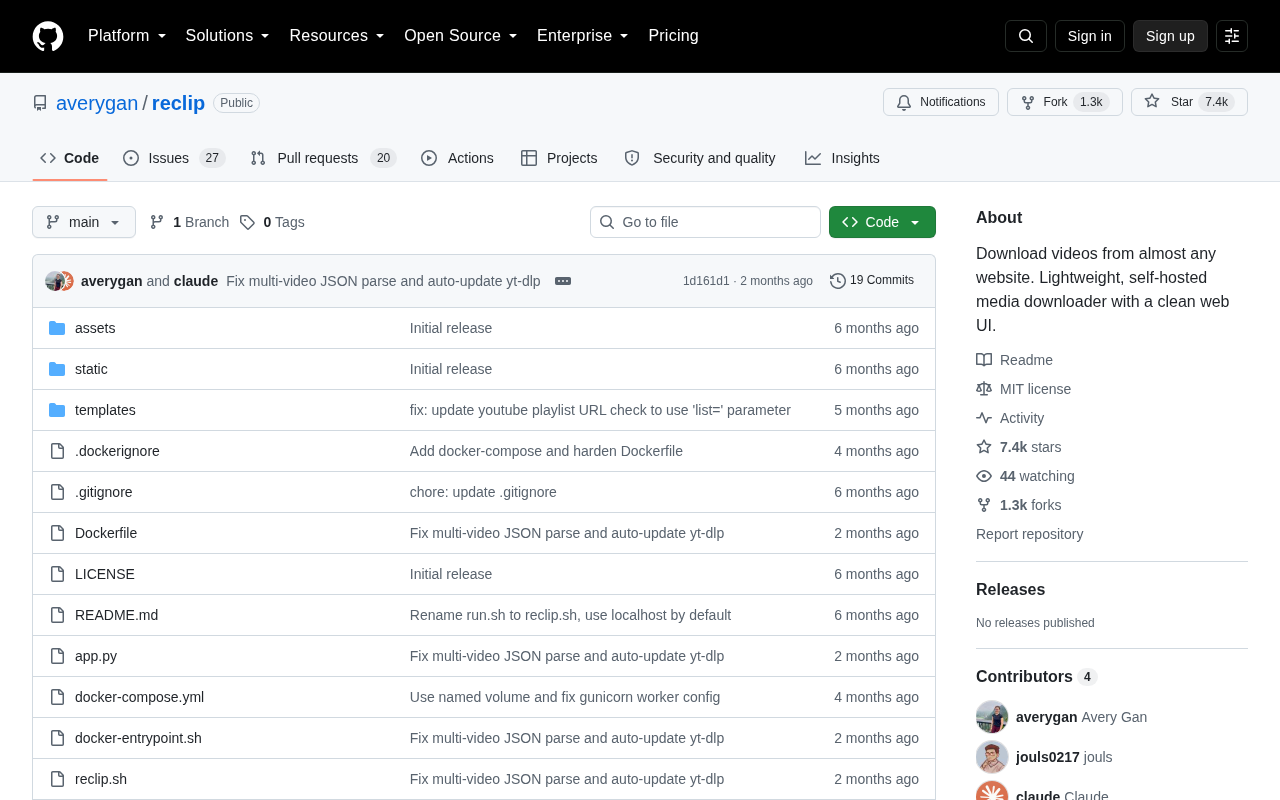
reclip: Self-Hosted Video Downloader with Clean Web UI as Command-Line Alternative
reclip is a lightweight self-hosted video downloader with a clean Web UI, built on yt-dlp to support downloads from almost any website. Easy deployment, privacy control, ad-free, ideal for NAS and VPS users.