sitesolide: Deploy Vibe-Coded Apps to Your Own Server with One Command

sitesolide deploys AI-generated apps to your own server in one command, with automatic HTTPS and access control.
sitesolide is an open-source deployment tool for AI coding developers that compresses the ops work between "code finished" and "shareable link" into a single `sitesolide deploy` command. Run in a project directory, it deploys the app to the user's own server with a dedicated address, automatic HTTPS, an isolated runtime, and fine-grained access control. It's MIT-licensed and free; users only pay for server and domain. The article argues it precisely fills the deployment gap left by vibe coding tools like Claude Code and Cursor, suited to personal projects, internal tools, and lightweight SaaS prototypes, but not covering enterprise needs like auto-scaling or complex CI/CD.
From Code to Live: The Minimalist Deployment Philosophy of sitesolide
Built an app with Claude Code or Cursor and want to ship it right away? The traditional process involves configuring servers, installing environments, setting up HTTPS, and managing permissions—so tedious you'd rather give up. sitesolide compresses all of this into a single command: sitesolide deploy. Run it in your project folder, and your app is automatically deployed to your server, assigned a dedicated address, with HTTPS enabled automatically, and isolated from other apps.
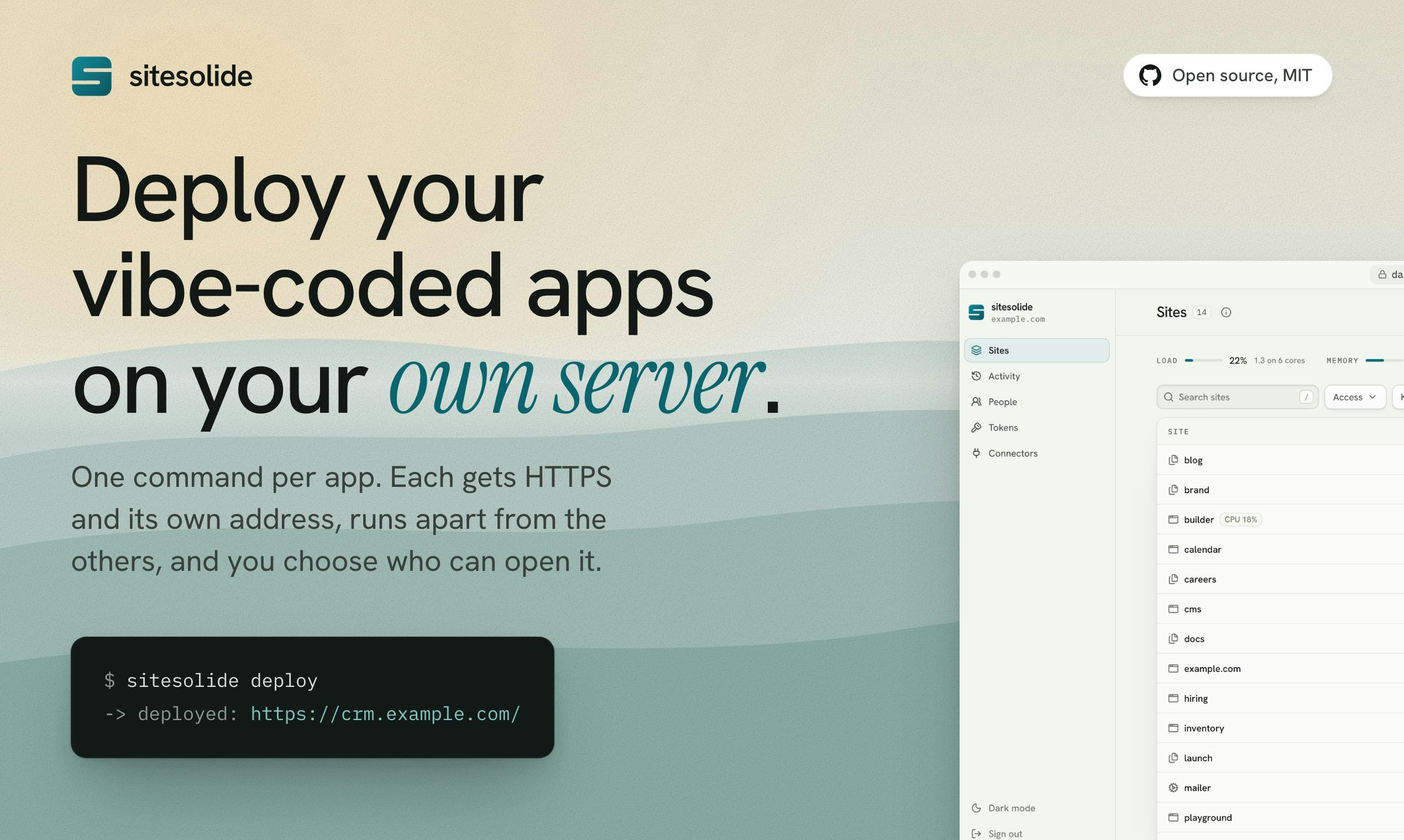
The tool's core logic is straightforward: you write code with AI, it turns that code into an accessible service. Developer Clément Thiriet launched the project on Product Hunt, where it currently has 64 upvotes and ranks 20th for the day.
Isolation and Permissions: More Than Deployment, It's Hosting
sitesolide doesn't just upload files. Each app runs in its own isolated environment, with no interference between them. You decide who has permission to open a given app—meaning it works well for internal tools, client demos, or small-scale collaboration scenarios.
HTTPS is configured automatically—no need to manually request or renew certificates. For the rapid prototypes, personal projects, and lightweight SaaS common among vibe-coded apps, this "zero-ops" experience is compelling. You only pay for your server and domain; the software itself is free and open source (MIT license).
What "Isolation" Means
Here, "apps run in isolated environments" typically refers to container-level isolation—each app has its own filesystem, runtime dependencies, and network namespace, so one app's crash or resource consumption won't affect the others. Compared to cramming every project into the same Python or Node process on a single server, container isolation lets different versions of dependencies coexist and makes removing an app clean and simple. This layer of isolation is exactly what allows sitesolide to safely assign each app its own domain and control access permissions without worrying about apps stepping on each other.
Open Source and Cost: Returning Control to Developers
sitesolide uses the MIT license, with fully open code. That means you can review it, modify it, or even build your own fork. The cost structure is also clear: no subscription fees, no per-app charges—you only bear the cost of the server and domain.
For developers who already have a VPS or idle server, this is essentially zero additional cost. Compared to relying on third-party PaaS platforms, sitesolide puts control back in your hands—data, deployment, and access permissions all live on your own server.
What the MIT License Means
MIT is one of the most permissive open source licenses: you can freely use, modify, distribute, and even commercially use it in closed-source form, with the only obligation being to retain the original copyright and license notices. For businesses or individuals, this means there's no risk of "crippled open source edition" or "pay up when you exceed the user limit," and it's easy to embed into your own internal toolchain. On the flip side, MIT provides no warranty, and project maintenance depends on the community or the author—a factor worth considering when judging whether such an early-stage tool is suitable for long-term reliance.
The Last Mile of the Vibe Coding Ecosystem
Tools like Claude Code and Cursor make writing code extremely fast, but deployment remains a breakpoint. sitesolide targets exactly this gap: giving AI-generated apps a live address quickly.
It doesn't handle complex enterprise requirements like auto-scaling, multi-region disaster recovery, or fine-grained monitoring and alerting. But for individual developers, indie hackers, and small teams, it covers the critical step from "code complete" to "shareable link." The engagement on Product Hunt—64 upvotes and 8 comments—shows the pain point is real, though the tool is still in its early stage.
Vibe Coding and the Deployment Breakpoint
Vibe coding refers to a development approach where, with the help of AI coding assistants, you describe your intent in natural language and the model generates most of the code—typical tools include Claude Code and Cursor. Its strength is turning ideas into runnable prototypes quickly, but the output usually stays on local localhost. Turning a local service into a link others can access still requires a series of business-unrelated work: domain resolution, reverse proxy, TLS certificates, process supervision, and more. sitesolide's value lies in automating this "non-creative labor," letting AI-generated apps get a public address with minimal friction.
Who It's For, and Who It Isn't
If you write code with AI assistance and want your app to quickly go live for a specific audience, sitesolide is worth a try. It suits: personal project showcases, internal tools, client previews, and lightweight SaaS prototypes.
If you need auto-scaling, complex CI/CD pipelines, or enterprise-grade security compliance, it may not be enough. But as an open source project, you can build more sophisticated deployment workflows on top of it.
sitesolide's positioning is clear: it doesn't try to be an all-encompassing platform; it solves just one problem—"how do I ship this once I'm done writing it." For independent developers riding the vibe coding wave, this might be exactly the missing piece.
Related articles

Mistral Large 4 Open-Sources a Trillion Parameters, Microsoft Offers Voluntary Severance to 60,000 Employees
Mistral Large 4 open-sources a trillion-parameter multimodal model with a coding agent score of 48; SanDisk earnings show AI inference reshaping NAND demand; Google Gemini adds in-app file editing, OpenAI raises Codex quotas, and Microsoft offers voluntary severance to 60,000 employees.
Mistral Large 4 Opens Its Weights: AI Morning Brief Roundup of Models and Ecosystem Trends
Mistral Large 4 opens its weights, a 1-trillion-parameter MoE architecture that can run locally on MacStudio; Meta's test-generation technology enters production; top tax benchmark pass rate only 10.8%; Canadian government takes a stake in Cohere; Doubao Work opens third-party model calls. This AI Morning Brief rounds up model, ecosystem, capital, and policy developments.
Mistral Large 4 Goes Open Source: A 1T-Parameter European Qwen Challenging DeepSeek
Mistral Large 4 is now open source: 1T total parameters, 52B activated, focused on coding and cybersecurity, with ~610G NVFP4 weights. We analyze its comparison with DeepSeek V4 Flash, API pricing, demo realism, and local deployment value.