Six Hard Standards for High-Quality AI Agent Projects
Six engineering standards that separate production-grade AI Agents from impressive demos.
This article outlines six hard standards for taking an AI Agent project from demo to production delivery. The core argument: Agents that look smart in demos but fail in production suffer from missing engineering standards, not weak models. The six standards are: quantifiable business value (define metrics before writing code), tiered model scheduling (match cost to task complexity), context engineering (prioritize information density over window size), skill engineering (codify capabilities into reusable playbooks), RAG and tool integration (retrieval via a rewrite-filter-rerank-cite pipeline), and evaluation with guardrails (90%+ task completion, 85%+ closed-loop rate as practical thresholds). The throughline: determinism beats the feeling of intelligence; a stable 80 points beats an occasional 100.
The biggest gap between a demo and a production AI Agent is rarely model capability — it's engineering standards. Many agents look brilliant in a demo, then fall apart in real delivery: PRs run but can't be merged, a parameter gets missed after three rounds of revisions, 20 files get read but earlier constraints are forgotten. This article distills six hard standards for judging whether an Agent project is truly production-grade, drawn from a systematic Agent development framework.
Standard 1: Business Value Must Be Quantifiable
The first test of a good Agent project isn't technical sophistication — it's whether someone can understand "what this project is worth" in 30 seconds. The core principle: define your metrics before writing the first line of code. A project without metrics can only prove it "runs" — not that it delivers value.
Real business value must translate into numbers: task completion rate improved to 88%, experiment costs reduced by 63%, per-call processing cost of just ¥0.21. Converting these gains into time saved and accuracy improved is what business value actually means.
A key distinction worth making: using the largest model or integrating 12 tools are "technical means," not "value." What actually proves business value are outcome metrics like "completion rate reached 88%, costs down 40%." Means are process; results are value.
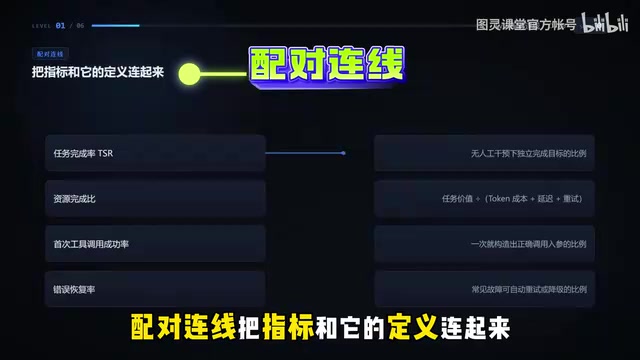
Some core metric definitions worth remembering: task completion rate is "the proportion of goals completed independently without human intervention"; resource efficiency ratio equals value divided by cost; first-call success rate and error recovery rate reflect system stability. The correct project launch sequence should be: define quantifiable metrics first, then break down subtasks, set acceptance baselines, and only then start writing code.
Standard 2: Tiered Model Scheduling
The second hard standard is tiered model scheduling. The one-line rule: don't use a flagship model to answer "what day is it today." A single routing function (a root function) can determine the entire cost profile of a project.
A sensible tiering logic looks like this: lightweight small models for simple tasks (no wasted budget); flagship models only for deep reasoning; multimodal models for image and audio tasks; long-context models for very long documents. When a user asks "what's the weather in Beijing today," the right approach isn't sending it to a flagship model — it's a lightweight model plus a weather tool call.

The task-to-model matching logic can be summarized as: lightweight models for small talk and retrieval, flagship models for complex reasoning, multimodal models for image and audio, long-context models for extended documents. Having a primary Agent handle unified routing is what lets you achieve both low cost and high precision simultaneously. This is the key step that takes an Agent from "works" to "affordable."
Standard 3: Context Engineering
The root cause of an Agent "getting dumb" is usually not a weak model — it's context management falling apart. A typical scenario: after reading 20 files, the Agent starts forgetting what it saw earlier; constraints get diluted, truncated, and pushed off the "workbench."
The core insight here is: context is not a chat history — it's a workbench assembled before execution. The problem isn't window length; it's information density. When an Agent forgets its constraints after reading 20 files, the right fix isn't switching to a bigger model or setting temperature to 0 — it's reading tiered summaries and pinning critical information to a file.

A layered context structure can be organized as follows: the inner persistent layer holds identity definitions and absolute prohibitions; the on-demand loading layer holds skills; the runtime injection layer holds timestamps and user preferences; the memory layer stores cross-session experience. Correct context compression strategies include sliding windows, model summarization, and replacing tool results with summaries — simply increasing parameters or raising temperature is not compression.
The context window is the maximum number of tokens a large language model can "see" in a single pass. Early models had windows of just 4K tokens; modern flagship models have expanded to 128K or even million-token scales. But a larger window doesn't make the problem disappear — a model's attention to information in the middle of its context window degrades significantly, a phenomenon known as "Lost in the Middle." This is why even with a 1-million-token window, context still needs careful layered design: don't just pile everything in — ensure the most critical constraints always appear where the model is most likely to "see" them (typically the beginning and end), and use summaries instead of raw content to improve information density.
Standard 4: Skill Engineering
The fourth standard is about turning "one-time reminders into default actions." What goes into a skill.md isn't motivational advice — it's operational discipline. There's a fundamental difference between a Prompt and a Skill: a Prompt is a one-time instruction for the current conversation; a Skill is a reusable capability package for long-term use.
A complete Skill contains instructions, scripts, and reference materials, and has the properties of being stable and controllable, low token consumption, high determinism, and securely auditable. It lets the Agent skip "re-learning the basics every time" and instead call a pre-built operations manual directly.
Getting the terminology right is worth the effort: a Prompt is a one-time instruction; a Skill is a reusable operations manual; a function call is an atomic unit; an Agent is a stateful decision-maker. The four requirements for a high-quality Skill, ranked by importance: stable and controllable, low token cost, high determinism, securely auditable.
Standard 5: RAG and Tool Integration
The fifth standard focuses on retrieval and tool integration, with the goal of grounding every critical judgment in evidence. The value of retrieval isn't "reading a bit more" — it's "reading with precision." The worst outcome isn't failing to retrieve anything; it's retrieving a pile of seemingly relevant noise.
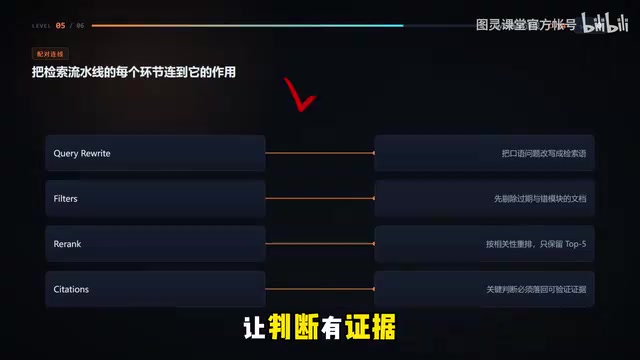
A sound retrieval pipeline looks like this: rewrite the query (convert colloquial questions into retrieval language), re-rank, filter, and answer with citations. When both API documentation V1 and V2 are retrieved simultaneously, the right approach isn't feeding both to the model to sort out, nor just taking the top-ranked one — it's filtering by version first, then re-ranking, then including citations. Version confusion is exactly where hallucinations come from.
Each stage in the pipeline has a clear responsibility: query rewriting converts colloquial questions into retrieval language; filters remove outdated documents first; re-ranking keeps only the top five results; citations ensure every judgment is backed by evidence. What MCP actually solves is scattered authentication, inconsistent error formats, and tool description drift — not making the model bigger or faster.
RAG (Retrieval-Augmented Generation) is an architecture that combines external knowledge bases with language models: before generating an answer, the model retrieves relevant document chunks from a vector database or search engine, then injects them into the Prompt as context. The core value is ensuring answers are grounded in retrievable evidence rather than relying on static knowledge memorized during training. MCP (Model Context Protocol) is an open protocol proposed by Anthropic to standardize how Agents connect to external tools — unifying authentication mechanisms, error formats, and tool description standards so that tools from different vendors can be called by Agents in a consistent way. It addresses fragmentation at the engineering integration layer, not model capability itself.
Standard 6: Evaluation and Guardrails
The final standard is evaluation and guardrails, with the goal of turning "sometimes good" into "consistently good." An Agent without guardrails is essentially gambling. An evaluation framework (harness) matters more than swapping in a bigger model — because the model sets the ceiling, but guardrails determine stability, and they decide whether an Agent can reliably complete a closed loop.
Practical evaluation thresholds include: task decomposition rate and tool selection accuracy both above 90%, closed-loop completion rate no lower than 85%, and error recovery rate no lower than 80%. The core mechanisms of safety guardrails are least-privilege permissions, output filtering, and human fallback — not "enable all tools and just log everything."
An Evaluation Harness is an automated testing infrastructure used to continuously measure Agent performance on a standardized test case set. Unlike unit tests, Agent evaluation must handle non-deterministic outputs: the same input may produce structurally different but semantically equivalent answers, so evaluation typically combines rule-based matching, LLM-as-Judge (using another model to score), and human annotation. Guardrails are the interception layer between model output and the end user — responsible for filtering harmful content, detecting unauthorized operations, and triggering human review. Together, they form the Agent's "quality floor": guardrails prevent major failures; evaluation ensures continuous visibility. This is the engineering foundation for "a stable 80 points beating an occasional 100."
A One-Page Summary: From Demo to Production
The six hard standards in one page: define metrics first (quantifiable business value), schedule by tier (match models to task complexity), manage context well (information density first), build up Skills (reusable capabilities), make retrieval evidence-based (RAG with citations), and build in guardrails (closed-loop evaluation).
The one sentence running through all of it: determinism beats the feeling of intelligence; a stable 80 points beats an occasional 100. That's the dividing line between an Agent that's "smart in demo" and one that's "deliverable in production."
Related articles
AI Agent Practical Guide: Three Levels of Use to Double Your Productivity
A practical guide to AI Agent usage across three levels: delegating routine tasks, stacking capabilities via CLI/Skills/plugins, and achieving complex goals autonomously.

Building Enterprise-Grade AI Agents from Scratch: A Complete Three-Phase Learning Path
A 748-episode AI Agent tutorial covering ReAct, LangChain, AutoGen, RAG hybrid architecture, and three enterprise projects: customer service, data analysis, and multi-Agent collaboration.

Hollywood's Take on AI Doomsday Warnings: Immediate Threats Matter More Than Existential Ones
Hollywood labor groups push back on AI doomsday narratives, urging focus on real, immediate threats: generative AI's impact on creative jobs, copyrights, and actor likeness rights.