SkillCore: Internalizing General Skills in Agents via De-scaffolded Fine-Tuning
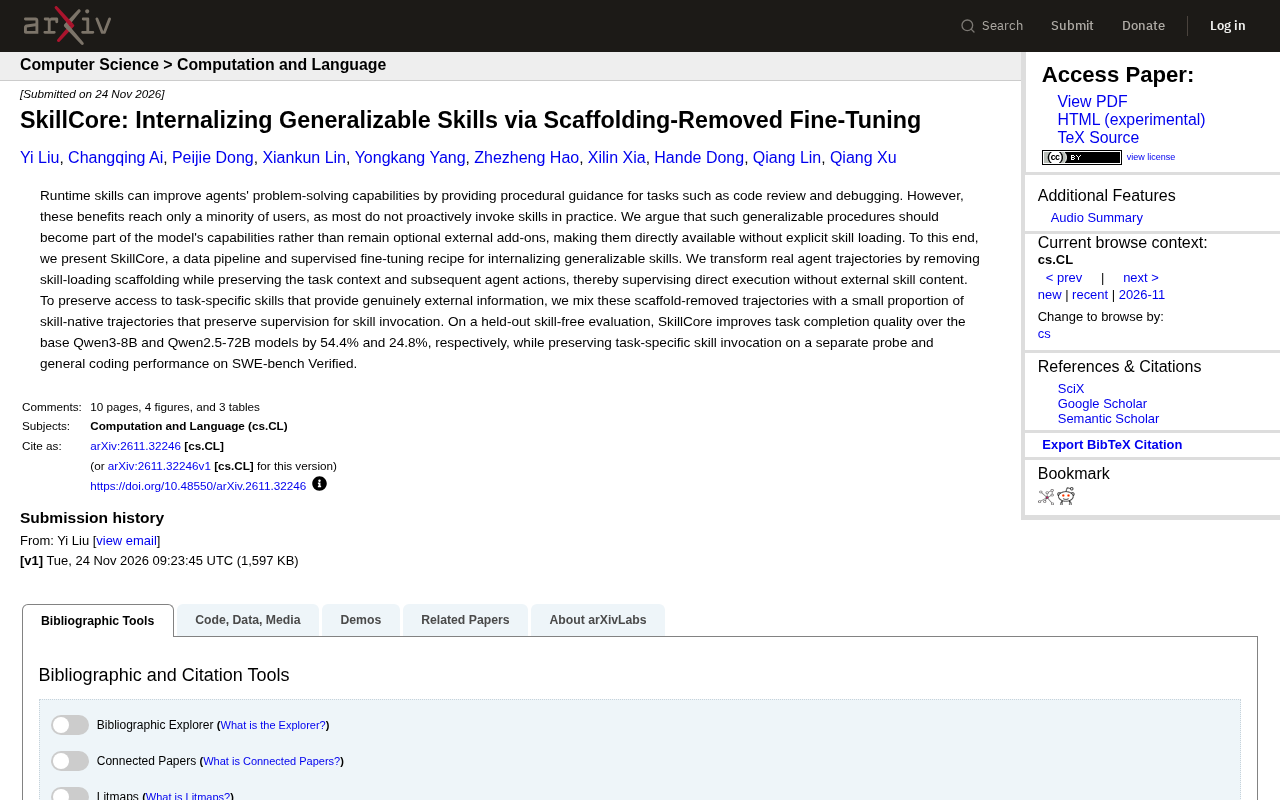
SkillCore internalizes generalizable procedures into model capabilities via de-scaffolded trajectory fine-tuning.
SkillCore tackles the limited benefit of runtime skills caused by users not invoking them, proposing to internalize generalizable procedural knowledge into model capabilities. It builds de-scaffolded real agent trajectories and mixes them with a few native skill-invocation trajectories for SFT. On a skill-free eval set, task completion quality improves 54.4% and 24.8% over base Qwen3-8B and Qwen2.5-72B, with no degradation in skill invocation or SWE-bench Verified coding performance.
Agents can significantly improve problem-solving on tasks like code review and debugging when they can invoke runtime skills for procedural guidance. But the reality is that most users don't proactively invoke these skills, so the benefits only reach a minority. This research from rss proposes an approach: internalize generalizable procedures directly into the model's capabilities, rather than continuing to treat them as optional external plugins.
The Problem: Skill Invocation Depends on User Initiative
The awkward thing about runtime skills is that everyone praises them but few use them. The skill content itself is valuable—it provides reusable procedural knowledge for tasks like code review and debugging—but the skill mechanism requires users to explicitly load it during interaction, and in practice most people don't. From this, the researchers draw a judgment: such generalizable procedures should become part of the model's own capabilities, usable directly without explicit loading.
This judgment changes the optimization target. The traditional approach is to improve the skill library and lower the barrier to invocation; SkillCore instead targets model training, attempting to make the model execute the procedures described by skills even without seeing the skill content.
Runtime Skills refer to skill modules that are dynamically loaded and executed via external calls (such as function or tool interfaces) during agent operation. These skills typically encapsulate procedural knowledge for specific tasks (like code review or debugging), exist as plugins, and require explicit triggering by the user or an upper-layer system. In contrast, internalized capabilities are skills the model masters directly through training, usable at inference time without external loading. Runtime skills have the advantage of flexibility and updatability, but their downsides are obvious: they depend on user initiative and add interaction complexity. SkillCore's research is built on this distinction, exploring how to transform generalizable procedures from external skills into the model's internalized capabilities.
Method: Remove the Scaffolding, Keep the Supervision Signal
At the core of SkillCore is a data pipeline and supervised fine-tuning recipe. The specific approach is to take real agent trajectories and modify them: remove the "load skill" scaffolding portion of the trajectory, but keep the task context and subsequent agent actions. Training samples constructed this way supervise "how to execute directly when no external skill content is present."
The key to this approach is distinguishing two types of knowledge. One is generalizable procedures—such as how to organize a code review or how to locate debugging clues—which should be internalized; the other is task-specific skills that genuinely depend on external information and cannot be inferred from scratch, for which invocation capability must be retained. To this end, SkillCore mixes de-scaffolded trajectories with a small number of native trajectories that retain skill invocations during training—the former internalizes general procedures, while the latter maintains invocation supervision for task-specific skills. The design of this mixing ratio is key to whether the method can balance both capabilities.
Supervised Fine-Tuning (SFT) is a common model adaptation technique that continues training a pretrained model on task-specific data so it learns to perform the target behavior. In SkillCore, SFT is used to make the model imitate "no skill loading" trajectories—that is, given task context as input, output the correct agent actions. The key lies in the construction of training data: remove the skill-loading steps from the trajectory but retain the task description and subsequent actions, thereby supervising the model to directly generate reasonable actions without relying on external skill content. This recipe differs from traditional skill invocation training, which explicitly provides skill descriptions as input. SkillCore's SFT recipe aims to encode procedural knowledge into model parameters rather than relying on external information at inference time.
Scaffolding in the agent context refers to prompts, tool calls, or procedural guidance added to help the model complete a task. In skill invocation scenarios, scaffolding typically includes commands to load skills, injection of skill content, and related control logic. SkillCore's "de-scaffolding" operation removes these auxiliary parts from real agent trajectories, keeping only the task context and the action sequences the model actually executed. The purpose is to let the model learn to execute procedures autonomously without external guidance, rather than relying on structured prompts provided by scaffolding. De-scaffolded trajectories are closer to scenarios where the model solves problems independently, which helps internalize general procedures.
Results: Completion Quality Improvement Under Skill-Free Evaluation
The research validates the effect on a held-out skill-free evaluation set: compared with base Qwen3-8B and Qwen2.5-72B, SkillCore improves task completion quality by 54.4% and 24.8%, respectively. At the same time, on separate probe tasks, the model's ability to invoke task-specific skills is preserved; general coding performance on SWE-bench Verified also does not degrade.
These results address two common concerns: whether internalizing general skills will cause the model to lose the ability to invoke specialized skills on demand, and whether fine-tuning will harm general coding proficiency. From the data, neither concern holds. One detail: the improvement margins for the two base models differ considerably, with the smaller model benefiting more, suggesting that internalization training may partially compensate for the procedural knowledge gap caused by model scale.
A Few Observations
The value of SkillCore lies not only in the metrics but in the fact that it redraws the boundary between skills and model capabilities. In the past, skill systems were treated as bolt-on capability extensions while the model itself remained unchanged; SkillCore turns "what should be internalized and what should be externalized" into a design question at the training stage.
This approach also has its applicable boundaries. The paper's validation focuses on code-related tasks; the construction of de-scaffolded trajectories depends on the quality of real agent trajectories, and the mixing ratio also needs to be adjusted for specific scenarios. For tasks that highly depend on real-time external information, internalization is clearly not the answer. But from "skills are used by only a few" to "skills become default capabilities," SkillCore provides an actionable training paradigm.
One-line Summary
SkillCore proposes internalizing generalizable procedures into model capabilities through supervised fine-tuning on de-scaffolded trajectories, improving task completion quality.
Paragraph Summary
SkillCore addresses the limited benefit of runtime skills due to users not proactively invoking them by proposing to internalize generalizable procedural knowledge into model capabilities. Methodologically, it constructs de-scaffolded real agent trajectories (removing skill-loading portions while retaining task context and actions) and mixes them with a small number of native trajectories that retain skill invocations for supervised fine-tuning, balancing general procedure internalization and task-specific skill invocation. On a skill-free evaluation set, compared with base Qwen3-8B and Qwen2.5-72B, task completion quality improves by 54.4% and 24.8%, respectively, while task-specific skill invocation ability and general coding performance on SWE-bench Verified do not degrade. The smaller model benefits more, suggesting internalization training can partially compensate for the procedural knowledge gap caused by scale. This work turns the boundary design between skills and model capabilities into a training-stage problem.
Related articles

Astrophysicist Pokes Fun at Supermoons: The Difference Between a 16-Inch and a 15-Inch Pizza
Astrophysicist Neil deGrasse Tyson criticizes the terms supermoon and micromoon, using a 16-inch vs. 15-inch pizza analogy to show the visual difference is negligible, and calls out exaggerated labels in science communication.
Bypassing the iOS Safari 60fps Limit: Building a Native-Like Web App Experience
A deep dive into bypassing iOS Safari's 60fps limit through compositor animations, frame rate decoupling, and interaction detail optimization to give web apps a near-native feel on iPhone.

Allstate's Multi-Day Technical Outage Before Thanksgiving
Insurance giant Allstate suffered a multi-day technical outage before the Thanksgiving travel peak. This article analyzes the impact of the timing, implications for insurtech, and the importance of system stability for financial institutions.