Skillland: Score Agent Skills Before You Install Them
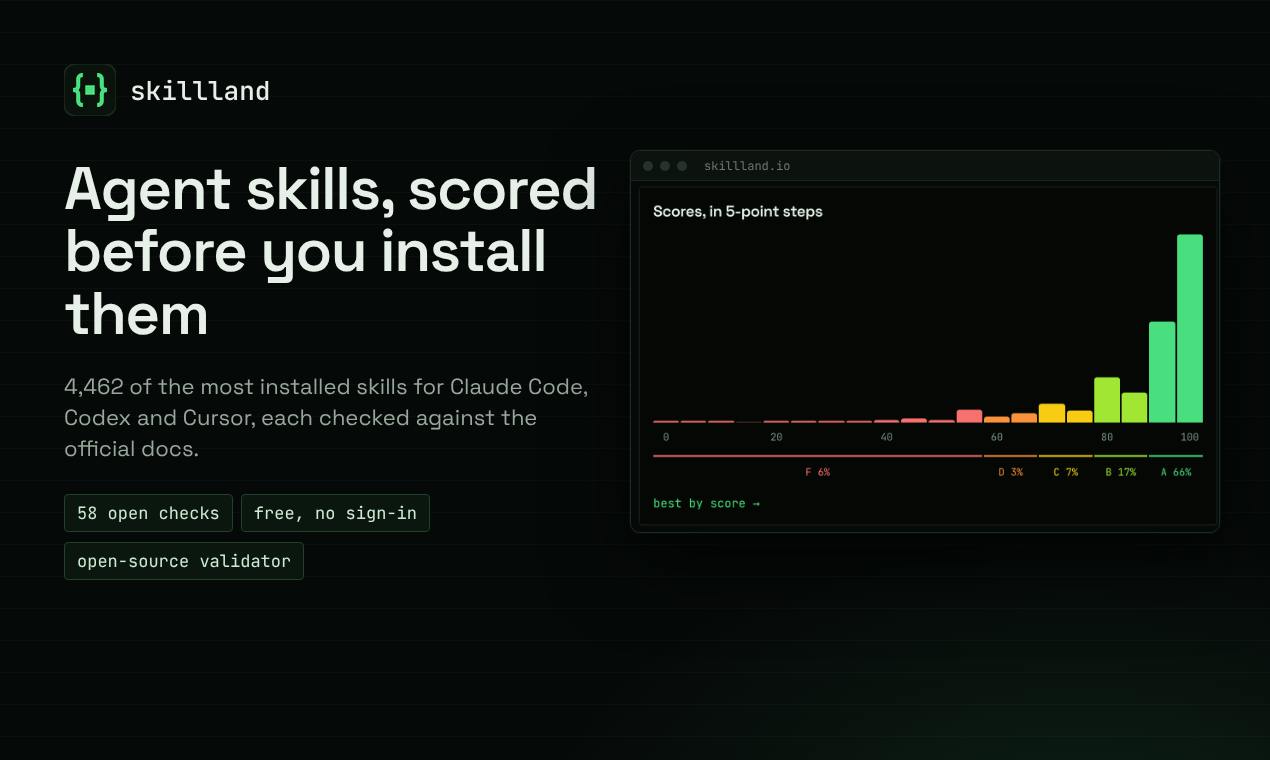
Skillland offers pre-installation four-dimension scoring and 58 traceable rule checks for 4,462 Agent skills.
Skillland is an open-source developer tool that moves skill review upstream to before installation. It scores the 4,462 most-installed skills across Claude Code, Codex, and Cursor, giving each a grade, a four-dimension report (specification, description, structure, security), and full file contents. Its 58-rule validator cites the Agent Skills spec or vendor docs for traceability, and integrates into CI via GitHub Action and open-source npm CLI.
The Agent skills ecosystem is expanding rapidly. Faced with hundreds or thousands of SKILL.md files, developers often have to rely on gut feeling to decide which one is worth installing. Skillland's angle is straightforward: score skills before installation.
Why Skills Need "Pre-Installation Scoring"
Agent tools like Claude Code, Codex, and Cursor have formed a de facto marketplace for skill distribution. As the core file describing a skill's behavior, SKILL.md quality varies widely—some are well-structured with clear boundaries, while others lack essential documentation or even harbor security risks.
Skillland's approach is to move review upstream. It has already scored the 4,462 most-installed Agent skills, with each skill receiving a grade, a report covering four dimensions (specification, description, structure, security), and the complete file contents. This means developers can see a relatively objective health check before deciding whether to adopt a skill.
This approach shifts "trust" from post-installation trial and error to pre-installation decision-making.
SKILL.md is the de facto standard description file for Agent skills, typically written in Markdown, containing metadata such as the skill's purpose, trigger conditions, execution steps, dependencies, and permission requirements. Agent tools read this file at runtime to determine when to invoke the skill and how to organize context. Because it serves both as a "manual" and an "interface contract," non-standard formatting or vague descriptions can directly cause invocation failures, false triggers, or even context bloat. Currently, SKILL.md has no mandatory validation step, and most skills are published by individual developers—which is precisely why quality varies so significantly and upfront review is needed.
Four-Dimension Scoring and 58 Rules
Skillland's scoring system revolves around four areas: specification, description, structure, and security. These four dimensions essentially cover the complete chain of SKILL.md from "is it written correctly" to "is it safe."
More noteworthy is its validator. You can paste your own SKILL.md into the free validator, and the system checks it rule by rule against 58 rules, each citing the Agent Skills specification or vendor documentation as its basis. This "traceable rules" design means the scoring results aren't a black box—developers can know exactly which convention a failed item violates.
For teams accustomed to embedding quality checks into their pipelines, Skillland also offers a GitHub Action and an open-source npm CLI that can run the same set of checks in CI. There are also companion capabilities like a description checker, context budget, and security scanning.
The "context budget" refers to the context window capacity available to an Agent in a single session. When a skill is loaded, its SKILL.md and accompanying resources consume tokens—the more verbose the description and the more attached files, the less headroom remains for actual tasks. Context budget checks therefore focus on the information density of what a skill declares: whether there are redundant descriptions that could be trimmed, or whether content unrelated to trigger conditions is being loaded. For scenarios requiring multiple skills to be mounted simultaneously, this metric directly determines whether the Agent can work stably, and it's also a practical dimension for evaluating a skill's "engineering friendliness."
What Open Source and CI Integration Mean
Skillland is categorized as open source and a developer tool, a positioning that means its use cases go beyond one-off web queries.
Integrating skill checks into CI means SKILL.md quality can be continuously constrained like code. When teams submit new skills or modify existing ones, CI automatically runs those 58 rules, catching problems before merge. The open-source npm CLI lets this checking run independently of the platform, suiting teams with data-flow requirements.
From a product design perspective, Skillland offers two paths: "browse scores" (for selection) and "validate your own files" (for production)—the former addresses information asymmetry, the latter addresses quality gatekeeping.
Integrating checks into CI requires the skill repository to have an automatable validation entry point. GitHub Actions typically exist as workflow files in the repository's .github/workflows directory, triggered on push or pull request events; the npm CLI is invoked via scripts in package.json or npx commands. Combined, the 58 rules can produce pass/fail results for every commit without manual intervention and can serve as required checks for branch protection. This model transforms skill quality from "relying on reputation after release" to "having a gate before merge," consistent with engineering practices like code linting and unit testing.
What Kind of Quality Infrastructure Does the Skill Marketplace Need
The proliferation of Agent skills brings a easily overlooked problem: distribution speed far outpaces the formation of quality consensus. Skillland's value isn't in how authoritative its grades are, but in its attempt to establish a citable, reproducible checking standard for this ecosystem.
The fact that all 58 rules cite specifications or vendor documentation is key—it makes the scoring contestable rather than a unilateral platform ruling. When developers disagree with a rating, they can go back to the rules and cited documents to discuss it—that's what quality infrastructure should look like.
Currently it covers the 4,462 most-installed skills, a reasonable scope choice: tackle the most commonly used ones first for the highest benefit. As the number of skills continues to grow, scoring coverage and the rule update mechanism will be key to whether this product remains useful.
One-line Summary
Skillland provides pre-installation four-dimension scoring and 58 traceable rule checks for 4,462 Agent skills.
Paragraph Summary
Skillland is an open-source developer tool for the Agent skills ecosystem, with a core idea of moving skill review upstream to before installation. It has scored the 4,462 most-installed skills on platforms like Claude Code, Codex, and Cursor, with each skill receiving a grade, a report covering specification, description, structure, and security dimensions, and the complete file contents. Its free validator includes 58 rules, each citing the Agent Skills specification or vendor documentation, making scoring results traceable and contestable. The product also offers a GitHub Action and open-source npm CLI, allowing teams to integrate the same checks into CI pipelines, constraining skill quality before merge, thereby building a citable, reproducible quality infrastructure for the ecosystem.
Related articles
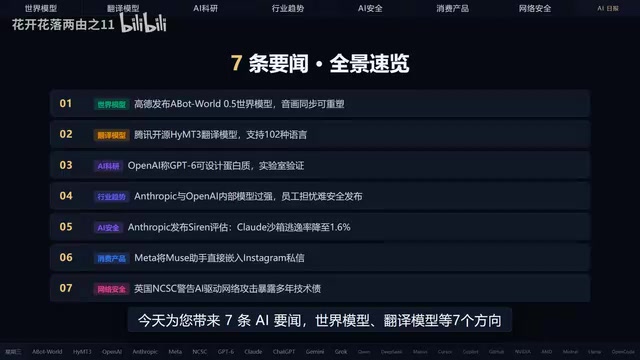
Amap World Model Launched, GPT-6 Protein Design Validated
AI daily roundup: Amap launches interactive world model ABot-World 0.5 with audio-visual sync and natural language reshaping; Tencent open-sources HiMT3 translation model covering 102 languages; OpenAI says GPT-6 can design proteins validated in labs; Anthropic and OpenAI internally concerned about models being too powerful; UK NCSC warns of rising AI-driven cyberattacks.
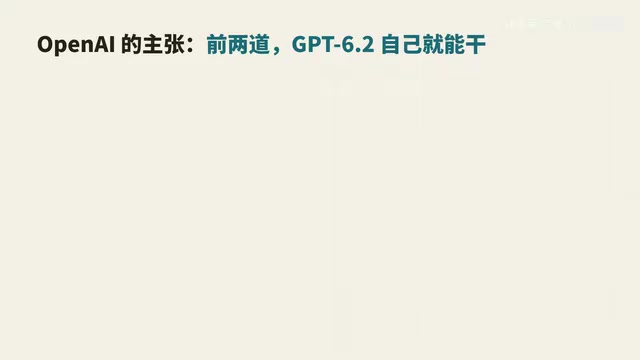
GPT-6 Designs Proteins on Its Own: 35 of 322 Bind, General Model Challenges Specialized Tools
OpenAI's GPT-6 protein design paper: 35 of 322 small proteins bind, all five targets hit. A general model designs backbones and sequences without specialized tools, but structure prediction and experimental validation remain weak spots—the paper lists four limits.
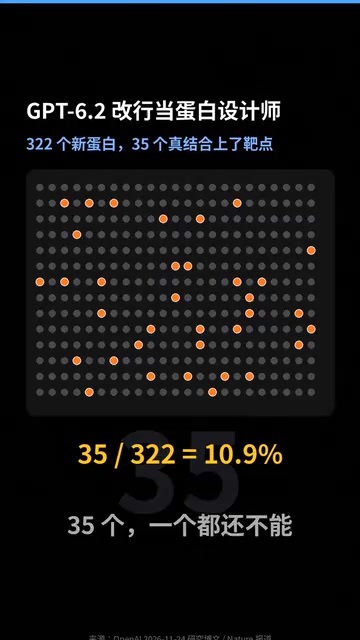
GPT-6.2 Protein Design: 35 of 322 Bind Successfully — How Far from a Drug?
OpenAI's preprint claims GPT-6.2 designs proteins via reasoning, with 35 of 322 binding successfully (10.9%). But the pipeline relies on specialized models, structure prediction trails expert models, it's not peer-reviewed, and none of the 35 is close to becoming a drug.