Slashy Assistant: The AI Email Assistant That Handles Your Inbox for You
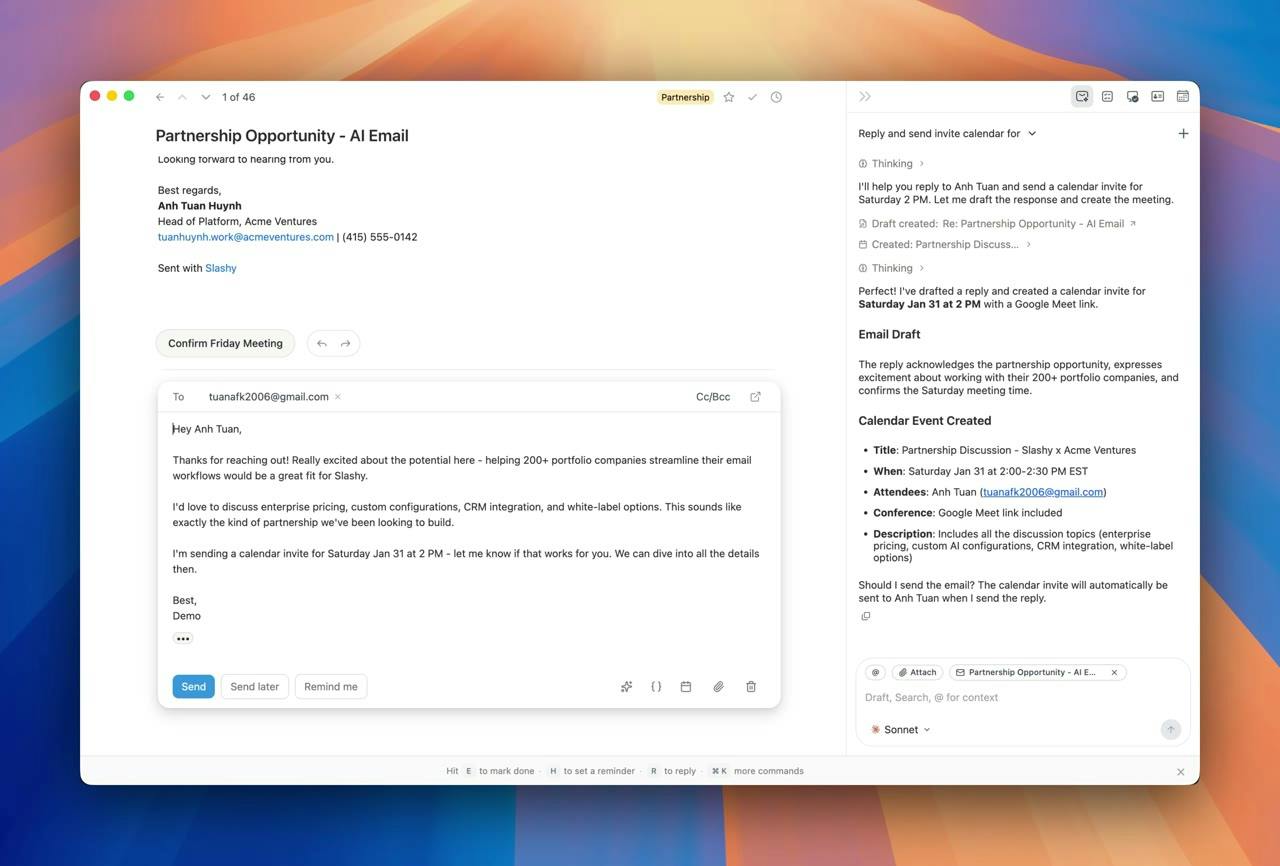
Slashy Assistant is an AI-native email client that automates drafting, organizing, and follow-ups end to end.
Slashy Assistant is the AI brain built into Slashy, an AI-native email client created by Harsha Gaddipati that ranked #4 on Product Hunt on launch day. It promises to handle email end-to-end — drafting replies in your voice, auto-organizing, scheduling meetings, preparing briefings, and tracking follow-ups. Setup takes five minutes, it's accessible via iMessage, Slack, or phone, and automations can be configured in plain English. In a crowded AI email space, Slashy differentiates through its full-client ownership, external data integrations (CRM, meeting notes), and a proactive, agent-style execution model — though reply quality, automation reliability, and data security still need real-world validation.
Email remains one of the biggest time drains in the modern workplace. Drafting replies, organizing threads, scheduling follow-ups, booking meetings — these repetitive tasks eat into hours that could go toward deep, focused work. A product called Slashy Assistant, recently launched on Product Hunt, aims to change that fundamentally. It's not just another inbox management tool — it's an AI assistant built directly into an email client, designed to "handle your email for you."
Built by Harsha Gaddipati, the product earned 132 upvotes and 30 comments on launch day, reaching #4 on the daily leaderboard across the Email, Productivity, and Artificial Intelligence categories.
What Is Slashy Assistant?
Slashy itself is an AI-native email client built to unify all your inboxes. Slashy Assistant is the AI brain embedded within it. According to the official description, it handles an end-to-end email workflow:
- Drafts replies in your voice
- Auto-organizes your emails
- Schedules meetings
- Prepares briefings
- Tracks to-dos and follow-ups
Unlike traditional email plugins, Slashy emphasizes its "AI-native" positioning — AI isn't a feature bolted on after the fact, it's the foundation of the product design. The goal is to take over all the repetitive labor involved in email, from organizing and writing to following up.
Five-Minute Setup, Multiple Access Points
On the usability front, the product makes an appealing promise: connect your calendar, CRM, meeting notes, and other tools, and you're up and running within five minutes. For busy professionals, this low-friction onboarding is critical — the value of AI tools is often undermined by lengthy configuration processes.
Equally notable is its multi-channel design. Users aren't locked into the Slashy client itself — they can invoke the assistant through iMessage, Slack, or even a phone call. This "use it anywhere" approach transforms the AI assistant from a standalone app into a service layer woven into everyday communication, reducing the cognitive overhead of switching between tools.
Automations Set in Plain English
The feature that best embodies Slashy's "AI-native" philosophy is how automations are configured. Users can define automation rules in plain English, with no need to learn complex conditional logic or workflow editors.
On top of that, Slashy bills itself as proactive — it proactively handles recurring work before you have to ask. This is the direction most AI assistant products are pushing toward right now: shifting from passively responding to commands toward anticipating needs in advance. For users who deal with large volumes of similar emails every day, this kind of proactive capability — if well executed — can save a meaningful amount of time.
"Proactive AI" is an increasingly important direction in LLM application development, closely tied to the concept of AI Agents — systems that can autonomously plan steps, call external tools, and execute tasks continuously, as opposed to traditional chatbots that only handle single-turn Q&A. Email is a classic use case for AI Agents: an agent can read incoming messages, check calendar availability, query CRM data, and generate and send a draft reply — all without requiring step-by-step user confirmation. However, this "autonomous execution" also raises the bar for error tolerance. If an AI misreads your intent and sends an inappropriate reply on your behalf, the consequences are far more serious than a bad suggestion. That's why many similar products build in "draft review" or "delayed send" buffers to balance automation efficiency with human oversight. The actual execution boundary of Slashy — which actions require user confirmation and which can run fully automatically — is a key dimension for evaluating its reliability.
Positioning in a Crowded Market
AI email assistants are hardly a new category. From Gmail's Smart Reply to Superhuman's AI features to a wave of LLM-powered inbox plugins, this space is already crowded. Slashy's differentiation comes through on a few fronts:
First, it positions itself as a complete email client, not an add-on plugin, giving it much stronger control over the overall email experience. Second, it integrates external data sources like CRM and meeting notes, giving the AI richer context so that replies and briefings are more aligned with real business situations. Third, the combination of multi-channel access and proactive execution attempts to extend the email assistant into a cross-context personal work agent.
That said, the real test for products like this lies in execution quality: whether AI-drafted replies actually sound like you, whether automations are reliable, and how privacy and data security are handled. These questions can only be answered through real-world use — product page descriptions alone don't tell the full story.
It's worth noting that Superhuman — the pioneer of the "AI-native email client" concept — has already validated that a paying user base for premium email experiences does exist. But its steep monthly price tag (~$30/month) has kept its user base relatively small. Even earlier, Inbox by Gmail attempted to reimagine the inbox with bundles and reminders, only to be shut down by Google in 2019, with some features gradually folded back into Gmail. This history suggests that efforts to redefine the email experience consistently face two major obstacles: high user habit migration costs and platform dependency risk. Slashy's choice to operate as a standalone client gives it full control over the experience and avoids the risk of being constrained by a host platform's policies — but it also means independently handling email protocol compatibility, security audits, and other foundational engineering work. For an early-stage startup, that's no small execution burden.
Closing Thoughts
Slashy Assistant represents a design philosophy increasingly common among "AI-first" productivity tools — rather than adding an AI button to an existing product, these tools rebuild the entire workflow around AI capabilities. For knowledge workers drowning in email, the full-stack automation it offers — drafting, organizing, scheduling, and follow-up — combined with multi-channel access and natural language configuration, makes for a compelling product narrative. Whether it can actually deliver on the promise of "handling your email for you" will come down to real-world accuracy and reliability.
Related articles
Losing Memory After Claude Code Context Compaction? Practical Solutions Explained
Claude Code losing debugging context after compaction? Learn how CLAUDE.md persistent memory, manual /compact control, session splitting, and external records solve the problem.
Great at the Work, Bad at the Hustle: A Realistic Look at Monthly Income for Independent Professionals
Can a 12-year professional who hates self-promotion earn well independently? Explore real Reddit insights on income expectations and non-sales client acquisition paths.
COGEXT: A Verification Layer That Gives AI Agents a "Lie Detector"
COGEXT is a verification layer for AI Agents like LangChain that extracts commitments and cross-checks them against Gmail, GitHub, and other external systems to catch agents lying about task completion.