SlickToken: A Deep Dive into GPU Fleet and Agentic Workflow Planning

SlickToken enables offline GPU fleet and agentic workflow simulation for secure, data-driven AI capacity planning.
SlickToken is an offline GPU fleet and agentic workflow planning tool that lets AI teams import cluster configs and simulate system behavior under various loads. Its no-internet design protects data sovereignty, making it appealing to compliance-sensitive enterprises seeking data-driven, fine-grained compute planning.
GPU Resource Planning: The Invisible Barrier to AI Deployment
With the rapid adoption of large language models and agentic applications, enterprise demand for GPU compute is growing explosively. High-end GPUs used for mainstream AI training and inference (such as NVIDIA's H100 and A100 series) typically cost between $20,000 and $40,000 per card, and a mid-sized 8-GPU node can run into hundreds of thousands of dollars to procure. When you factor in high-speed interconnect networks (InfiniBand or NVLink), cooling infrastructure, and operational staffing, the total cost of ownership (TCO) for building an in-house GPU cluster is often 2-3x higher than the surface hardware cost. While on-demand cloud rental offers flexibility, H100 instances can cost over $30 per hour, making long-term operation equally expensive. This cost structure makes precise, "buy-only-what-you-need" planning a central issue for enterprises seeking to cut costs and boost efficiency. Yet given the high cost of building GPU clusters, figuring out how to allocate resources sensibly and optimize workflows within a limited budget has become a pressing challenge that many technical teams must confront head-on.
Recently, a tool called SlickToken (www.slicktoken.ai) sparked discussion on Reddit. It positions itself around GPU fleet and agentic workflow planning, aiming to provide a systematic solution to this pain point.
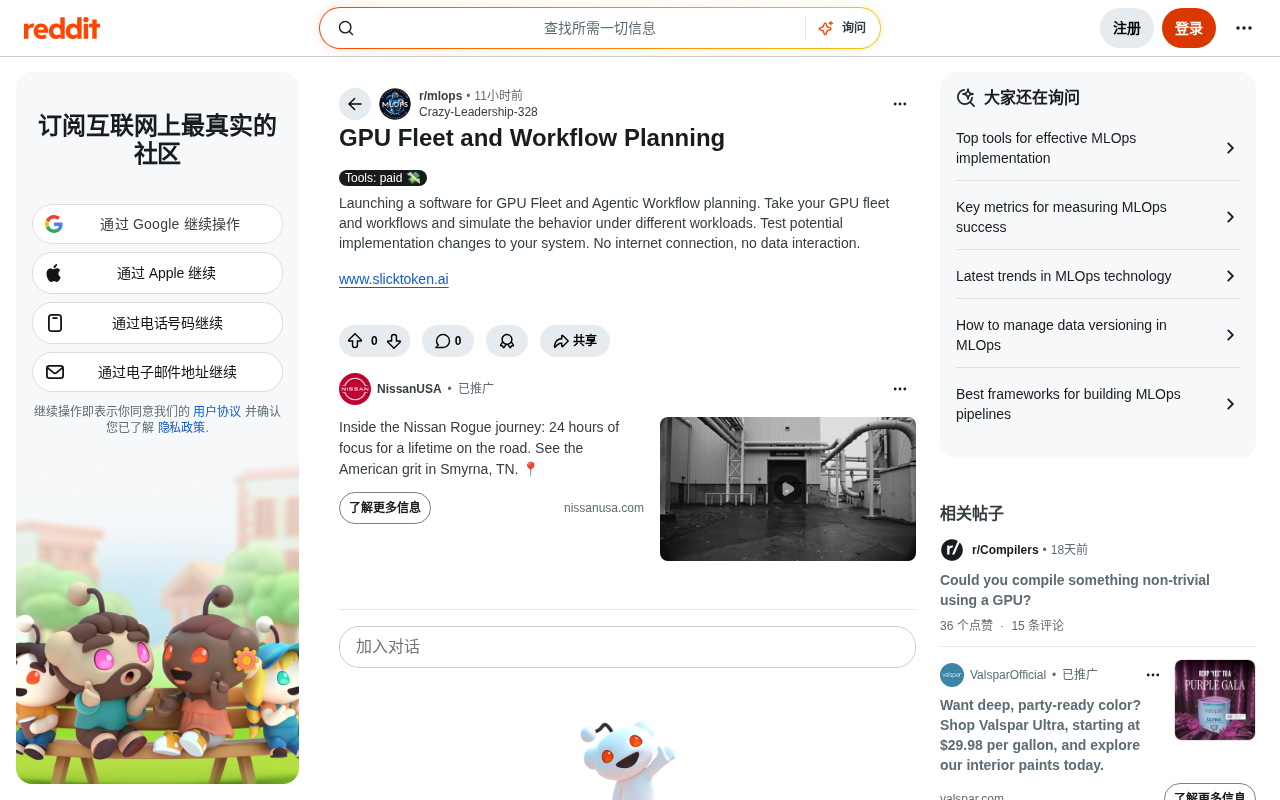
Drawing on the product's publicly available information, this article analyzes its core positioning, technical value, and potential significance in the AI infrastructure space. It's worth noting that public information about the product is currently limited, so the following analysis is based on its official descriptions.
SlickToken's Core Features: Simulation-Driven Resource Planning
Simulating Real Workload Behavior of GPU Clusters
According to the official description, SlickToken's core capability is to let users import their own GPU cluster configurations and workflows, then simulate system behavior under various load scenarios. The value here is that before formal deployment or a large-scale launch, teams can use simulation to anticipate how the system will perform under high concurrency, peak traffic, and other scenarios.
For teams running LLM inference or training workloads, GPU scheduling strategies and queuing mechanisms directly affect both cost and response latency. In LLM inference scenarios, mainstream scheduling optimization techniques include: continuous batching, which dynamically adds new requests during ongoing execution to significantly boost GPU utilization; PagedAttention (pioneered by the vLLM project), which reduces memory fragmentation through paged management of the KV Cache; and priority preemptive scheduling, which dynamically allocates compute across tasks with different SLA (Service Level Agreement) requirements. On the queuing model front, inference services typically need to balance the tension between time-to-first-token (TTFT) and overall throughput (tokens per second)—aggressive batching improves throughput but increases per-request wait times. With a simulation tool, engineers can avoid repeated trial-and-error in real environments, saving expensive compute costs and debugging time.
Safely Validating System Change Proposals
Another core capability of SlickToken is allowing users to test potential changes to their system implementation. When a team is considering adjusting scheduling algorithms, adding or removing GPU nodes, or altering workflow topology, they can first validate the real-world impact of these changes in a simulation sandbox—without risking direct operations in a production environment.
This "sandbox-style" planning approach essentially combines traditional capacity planning with modern AI workflows. Capacity planning is a classic methodology in IT infrastructure management, whose core goal is to provision compute, storage, and network resources at the lowest cost while meeting business performance requirements. Traditional capacity planning relies on historical monitoring data and statistical models (such as the M/M/c model in queuing theory) to forecast resource demand. In the AI era, the load characteristics of LLM inference differ starkly from traditional web services: a single request can consume tens of GB of memory, computation time varies widely across requests of different lengths, and batching strategies and KV Cache management mechanisms significantly affect the trade-off between throughput and latency. This complexity makes it difficult to directly apply traditional capacity planning methods, giving simulation tools tailored specifically to LLM inference scenarios unique value. For agentic systems involving multi-step, multi-model collaboration, upfront modeling and simulation validation become especially critical.
Offline Operation and Data Security: A Core Enterprise Requirement
No Internet Connection, Fully Localized Data
One line in the product description particularly stands out: "No internet connection, no data interaction." This means SlickToken can run entirely in a local or isolated environment, and users' cluster configurations and workflow data are never uploaded to any external server.
For enterprises in finance, healthcare, government, and other sectors with strict compliance requirements, this feature is highly appealing. Data sovereignty refers to an enterprise's or nation's complete control and jurisdiction over its own data, and in recent years it has evolved from a legal concept into a core evaluation dimension in IT procurement. On the regulatory front, the EU's GDPR, China's Data Security Law, and its Personal Information Protection Law all impose strict limits on cross-border data transfer; at the industry level, financial institutions typically must comply with DORA (the Digital Operational Resilience Act) and various regional financial regulations, while healthcare organizations face compliance constraints such as HIPAA. This backdrop has driven a resurgence of on-premises deployment and air-gapped architectures. GPU cluster topology and workflow design often involve an enterprise's core technical secrets, and the offline design directly eliminates data leakage risk, aligning with the widespread enterprise demand for data sovereignty and private deployment.
Precisely Hitting Enterprise Security Pain Points
In recent years, as AI tools have become widely adopted, enterprises have grown increasingly strict in scrutinizing the data security of third-party SaaS tools. Many organizations would rather sacrifice some convenience to prioritize localized, controllable solutions. SlickToken's offline positioning makes "security and control" its core differentiator, carving out a clear competitive niche in the market.
Agentic Workflow Planning: Filling an Emerging Market Gap
From Single-Model Calls to Multi-Agent Collaboration
SlickToken places particular emphasis on planning capabilities for agentic workflows, reflecting the industry trend of AI applications evolving from single-model calls toward complex systems of multi-agent collaboration.
An agentic workflow refers to a system architecture in which multiple AI agents collaborate to complete complex tasks. Unlike a single model call, agentic workflows typically include: an orchestrator responsible for task decomposition and scheduling; multiple specialized sub-agents (for retrieval, code generation, reasoning, etc.); a tool-use layer (including search engines, code interpreters, and database interfaces); and multi-turn dialogue and feedback loop mechanisms. Representative frameworks include LangGraph, AutoGen, and CrewAI. The GPU load of such systems is highly bursty and irregular—certain nodes may sit completely idle while waiting for external API responses, then generate dense concurrent inference requests within a short window, producing a complex "burst-then-quiet" load curve that poses challenges far beyond those of traditional batch tasks for resource schedulers. Simulation and planning tools built specifically for agentic workflows are made precisely for this purpose.
Compute Planning Moves Toward Data-Driven Precision
In the past, GPU resource planning often relied on experience-based estimation and coarse-grained scaling. As compute costs keep climbing, this approach is becoming increasingly untenable. The emergence of tools like SlickToken marks the shift of AI compute planning toward a data-driven, simulation-validated, fine-grained direction. By quantifying performance and cost under different configurations, teams can make more rational resource decisions and avoid over-provisioning or wasted resources.
A Sober Assessment: Current Limitations and Observations
As a just-released product, SlickToken currently offers rather limited public information. How accurate is its simulation engine, which GPU models and mainstream frameworks does it support, what is its pricing model, and how much do simulation results deviate from real environments—these are all key factors in evaluating its practical value, and no definitive conclusions can yet be drawn.
Moreover, the core challenge of simulation tools lies in modeling accuracy. The real-world performance of a GPU cluster is affected by multiple underlying factors: PCIe and NVLink bandwidth bottlenecks, the Roofline model constraints between CUDA core utilization and memory bandwidth, communication overhead of multi-card tensor parallelism and pipeline parallelism, the latency of NCCL collective communication (AllReduce, AllGather), and jitter from OS interrupts and driver-layer scheduling. Common industry methods for evaluating simulation accuracy include comparing throughput error against real stress-test data (typically requiring <15%) and P99 latency prediction accuracy metrics. Additionally, performance differences across different CUDA versions, cuDNN optimizations, and specific hardware generations (such as Ampere vs. Hopper architectures) are difficult to fully generalize in modeling—a methodological limitation shared by all GPU simulation tools. Therefore, when using such tools, users should treat simulation results as a reference for decision-making rather than an absolute basis, and cross-validate against real environments.
Conclusion: A Niche Direction Worth Watching
The "GPU fleet and agentic workflow planning" space that SlickToken targets is a rapidly emerging niche. As AI applications scale up and compute costs rise, tools that help teams plan ahead and reduce trial-and-error costs will draw increasing attention. Its offline operation and no-data-transmission design precisely address enterprise users' security pain points around data sovereignty and regulatory compliance.
The product's ultimate value will still depend on continued refinement of its simulation accuracy and real-world usability. For technical teams focused on AI infrastructure optimization and GPU resource management, such tools are worth tracking—but their real-world effectiveness should be carefully validated in actual projects.
Key Takeaways
Related articles
What Is Vibe Coding? The AI Programming Skill Every Developer Needs
What is Vibe Coding? Learn how AI programming is reshaping dev teams, why traditional programmers face displacement, and why Cursor & Claude Code matter.
Making Rocks Think: A Philosophical Exploration of Generative AI and Information Compression
From a viral Reddit post to deep AI theory: why compression equals understanding, the Library of Babel thought experiment, semantic compression, and the Hutter Prize.
Irregular Warns: Four AI Lab Security Breaches Traced to the Same Root Cause
Irregular reveals four AI lab security breaches share a single root cause, exposing systemic risks from technology stack homogeneity across the AI industry.