Slopstrap: A Parody Framework That Makes Your Site Look Hastily Vibe-Coded

Slopstrap ironically reproduces the rough style of AI-generated web pages, sparking developer resonance and reflection on homogenized design.
Slopstrap is an ironic project that sparked heated discussion on Hacker News, with the tagline "make your website look like it was hastily vibe coded with AI." It deliberately reproduces typical visual features of AI-generated web pages—excessive rounded corners, rampant gradients, cookie-cutter card layouts—distilling web design homogenization into a reusable style formula. The article notes the project gained hundreds of points and dozens of comments because it hits on the reality that "looking AI-made" is becoming a liability. The community is divided: some see it as a precise roast, others worry it deepens stereotypes about AI-assisted development. The article concludes with three takeaways: be wary of default styles, treat anti-patterns as a self-check list, and efficiency and quality can coexist.
A project called Slopstrap has sparked discussion on Hacker News. Its tagline is blunt: 「Make your site look hastily vibecoded」—make your website look like it was hastily "vibe coded" with AI.
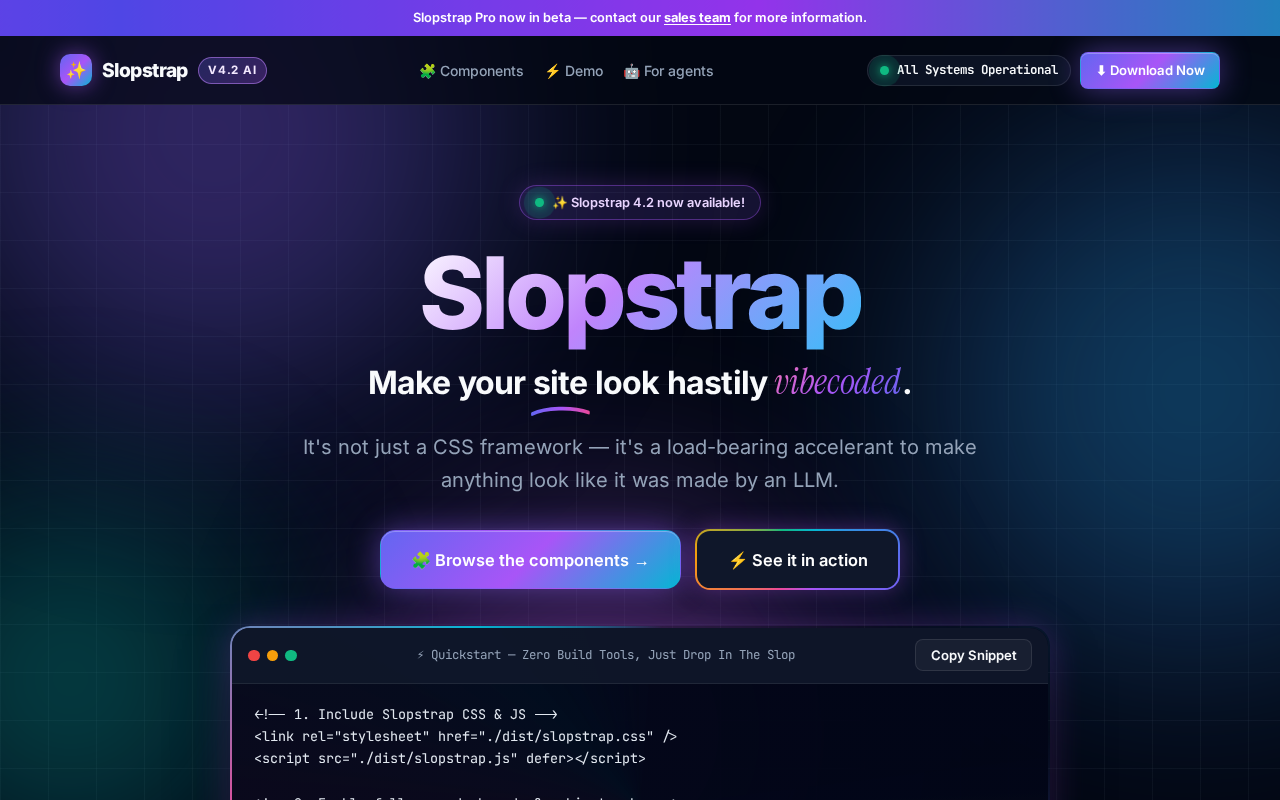
This project taps into a subtle phenomenon in the current AI coding boom: as more and more people use AI to rapidly generate web pages, a visual style that's "instantly recognizable as AI-made" is taking shape. Slopstrap flips the script, turning that roughness into a reusable set of styles.
What Slopstrap Actually Does
You can tell its positioning from the name. "Slop" in internet parlance often refers to low-quality, mass-generated content, while "Bootstrap" is a widely known front-end framework. Splicing the two together hints at a "shoddy version of Bootstrap."
It's not meant to help you build a beautiful website—instead, it deliberately reproduces the visual hallmarks of AI-generated work: perhaps excessive rounded corners, rampant gradients, cookie-cutter card layouts, or that typography that's hard to pinpoint but just screams "AI." This ironic design is essentially a jab at the homogenization of modern web design.
You might not have noticed, but the fact that this project earned hundreds of points and dozens of comments on Hacker News shows it resonates far beyond a simple joke. Developers clearly see some familiar reality reflected in Slopstrap.
Bootstrap is a front-end framework open-sourced by the Twitter team in 2011, offering a full set of pre-built components and styles—grid system, buttons, forms, navbars, and more—and was once one of the most widely used front-end tools in the world. Its defining feature is "out-of-the-box" usability: developers can quickly build complete, cross-device-compatible pages without writing much custom CSS. Because of this, a huge number of websites display a highly similar default Bootstrap look: the same button corners, the same gray-blue palette, the same card shadows. Slopstrap's name is a parody of this phenomenon: pushing Bootstrap's "templatization" to the extreme of "mass-generated low-quality content," using the name itself to satirize how "default styles dictate perception."
Why the "Vibe Coding" Style Deserves to Be Mocked
Vibe Coding refers to a way of working where you use AI tools to quickly turn ideas into code by feel. Its efficiency advantage is undeniable, but the cost is that the output often lacks polish.
When a large number of websites are AI-assisted in similar ways, their visual language converges. Slopstrap is amusing because it distills that "convergence" into a formula. Once a style can be formulaized, it means it's already common enough and recognizable enough.
This is a reminder for product people: AI can help you quickly build an interface, but "looking like it was made by AI" is itself becoming a liability. Users are developing aesthetic fatigue with cookie-cutter generative design.
Vibe Coding was coined by AI researcher Andrej Karpathy in early 2025, describing a programming approach of "being completely immersed in the feel": developers describe intent to large models in natural language, barely reading or reviewing the generated code line by line, and instead relying on run results and intuition to keep adding prompts and iterating. Its core is "accepting AI output without digging into details," making it especially suited for rapid prototypes, small tools, and one-off pages. This mode is extremely efficient, but it also explains why the output often carries a similar "AI flavor": models tend to reuse high-frequency visual patterns from training data—large rounded corners, soft gradients, centered cards, and generic icons—causing different projects to look highly alike.
Two Voices in the Open-Source Community
Discussion around Slopstrap reveals two attitudes. One sees it as a precise roast of the flood of AI-generated content, using humor to highlight an industry problem; the other worries such projects deepen stereotypes about AI-assisted development and overlook the value of the tools themselves.
According to discussions in the Hacker News comment section, many developers shared their experiences identifying "AI-flavored" websites, and some used it as a stress-testing tool—if your design has nothing left after removing these elements, then maybe you really do need to rethink.
This divergence is itself interesting. It shows that Vibe Coding has gone from a niche workflow to a cultural phenomenon that needs public discussion.
Hacker News is a tech community under Y Combinator, using a "points + comments" voting mechanism, where front-page ranking is determined jointly by a post's votes and posting time. Hundreds of points (points) in this community usually means a post has reached the top of the day's front page, gaining tens of thousands of impressions; while dozens of comments indicate the topic is controversial or offers value for experience sharing. Therefore, the 331 points and 62 comments mentioned in the article are not simple traffic numbers, but quantitative signals that "the developer community broadly cares and is willing to participate in discussion"—such data is often used to gauge the real heat of a tech topic among practitioners.
Practical Takeaways for Developers
Slopstrap's value isn't in making you actually use it, but in offering a mirror.
First, be wary of default styles. Whether it's AI-generated code or ready-made frameworks, default configurations often determine the final look. Taking time to adjust these details is the key to distinguishing "it runs" from "it works well."
Second, treat anti-patterns as a checklist. The features Slopstrap reproduces can be turned into self-check items. If your page hits several of them, maybe it's time to stop and re-examine your design decisions.
Third, efficiency and quality can coexist. Rapid generation doesn't mean it must be rough. What AI tools truly save is the time to build structure; aesthetic judgment and detail polishing still require humans.
Conclusion
Slopstrap is a project with a joking nature, but the issues it discusses are real. When AI makes building websites unprecedentedly easy, how to preserve quality beyond efficiency has become a multiple-choice question every developer must face. By "making you look worse," it reminds us not to let tools make all the decisions for us.
One-line Summary
Slopstrap ironically reproduces the rough style of AI-generated web pages, sparking resonance and reflection among developers about homogenized design.
Paragraph Summary
Slopstrap is an ironic project that sparked heated discussion on Hacker News, with the tagline "make your website look like it was hastily vibe coded with AI." It deliberately reproduces the typical visual features of AI-generated web pages—excessive rounded corners, rampant gradients, cookie-cutter card layouts—distilling the homogenization of modern web design into a reusable style formula. The article points out that the project gained hundreds of points and dozens of comments because it hits on the reality that under the Vibe Coding boom, "looking like it was made by AI" is becoming a liability. The community is divided: some see it as a precise roast, others worry it deepens stereotypes about AI-assisted development. The article ends with three takeaways: be wary of default styles, treat anti-patterns as a self-check list, and efficiency and quality can coexist.
Related articles

ChatGPT Plus Subscription Pitfall Guide: Go/Plus/Pro Tier Comparison and Quick Activation
A complete ChatGPT Plus subscription guide based on a Bilibili tutorial: from registering an account, comparing Go/Plus/Pro tiers, to the practical steps for quickly completing your subscription.

GPT-6.2 Sol/Astra Released! A Step-by-Step ChatGPT Plus Subscription Guide and Tier Comparison
GPT-6.2 Sol/Astra is out—here's a ChatGPT Plus subscription guide: register an account, compare Go/Plus/Pro tiers, and subscribe in a minute.

Comparing Three Channels for Subscribing to GPT Plus in China: Is Website Top-Up the Easiest?
How to subscribe to GPT Plus in China? This article compares website top-up, credit card, and mobile top-up channels—process, cost, and risk—with steps and tips to help you choose wisely.