Small Model Strikes Back: Fine-tuned 0.8B SLM Outperforms GPT-5.4 on Grammar Annotation

Fine-tuned 0.8B SLM beats GPT-5.4 on grammar annotation at 1/16th the cost.
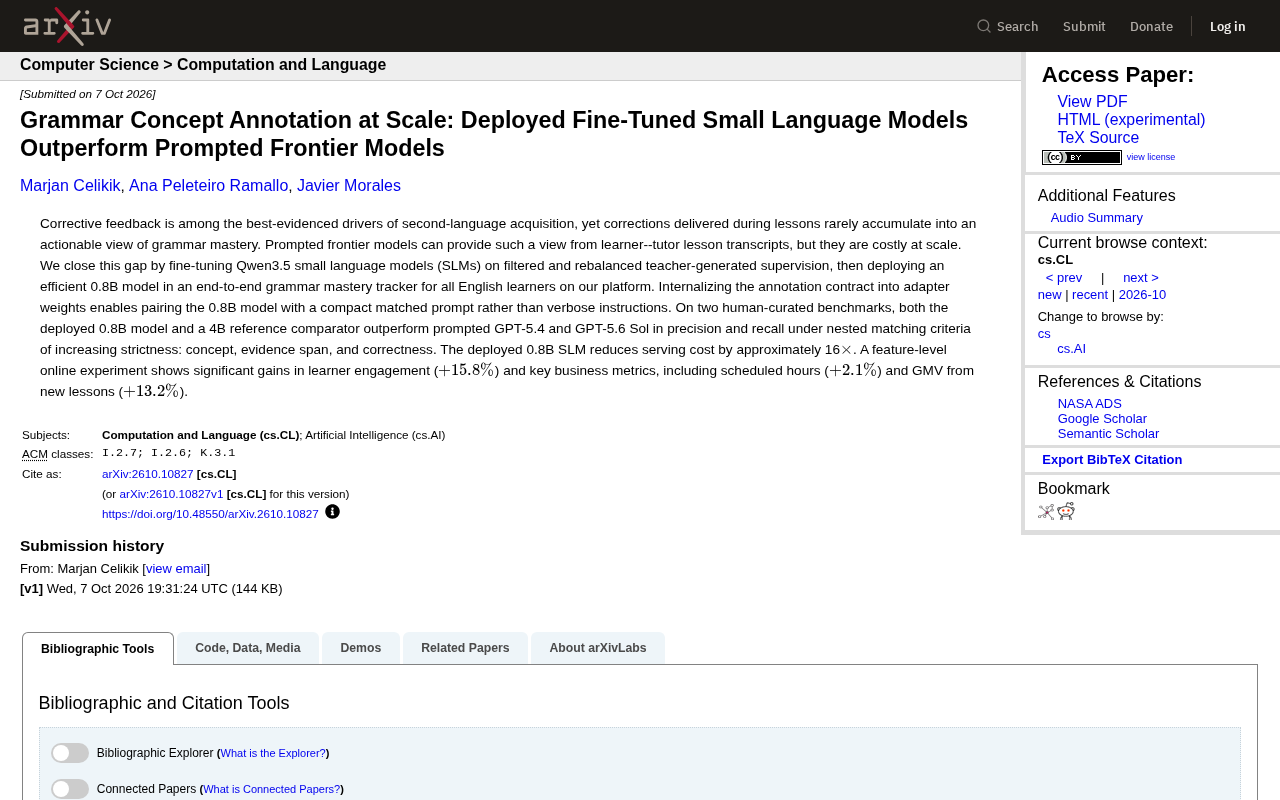
An arXiv study on scalable grammar mastery tracking for online language education shows that fine-tuning small language models (primarily a 0.8B Qwen3.5) on teacher-generated supervision data outperforms prompted GPT-5.4 and GPT-5.6 Sol on both precision and recall, while reducing serving costs by ~16×. Online A/B experiments confirmed real business impact: +15.8% learner engagement, +2.1% booked lessons, and +13.2% new course GMV. The work provides a complete technical and business validation of the paradigm that fine-tuned small models can outperform general-purpose frontier models on well-defined vertical tasks.
When Grammar Correction Meets the Scale Problem
Corrective feedback is widely recognized as one of the most effective drivers in second language acquisition. But in real-world language teaching, the corrections a teacher gives on the fly tend to be scattered and fleeting — rarely coalescing into an actionable panorama of grammar mastery. What learners need isn't just "that sentence was wrong," but rather "here are the grammar concepts you keep getting wrong, and here's how well you've mastered them."
A newly published paper on arXiv (arXiv:2610.10827) targets exactly this pain point. The research team argues that while frontier LLMs driven by prompting can generate such mastery views from teacher-student classroom transcripts, the cost of doing so at platform scale is prohibitively high. Their answer is surprising: a fine-tuned small language model (SLM) not only holds up — it actually surpasses prompted frontier models on both precision and recall.
In second language acquisition (SLA) research, corrective feedback takes several main forms: explicit correction (directly pointing out the error and providing the correct form), recasts (restating the learner's utterance in correct form without explicitly flagging the error), and metalinguistic feedback (prompting grammar rules without giving away the answer), among others. Metalinguistic feedback is often considered the most durable because it encourages learners to actively process grammar rules. But regardless of the form, traditional classroom feedback shares a common bottleneck: coarse granularity and low retention. Teachers find it hard to systematically log each learner's error patterns on specific grammar concepts — verb tense, article usage, clause structure — during live conversation, let alone track them longitudinally across multiple lessons. This is precisely the problem computer-assisted language learning (CALL) has long tried to solve: how to aggregate the language error signals scattered across real interactions into actionable, personalized diagnostics.
Running End-to-End Grammar Tracking with a 0.8B Model
The team's core approach is to fine-tune the Qwen3.5 family of small language models on curated and rebalanced teacher-generated supervision data, then deploy an efficient 0.8B model to provide end-to-end grammar mastery tracking for all English learners on the platform.
There's an engineering detail worth noting here: once the annotation contract is internalized into the adapter weights, the 0.8B model no longer needs lengthy instruction prompts — it can work with a compact, well-matched prompt instead. In other words, the model has learned how to annotate directly into its parameters, eliminating the need to re-feed long instructions at every inference step. This cuts token overhead and makes the small model more stable on the specific task.
This approach — "burning the rules into the weights" — is a defining pattern for deploying small models today: rather than pursuing broad general capability, you specialize deeply on a single vertical task.
The "adapter weights" mentioned here refer to mechanisms like LoRA (Low-Rank Adaptation) used in parameter-efficient fine-tuning (PEFT). Unlike full fine-tuning, adapter tuning inserts a small number of trainable parameters alongside the original pretrained weights while freezing most of the backbone. This has two key advantages: training costs drop dramatically since you don't need to backpropagate through billions of parameters, and "task knowledge" is encapsulated in the adapter layers, preserving the base model's capabilities and enabling easy task switching. When the researchers say the annotation contract is "internalized into the adapter weights," they mean the model has encoded — through supervised training — the rules for what constitutes a valid grammar concept annotation, how to locate evidence spans, and how to judge correctness, all without needing a long system prompt to re-explain those rules at inference time.
Head-to-Head on Two Benchmarks
The evaluation section is the most compelling part of the paper. The team tested on two manually curated benchmarks using a nested, progressively stricter matching criteria:
- Concept: Did the model identify the correct grammar concept?
- Evidence span: Did it locate the correct text evidence?
- Correctness: Was the correct/incorrect judgment accurate?
The results show that both the deployed 0.8B model and the 4B reference model outperform prompted GPT-5.4 and GPT-5.6 Sol on both precision and recall. And as the matching criteria grow stricter, the smaller models' advantage holds.
This result challenges a common intuition — that bigger parameters always means better performance. On well-defined tasks with high-quality supervision data, a carefully fine-tuned small model can outperform general-purpose frontier giants. What matters isn't model size; it's whether the model is truly "aligned" to the task's annotation logic.
Cost and Business Metrics: The Real Value of Production Deployment
If the precision gains are the technical headline, the cost and business data are what make this approach genuinely worth deploying.
The numbers in the paper are straightforward: the deployed 0.8B SLM reduces serving cost by approximately 16×. For a tracking system that needs to run continuously for all English learners on a platform, that order-of-magnitude cost reduction represents the difference between "can't afford to run it" and "can actually run it."
More impressively, the team ran feature-level online experiments and obtained concrete business results:
- Learner engagement up +15.8%
- Booked lessons up +2.1%
- New course GMV up +13.2%
Strong technical metrics don't automatically translate to user value — but this set of online results directly connects grammar mastery tracking to real learning behavior and business outcomes. The double-digit engagement lift shows that when learners can see a clear picture of their grammar mastery, they genuinely become more motivated to keep learning.
GMV (Gross Merchandise Volume) is a commonly used revenue scale metric in e-commerce and online education platforms, reflecting the total transaction value completed through the platform over a given period — not the platform's actual net revenue. In online education, a +13.2% increase in new course GMV means that after launching the grammar mastery tracking feature, the total amount learners spent on new courses increased by that proportion — a direct measure of the feature's contribution to monetization. Online experiments (A/B tests) are critical for this kind of evaluation: random assignment to control and treatment groups allows changes in engagement, bookings, and GMV to be attributed to the feature itself rather than other concurrent factors. Papers that report both technical metrics and online A/B experiment business results remain relatively rare in NLP/EdTech, which is part of what makes this study particularly persuasive.
What This Means for the Industry
This research offers a representative case study: on well-defined vertical tasks, fine-tuning a small model on high-quality supervised data is becoming a more economical — and even more accurate — solution than calling a large model API.
This path is especially worth considering for edtech, customer service, content moderation, and other scenarios that require scalable, structured classification at volume. The underlying logic chain is clear: curate and rebalance supervised data → fine-tune a small model to internalize the task contract → use compact prompts to reduce inference overhead → deploy and validate business value via online experiments.
Frontier LLMs remain powerful general-purpose foundations and prototyping tools. But once a task is well-defined and needs to be deployed at scale, a carefully tuned small model is often the more pragmatic endpoint.
Related articles

MCP Protocol in 60 Seconds: A Real Session, Message by Message
Dissecting a real MCP session message by message: how an Agent dynamically discovers tools, forwards call requests, and has an MCP server execute them — all in just 9 JSON messages, with the model and reasoning loop untouched.

n8n 40-Minute Masterclass: Build Your First AI Automation Workflow from Scratch
Distilled from a 40-minute n8n masterclass: the core differences between automation, AI, and AI Agents, a comparison of n8n's four deployment methods, and a complete guide from dashboard to your first workflow.

Why Does a 35GB Quantized Model Blow Up an 80GB GPU? The Truth About KV Cache VRAM
Why does a 35GB 4-bit quantized LLM still blow up an 80GB GPU? This article breaks down the four components of inference VRAM, provides precise KV Cache formulas, compares GQA vs DeepSeek MLA memory, and offers production-grade OOM prevention like FP8 KV Cache.