Smart Displays Revived: How HomeView and Echo Show 16 Become Family Computers

HomeView and Echo Show 16 revive the smart display category with a "family computer" positioning.
The article reviews the smart display category's journey from being written off to a revival. Three years ago, screen-equipped smart speakers were criticized for poor performance, laggy interaction, and a barren ecosystem, prompting the author to write an "obituary." Now HomeView and Echo Show 16 attempt to address these flaws with a new "family computer" positioning: better hardware, optimized touch-and-voice interaction, and scenario-based features for family schedules, communication, and entertainment. The author sees this as a shift from "speakers with screens" to family computing hubs, though price, privacy, and ecosystem compatibility remain risks to watch.
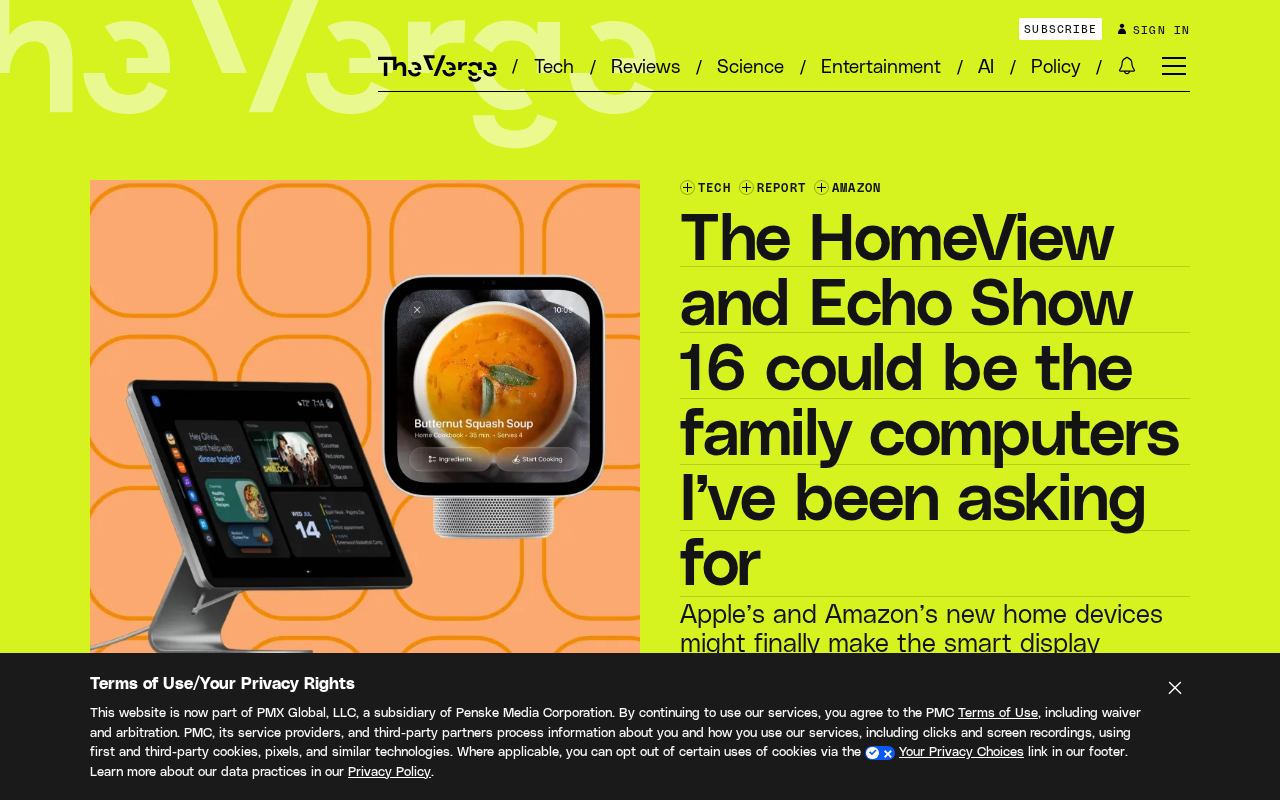
Three years ago, the smart display category was almost pronounced dead. At the time, the products on the market—those smart speakers with touchscreens—were mostly low-spec devices from Google and Amazon, trying to do too much and failing at all of it, with a terrible user experience. The author even wrote a dedicated "obituary" and offered suggestions for improvement. Now, two new products have brought the category back into the spotlight: HomeView and Echo Show 16. They may be exactly the "family computers" the author has been calling for.
The Plight and Turning Point of Smart Displays
Smart displays were initially greeted with high expectations but quickly fell into an awkward position. They tried to integrate voice assistants, video playback, smart home control, and other functions, but ended up mediocre at each. Insufficient performance, laggy interactions, and a barren app ecosystem caused users to lose patience. In the "obituary," the author explicitly stated that the category needed more powerful hardware, more natural interactions, and software design truly suited to home scenarios.
Three years later, the arrival of HomeView and Echo Show 16 seems to answer these demands. Although the original article does not disclose specific hardware specifications, judging from their product positioning, they are no longer just "speakers with screens" but are evolving toward family computing hubs.
Smart Display is a category between smart speakers and tablets, typically represented by Google Nest Hub, Amazon Echo Show, and others. Its core logic is to add a touchscreen on top of a voice assistant to support visual interactions such as video playback, video calls, and smart home control. However, early products generally used low-power processors and stripped-down operating systems, leading to multitasking lag and a poor app ecosystem; at the same time, the product definition was vague—neither as portable as a tablet nor as cheap as a speaker—and thus marginalized by the market. This background helps explain why the author wrote an "obituary" for it three years ago, and why new products must re-answer the fundamental question of "what role the screen actually plays in the home."
The Differentiated Approaches of HomeView and Echo Show 16
Although HomeView and Echo Show 16 both belong to the smart display category, their design philosophies differ. HomeView emphasizes family sharing and information display, making it suitable for the living room or kitchen as a shared terminal; Echo Show 16, on the other hand, may strengthen video calls, streaming, and smart home control on top of Amazon's ecosystem. Both attempt to solve the early products' problem of "trying to do everything and doing nothing well" by improving practicality through more focused scenario definitions.
Interestingly, both products focus on collaboration and communication in family scenarios. For example, they may support multi-user accounts, shared family calendars, message boards, and other features to make interaction among family members more convenient. This positioning aligns closely with the concept of a "family computer"—not a personal device, but a shared tool that the whole family can use.
Why They Could Become "Family Computers"
The author calls these two products "family computers," meaning they possess the core capabilities that traditional smart displays lacked: sufficiently strong performance, intuitive interaction, and a software ecosystem built around family needs. The concept of a family computer is not new, but implementing it on a smart display requires balancing cost, ease of use, and feature richness.
Judging from the optimistic tone of the original article, HomeView and Echo Show 16 have made improvements in the following aspects:
- Improved hardware performance: Although specific specs are unknown, they are sufficient to support smooth multitasking.
- Optimized interaction design: The combination of touchscreen and voice is more natural, suitable for family members of different ages.
- Scenario-based features: Deep customization for high-frequency scenarios such as family schedules, entertainment, and communication.
These improvements turn smart displays from "white elephants" into genuinely useful family assistants.
The term "Family Computer" borrows from the concept of the early days of personal computing, referring to a computing terminal placed in a shared area of the home for multiple members to use. Unlike personal devices, it emphasizes multi-user account switching, shared calendars and messages, family photo display, video calls, and other collaborative features rather than private entertainment. Implementing this form on a smart display requires balancing computing power, cost, and the power consumption of always-on, always-lit devices, while ensuring that the elderly and children can also operate them with a low barrier to entry. Only if HomeView and Echo Show 16 meet these dimensions will they truly deserve the "family computer" positioning, rather than just being smart speakers with larger screens.
Future Outlook for the Smart Display Category
Whether HomeView and Echo Show 16 succeed remains to be tested by the market. But their emergence at least proves that the smart display category is not dead but undergoing a transformation. The shift in positioning from "speakers with screens" to "family computers" may attract more manufacturers to follow suit.
For consumers, this means more choices and the possibility of new forms of smart home hubs. Of course, issues such as price, privacy, and ecosystem compatibility still need attention. The author does not delve into these details in the original article, but as observers, we should remain cautiously optimistic.
The "obituary" for smart displays may have been written too early. HomeView and Echo Show 16 give us hope for the rebirth of this category.
The transformation of smart displays also involves competition for the role of Smart Home Hub. With the advancement of connectivity standards such as Matter, home control devices need to simultaneously possess local computing power, protocol compatibility, and a visual interface, and devices with screens are naturally suited to take on this responsibility. At the same time, privacy issues are particularly prominent: always-on cameras and microphones, and the uploading and storage of home video data, may become user concerns. In addition, ecosystem compatibility determines whether a product can connect to enough third-party devices and services. These factors will directly affect whether HomeView and Echo Show 16 can go from "new products" to "commonly used products," and they are also key indicators for observing whether the category can continue to recover.
One-line Summary
HomeView and Echo Show 16 revive the smart display category with a "family computer" positioning.
Paragraph Summary
The article reviews the journey of the smart display category from being written off to showing signs of a turnaround. Three years ago, the author wrote an "obituary" for screen-equipped smart speakers due to insufficient performance, laggy interactions, and a barren ecosystem. Now two new products, HomeView and Echo Show 16, attempt to address early shortcomings with a new "family computer" positioning: improving hardware performance, optimizing the combination of touchscreen and voice interaction, customizing scenarios around family schedules, communication, and entertainment, and emphasizing multi-user sharing and family collaboration. The author believes this marks a transformation of the category from "speakers with screens" to family computing hubs, which may attract more manufacturers to follow suit, but risks such as price, privacy, and ecosystem compatibility still require cautious observation.
Related articles

AI Can Read Neural Network Weights Directly: Do Models Already Exceed Expectations?
A Reddit developer experiment shows language models can directly read neural network weights and infer their function. Astra, Opus 5.5, and Muse Spark 1.3 all passed the test, sparking discussion on model generalization and training sources.

India's Microdrama Market Explodes: EloElo Secures $80M Investment from NBCUniversal
EloElo secures $80M from NBCUniversal to boost StoryTV, its microdrama platform with over 33M monthly active users, as India's microdrama market draws global capital.

Acoustic Detection of Multi-Rotor UAVs: Fusing Handcrafted Features with Pre-Trained Embeddings
Study reveals data leakage from random splits in UAV acoustic detection, proposes source-disjoint protocol with stacked ensemble of handcrafted features and YAMNet embeddings, achieving 95.29% accuracy for low-cost drone detection.