SMART KS: The AI System That Keeps Mainframe Knowledge From Disappearing

SMART KS turns AI mainframe Q&A into auditable, reusable organizational knowledge that persists over time.
InCommData's SMART KS is an AI knowledge management system for mainframe operations, built on the SmartTSXL agent. It accepts natural-language queries, retrieves real COBOL, JCL, and copybook resources directly, and refuses to guess when information is missing. Every request is organized into a fully traceable thread recording reasoning, sources, and conclusions — meeting audit requirements in regulated industries. Its most distinctive feature is one-click knowledge crystallization, which converts quality analysis into organizational knowledge and can even interview senior staff to capture tacit expertise before it walks out the door. The product's real-world effectiveness remains to be validated.
Enterprise teams ask complex mainframe questions every day — and the answers almost always vanish the moment they're received, never becoming reusable organizational assets. SMART KS (Knowledge System), launched by InCommData, aims to solve exactly that problem. It doesn't just answer questions; it transforms every valuable response into knowledge that lasts.
From One-Off Q&A to Persistent Knowledge
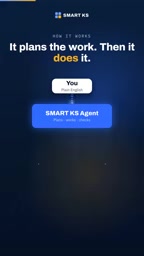
SMART KS is built on SmartTSXL, an AI agent that can actually do the work — and remember what it learns. Users ask questions in plain English, and the agent plans its approach, calls the organization's own LLM alongside SmartTSXL's MCP server, and retrieves real COBOL, JCL, and data resources.
The core value of this approach is no guessing about the production environment. When information is missing, the agent asks — it doesn't make assumptions. For mainframe systems running mission-critical workloads, that kind of discipline matters. A single wrong assumption can trigger a serious production incident.
The MCP (Model Context Protocol) server is a standardized protocol layer that allows AI agents to interact in a structured way with external tools, data sources, and systems. In the mainframe context, SmartTSXL's MCP server acts as a bridge between the AI and actual mainframe resources — COBOL is the dominant business programming language on IBM mainframes, JCL (Job Control Language) is used to define and schedule batch jobs, and copybooks are reusable data structure definition files within COBOL programs. Together, these three resource types form the core of mainframe business logic and are the key entry points for understanding a production environment. The ability to query these raw resources directly — rather than relying on documentation or human retelling — is the technical foundation behind the system's claim to higher trustworthiness.
Every Request Is a Traceable Thread
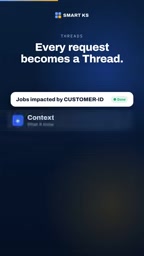
SMART KS organizes every request into a complete thread — recording what the agent knew, which steps it took, what evidence it relied on, and what conclusions it reached, forming a full audit trail.
Every answer shows its sources: which program? Which copybook? Which job? This traceability means analysis results aren't black-box outputs — they're reviewable, verifiable, and trustworthy decision support. For mainframe operations in regulated industries like finance and insurance, this level of transparency and auditability is essentially a hard requirement.

Audit trails carry mandatory regulatory weight in regulated industries. In finance and insurance, compliance frameworks such as Basel accords and SOX (the Sarbanes-Oxley Act) require institutions to demonstrate the full context behind key system changes or decisions. The biggest compliance gap in traditional AI Q&A tools is the inability to reconstruct why the AI gave a particular answer after the fact. SMART KS archives the agent's reasoning path, called resources, and conclusions together as a thread record — making every AI-assisted decision both explainable and traceable. This elevates AI output from a "reference opinion" to a documented analytical conclusion that can be incorporated into compliance frameworks.
One Click to Crystallize Results Into Knowledge
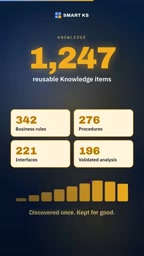
SMART KS's most distinctive feature is knowledge crystallization: a high-quality analysis result can be transformed into organizational knowledge with a single click. Business rules, operational procedures, validated analyses — discovered once, kept for good.
The system goes further: it can also interview enterprise experts, capturing 25 years of accumulated skills and tacit knowledge before a senior employee retires. For organizations that depend heavily on veteran engineers to maintain their mainframe systems, this knowledge transfer capability directly addresses a real industry crisis. Mainframe talent is increasingly scarce, and experience drain is a genuine emergency for many institutions.
The loss of tacit knowledge is a structural crisis for the mainframe industry. According to research from IBM and multiple industry bodies, approximately 220 billion lines of COBOL code remain in production, underpinning critical infrastructure in banking, government, aviation, and beyond — while the engineers who understand these systems are retiring at an accelerating pace. This kind of knowledge is difficult to document; it often lives only in an engineer's intuition and experience — for example, the historical reason why "this JCL must execute in a specific order during month-end settlement." By conducting structured expert interviews, the system converts this tacit experiential knowledge into searchable, explicit knowledge — essentially combining Knowledge Management methodology with AI capability.
Around-the-Clock Operations Through Automation
SMART KS keeps running 24/7 through automation. A job fails at 4 a.m. — by the time the ops team arrives in the morning, a remediation plan is already waiting. Users can kick off 10 investigations simultaneously, and the system will only alert them on the two that actually require human intervention.
This notify-on-need design respects operators' attention and prevents alert fatigue. The key insight: every answer makes the next one smarter. The system forms a positive flywheel as it continuously accumulates knowledge — the more it's used, the richer it becomes.
Closing Thoughts: Mainframe Operations With Knowledge as an Asset
SMART KS represents a product philosophy worth paying attention to: not replacing humans with AI, but ensuring every valuable AI output is preserved as reusable, auditable, and transferable organizational knowledge. Against the backdrop of a mainframe talent gap and aging-yet-indispensable systems, the practical value of tools like this is worth evaluating seriously.
One caveat: this article is based on InCommData's official promotional materials. The product's real-world performance, retrieval accuracy, and knowledge management effectiveness remain to be validated in actual production environments.
Related articles

RAG Getting Started in Practice: From Principles to Building an Enterprise Knowledge Base
Bilibili RAG course highlights: from retrieval-augmented generation principles, document chunking and vectorization, to five accuracy factors and enterprise knowledge base boundaries, with fine-tuning vs RAG selection advice.

AI Model Selection Guide: DeepSeek vs. Qwen3 in Practice
How should AI developers choose models? Based on a Bilibili tutorial, this article breaks down the Function Calling differences between DeepSeek V3 and R1, Qwen3's programmatic thinking mode switching and agent capabilities, and outlines a multi-model learning path and practical selection logic.

Anchoring, Loss Aversion, and Nudges: 5 Psychological Tactics Retailers Use to Make You Spend
Behavioral economics reveals how retailers use anchoring, framing, loss aversion, and nudge theory to manipulate your spending decisions. This article breaks down 5 common psychological tactics and offers counterstrategies like slowing down decisions and setting your own anchors to see through the pricing design behind discounts.