SMO Framework: Compiling Natural Language Skills into Reusable Graph Structures
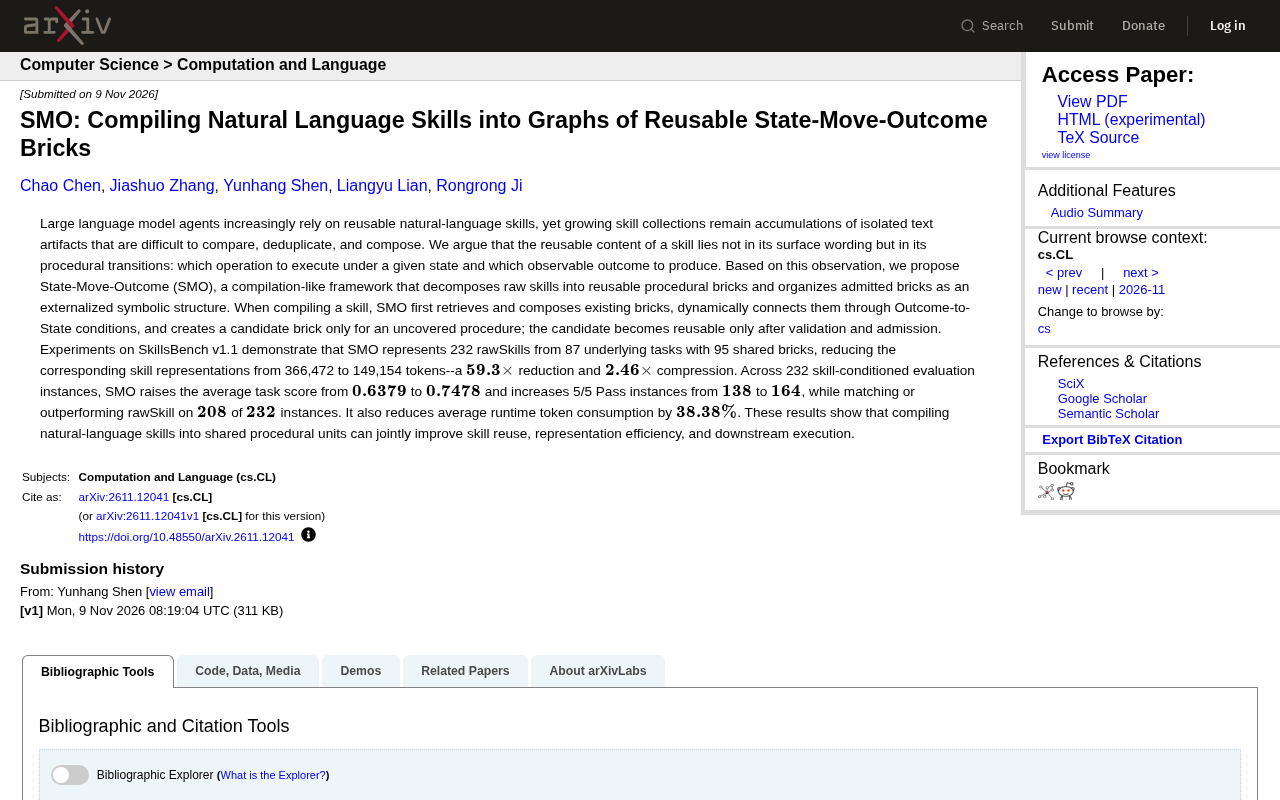
SMO framework compiles natural language skills into shared procedural bricks, achieving 59.3x representation reduction and improved task performance.
Agent skill libraries often consist of isolated natural language text piles that are hard to compare, deduplicate, and compose. The State-Move-Outcome (SMO) framework defines reusable skill content as procedural transformations (state-action-outcome) rather than surface wording. Using a compiler-like pipeline, SMO decomposes raw skills into reusable procedural bricks and dynamically connects them via Outcome-to-State conditions, creating candidate bricks only for uncovered procedures. On SkillsBench v1.1, 232 raw skills compress into 95 shared bricks, reducing token representation from 366,472 to 149,154 (59.3x reduction); average task score rises from 0.6379 to 0.7478, 5/5 Pass instances increase from 138 to 164, and runtime token consumption drops by 38.38%.
Large language model agents increasingly rely on reusable natural language skills, but growing skill libraries often amount to piles of isolated text artifacts that are hard to compare, deduplicate, and compose. To address this pain point, researchers propose the State-Move-Outcome (SMO) framework, which decomposes raw skills into reusable procedural "bricks" and organizes them into an externalized symbolic structure. Experiments show that this approach yields significant improvements in both skill representation efficiency and downstream task performance.
The Core Tension in Skill Reuse: Surface Text vs. Procedural Transformations
Current agent skill libraries typically take the form of large collections of natural language descriptions, with each skill existing as an independent text fragment. While flexible, this paradigm leads to three structural problems: skills are hard to compare side by side, duplicate or near-duplicate skills cannot be automatically deduplicated, and there is no actionable interface for composing new skills. The core insight of SMO is that what is truly reusable in a skill is not its surface wording but its procedural transformation—what operation is performed given a state, and what observable outcome it produces. This view redefines skills from "text artifacts" into "state-action-outcome" transformation units.
Based on this, SMO designs a compiler-like pipeline: it decomposes raw skills into reusable procedural bricks and organizes validated bricks into an externalized symbolic structure. When compiling a skill, the system first retrieves and combines existing bricks, dynamically connecting them through Outcome-to-State conditions, and only creates candidate bricks for uncovered procedures. Candidate bricks become reusable assets only after validation and admission. This mechanism ensures continuous evolution and quality control of the skill library.
State-Action-Outcome modeling originates from planning and reinforcement learning frameworks in classical AI, whose core is to formalize an executable unit as a triple: the current world state, the applicable operation, and the state change observed after the operation. In the context of agent skills, this modeling approach makes explicit the execution semantics implicit in natural language descriptions, enabling skills to be matched and composed based on states and outcomes rather than text similarity. The "procedural bricks" in SMO are precisely the reusable abstraction of this triple, and Outcome-to-State conditions serve as the interface contracts between bricks, ensuring that composed skills connect seamlessly along the state flow. The advantage of this symbolic modeling lies in verifiability and composability, but it also requires structured extraction from natural language skills, and extraction quality directly affects subsequent reuse.
Experimental Validation: Improvements in Both Representation Efficiency and Task Performance
On the SkillsBench v1.1 benchmark, SMO compiles 232 raw skills from 87 underlying tasks, ultimately representing all skills with 95 shared bricks. The corresponding skill representation drops from 366,472 tokens to 149,154 tokens, achieving a 59.3x reduction and 2.46x compression. This result directly addresses the storage and retrieval overhead caused by skill library bloat.
Across 232 skill-conditioned evaluation instances, SMO raises the average task score from 0.6379 to 0.7478, and the number of 5/5 Pass instances from 138 to 164. On 208 of the 232 instances, SMO matches or outperforms the raw skill (rawSkill). Meanwhile, average runtime token consumption is reduced by 38.38%. These data indicate that compiling natural language skills into shared procedural units can simultaneously improve skill reuse, representation efficiency, and downstream execution.
SkillsBench v1.1 is a benchmark suite for evaluating agents' skill representation and reuse capabilities, with task designs that emphasize conditional skill use: given a set of available skills, the agent must select, compose, and execute them to complete an underlying task. The "232 raw skills" mentioned in the text come from 87 underlying tasks, each corresponding to several skill variants, and evaluation statistics (scores and 5/5 Pass rates) are computed per skill-conditioned instance. 5/5 Pass refers to the number of instances that succeed in all five independent runs, measuring the stability of skill execution rather than single-run best performance. The benchmark also records runtime token consumption, so it can reflect both the reduction in retrieval overhead from representation compression and changes in execution efficiency. Understanding the composition of this benchmark helps determine the scope of SMO's conclusions: it primarily validates improvements at the skill representation level, not open-domain skill discovery or cross-modal transfer capabilities.
Design Implications: From Text Stacking to Symbolic Skill Graphs
SMO's practice offers new ideas for agent skill management. Traditional skill libraries tend to keep appending text descriptions, whereas SMO enforces the distillation of shared structure through a compilation process, making inter-skill relationships explicit as an Outcome-to-State condition graph. This symbolic representation not only facilitates deduplication and composition but also provides clear interfaces for skill validation and admission. For teams building large-scale agent systems, this means skill libraries can shift from "static document collections" to "evolvable procedural knowledge graphs," thereby reducing maintenance costs and improving execution consistency.
Symbolic skill graphs contrast with traditional vector-retrieval-based skill libraries. The latter encode skills as dense vectors and recall candidate skills via semantic similarity; their advantage is that no manual structure definition is needed, but their drawback is that execution consistency after composition is hard to guarantee, and near-duplicate skills are easily stored repeatedly. Symbolic skill graphs instead organize skills with explicit nodes (bricks) and edges (Outcome-to-State conditions), making deduplication, composition, and admission validation operable at the structural level. This representation draws on the idea of compiler intermediate representations (IR): raw skills resemble source code, bricks resemble instructions, the condition graph resembles a control flow graph, and the compilation process is precisely the normalization of diverse surface texts into a reusable intermediate form. The cost is the need to maintain a symbolic structure and its validation mechanism, which imposes higher requirements on the standardization of skill descriptions.
Limitations and Outlook
SMO has currently validated its effectiveness on a specific benchmark, but its compilation process depends on accurate extraction of the procedural content of skills, which imposes certain requirements on the standardization of natural language descriptions. Future work may need to explore more robust procedural extraction methods and how to handle semantic conflicts between cross-domain skills. In addition, extending SMO to multimodal skills or interactive skill learning scenarios is also a direction worth attention.
One-line Summary
SMO framework compiles natural language skills into shared procedural bricks, achieving 59.3x representation reduction and improved task performance.
Paragraph Summary
Agent skill libraries for large language models often consist of isolated natural language text piles that are hard to compare, deduplicate, and compose. Researchers propose the State-Move-Outcome (SMO) framework, which defines the reusable content of a skill as its procedural transformation (state-action-outcome) rather than surface wording. SMO uses a compiler-like pipeline to decompose raw skills into reusable procedural bricks and dynamically connects them through Outcome-to-State conditions, creating candidate bricks only for uncovered procedures, which become shared assets after admission. On SkillsBench v1.1, 232 raw skills are compressed into 95 shared bricks, with token representation dropping from 366,472 to 149,154, achieving a 59.3x reduction; average task score rises from 0.6379 to 0.7478, 5/5 Pass instances increase from 138 to 164, and runtime token consumption decreases by 38.38%. This shows that symbolic skill compilation can simultaneously improve reuse efficiency and execution effectiveness.
Related articles

Zero-Code Replication of a $10,000 3D Website with Claude Code: A Six-Tool Breakdown
Bilibili creator Yomi used Claude Code plus five free tools to build a 3D product landing page quoted at $10,000 overseas—zero code. Breakdown of the six-tool division of labor, image-to-3D workflow, and the core collaboration method: "give AI a reference, not 'make it look better.'"
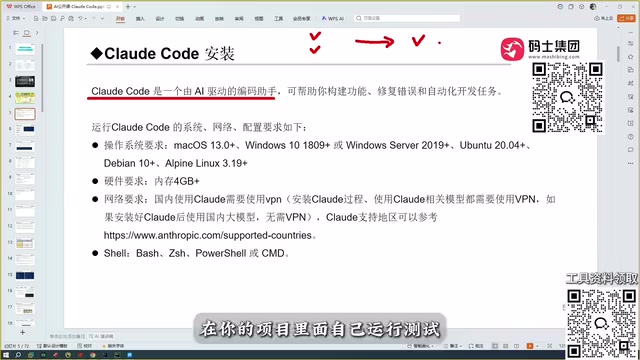
Claude Code in Practice: Install, Connect Models, Calculate Tokens, and Ship a Full-Stack Project with a Single Document
Based on a Bilibili public course demo, this covers Claude Code installation, model connection, token cost calculation, and the practical path of shipping a full-stack project with a single document, plus comparisons with Copilot, Cursor, Trae, and other coding assistants.
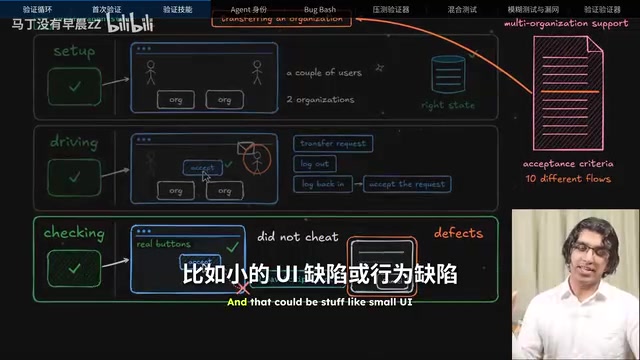
Who Accepts AI-Written Code? A 25-Minute Deep Dive into Verification Loops and the New Code Review Paradigm
After AI writes lots of code, how should Code Review verify it? This article breaks down the Claude Code team's verification loop framework: surface-level end-to-end verification, setup/drive/check three-stage skills, hybrid end-to-end testing and reliability checklists, and how to tighten the loop when issues slip through.