SnakeRank: Turning a Leaderboard into a Snake Game — A Pay-to-Rank Experiment

SnakeRank gamifies pay-to-rank leaderboards as a Snake game driven by competitive bidding.
SnakeRank reimagines the paid leaderboard as a Snake game where startups bid for position — the more you pay, the closer you get to the head. Its core mechanics include cumulative bidding, pay-only-the-difference climbing, and a first-mover advantage on ties. While the gamified approach cleverly drives virality and FOMO, questions remain about long-term sustainability and fairness as deep-pocketed players dominate.
A Quirky Idea That Turns a Leaderboard into a Game
On Product Hunt, a product called SnakeRank debuted with the tagline "The leaderboard is a snake — the more you pay, the closer you get to the head." It quickly garnered 82 upvotes and climbed to #18 on the daily chart. Its positioning is refreshingly blunt: a pay-to-rank display board, but with a highly unconventional twist — the entire leaderboard is designed as an auto-running Snake game, where each segment of the snake's body represents a startup, and rankings are determined entirely by how much each one has paid.
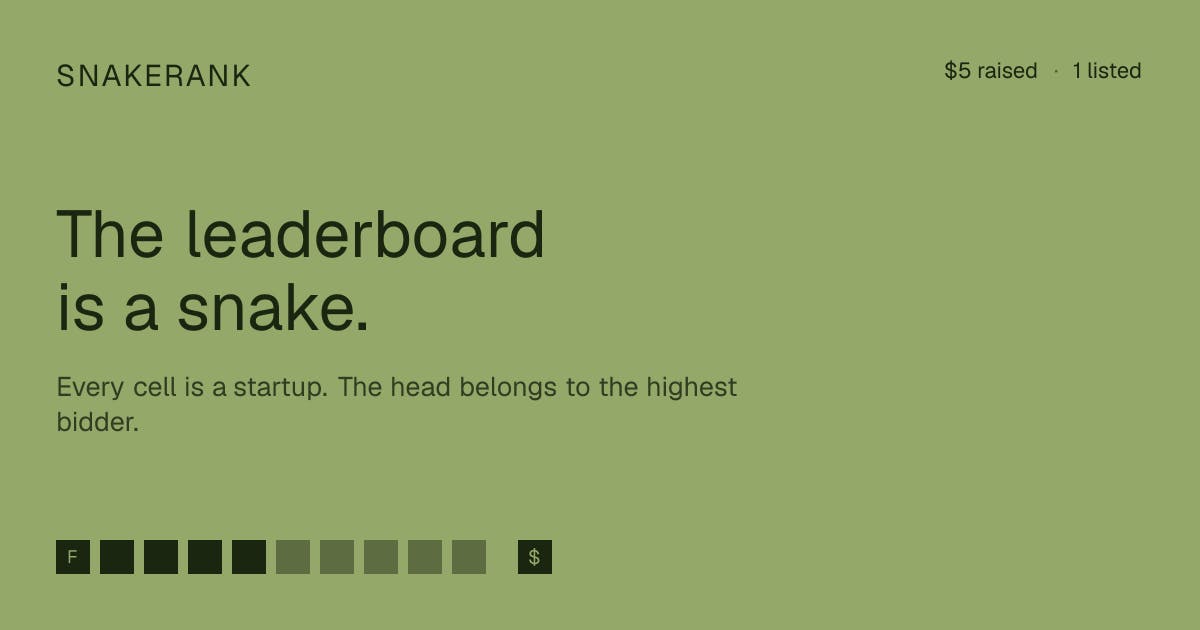
This isn't a traditional utility product — it's more of an experiment in marketing and game theory mechanics. It takes the familiar business logic of "ad slot bidding" and wraps it in a visual format everyone understands, turning the ranking itself into something inherently shareable and conversation-worthy.
Core Mechanics: Cumulative Bidding and the "Pay Only the Difference" Rule
SnakeRank's rule design is thoughtfully crafted. Let's break it down piece by piece.
Rankings Are Based on Cumulative Bids
According to the product description, rankings are determined by the "total dollar committed." In other words, your bids keep stacking up rather than resetting each time. This means once you've secured a position, anyone who wants to surpass you must commit a higher total amount.
Climbing Only Costs the Difference
The most interesting detail: moving up "only requires paying the difference." If you want to surpass the company above you, you don't need to start piling up money from scratch — you just need to bid more than their current total to take their spot. This design lowers the psychological barrier for each leap and keeps the entire leaderboard in a constant state of flux where any position can be challenged.
Ties Go to the First Mover
The rules also specifically state: ties go to whoever got there first. In other words, if you merely match the current leader's amount, you'll only get second place, not first. To truly claim the top spot, your bid must be strictly higher than the leader's. This seemingly minor detail creates a crucial premium in the game theory — if you want to be the snake's head, you have to spend just a little more than everyone else.
Cold Start Strategy: Why "The Snake Head Is Cheap Right Now"
The product team states upfront: new positions start at just $5, and since the leaderboard just launched, "the snake head is cheap right now."
This is a classic cold start incentive strategy. While the leaderboard has no high-spending competitors, early users can claim the most prominent position at minimal cost, gaining a head start in subsequent bidding escalations. As more startups join and keep raising bids, the cost of reaching the top naturally inflates — the later you enter, the more expensive it gets.
This combination of "early-bird pricing + cumulative bidding" essentially leverages FOMO (fear of missing out) psychology, encouraging users to place their bets early and come back to raise their bids each time they're overtaken — creating a continuous stream of cash flow and user stickiness.
Clever Design Choices and Potential Pitfalls
The Clever Part: Gamifying a Business Model
The smartest thing about SnakeRank is that it doesn't try to hide the "pay for rankings" mechanic — instead, it puts it front and center as the core gameplay. The Snake game, a visual metaphor everyone recognizes, makes the abstract dynamics of competitive bidding intuitive and fun. Every overtake, every time someone gets knocked down a spot — each is a natural conversation starter with built-in social sharing potential.
For startups, it serves as both an exposure channel and an entertaining attention competition. The product is tagged under three categories — Marketing, Advertising, and Games — which perfectly captures its positioning at the intersection of all three.
The Pitfall: Questions About Sustainability and Fairness
However, this mechanism also has an obvious ceiling problem. A pure "highest bidder wins" ranking system means the leaderboard will eventually be dominated by players with the deepest pockets, making it nearly impossible for small and mid-sized startups to maintain a visible position long-term. Once the novelty wears off and top positions get priced up, the willingness of average users to participate may drop off sharply.
Moreover, the value of this kind of product is highly dependent on traffic itself — "being on the board" only matters when enough people are actually watching the leaderboard. If the audience size can't keep up with the bidding scale, then the expensive snake head position may end up being nothing more than a costly spot that nobody sees.
Conclusion: An Attention Economy Experiment Worth Watching
SnakeRank may not become an evergreen product, but it offers a fascinating case study: how to use gamification mechanics to repackage "paid exposure," one of the oldest business models around. It cleverly stitches together competitive bidding, social virality, and FOMO psychology into a constantly slithering snake.
For practitioners interested in growth mechanics and marketing innovation, SnakeRank's rule design — especially the three pillars of "cumulative bidding," "pay only the difference," and "ties go to the first mover" — is a game theory mini-case study well worth examining. As for whether it can survive the cold start phase and sustain its bidding momentum, only time will tell.
Related articles

Amphibious Transforming Drone: Beyond 100x Power Savings, What Are the Real Needs?
Is the amphibious transforming drone just a gimmick? Starting from the 100x power difference of the M4 Morphobot, explore real application scenarios and thesis topic ideas, analyzing boundary conditions where pure drones and pure ground robots both fail.

Warhound Raises $200 Million: Genetically Engineered "War Dogs" Paired with Anduril Gear
Warhound raises $200M, backed by Ben Lamm and Palmer Luckey, to genetically engineer dogs for military and law enforcement use and equip them with Anduril gear. This article analyzes its technology direction, funding logic, and ethical controversy.

Claude API Comes to Google Cloud: IAM Integration and SDK Access Guide
Anthropic hosts the full Claude API on Google Cloud with IAM-controlled permissions and unified billing. This guide covers the Vertex AI and Anthropic-hosted entry points, IAM role configuration, and SDK access.