Sol 6.1 Debug Mode Consumes Quota Too Quickly, User Test Shows 12% Drop in 1 Hour

Sol 6.1's Xhigh mode is accused of a 2-4x surge in quota consumption, with no official response fueling user cost anxiety.
Multiple Pro subscribers in the Reddit community report that Sol 6.1's Xhigh mode consumes about 12% of the weekly quota in 1 hour, far above the previous 3%-4% level in Codex mode, with the full quota even exhausted in 16 hours. Independent observations from Bilibili and YouTube and log analysis show that Xhigh mode may enable more aggressive reasoning chains and tool-calling strategies by default, significantly increasing billing units per request, with the consumption increase estimated at 2-4x depending on task type. The community has spontaneously adopted mitigations such as downgrading modes and splitting tasks, but at the cost of output quality. As of press time, officials have not commented, and insufficient billing transparency and cost uncertainty have become the core controversies.
Abnormal Quota Consumption Raises User Concerns
A post that resonated widely has recently appeared in the Reddit community: a Pro subscriber reported that after using Sol 6.1's "Xhigh" mode for just one hour, their weekly quota plummeted from 100% to 88%. The user questioned the consumption rate, stating that when running the exact same workload last week, consumption in Codex mode never exceeded 3% to 4%.
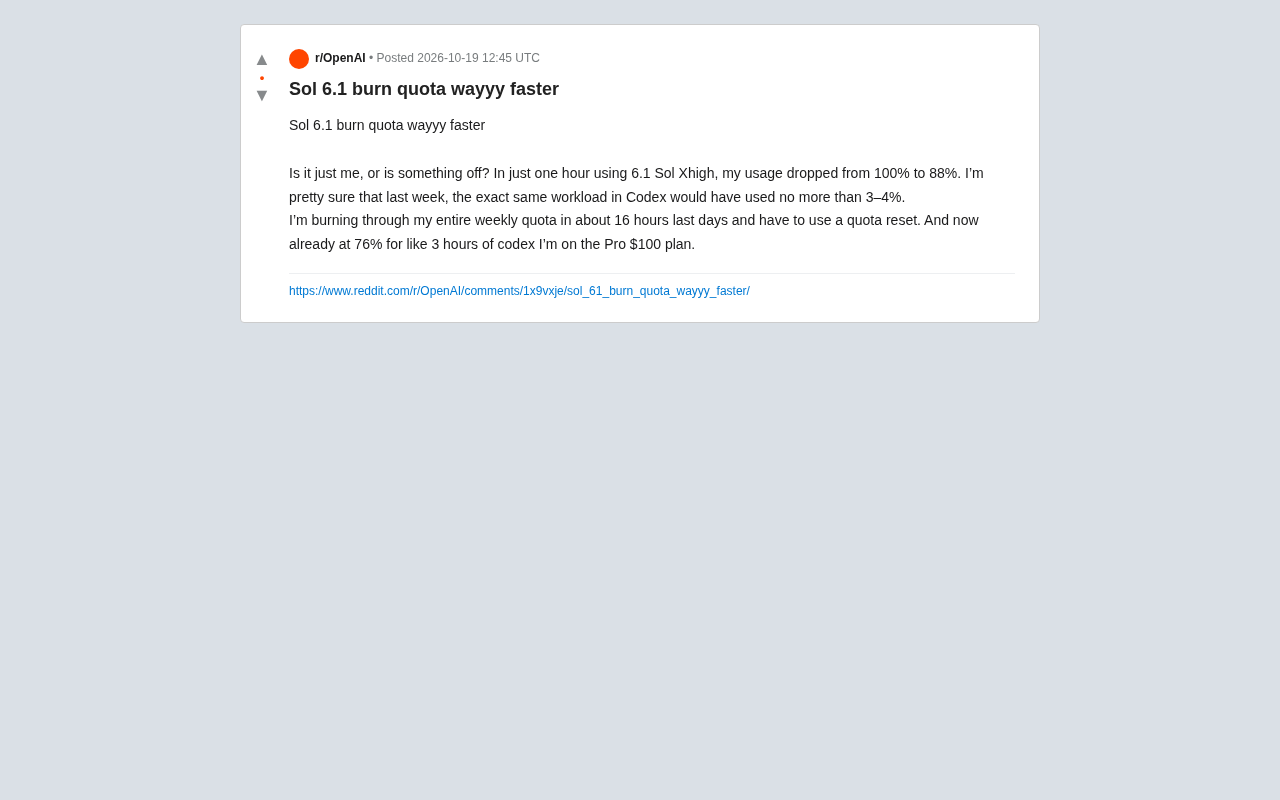
The user further added that in recent days their full weekly quota was exhausted in about 16 hours, forcing them to use the quota reset feature. After only about 3 hours of Codex operation, the quota had already dropped to 76%, and they are subscribed to the $100/month Pro plan. This feedback is not an isolated case—multiple users in the comments reported similar experiences.
Multi-Source Cross-Verification: The Problem May Be Widespread
Although this round of discussion is mainly on Reddit, according to independent observations from Bilibili creators and YouTube tech channels, Sol 6.1 does indeed show increased API call frequency and token consumption compared to the previous version after enabling high-precision mode. Some developers pointed out through log analysis that Xhigh mode may enable more aggressive reasoning chains and tool-calling strategies by default, significantly increasing the billing units per request.
One thing worth mentioning: there is still disagreement on the specific consumption multiplier. The original Reddit poster believes the consumption increase reaches 3 to 4 times, while some YouTube reviewers estimate it at around 2 times. The difference may stem from different workload types—tasks involving extensive code generation and iteration show a more pronounced consumption amplification effect.
Tokens and billing units are fundamental to understanding AI service quota consumption. A token is the smallest unit of text processed by a model, roughly understood as a word or word fragment—about 4 characters for English per token, while Chinese is often split by character or word. The input and output of each user request are billed by token count, and tokens generated by intermediate steps such as reasoning chains and tool calls are often also counted toward consumption. The so-called "billing unit" is an abstract unit that service providers create by layering a multiplier coefficient on top of tokens; different modes (such as standard mode and Xhigh mode) may correspond to different multipliers. Therefore, even if the workload text volume is the same, if the model executes more rounds of self-verification or tool calls in the background, the actual tokens and billing units consumed will multiply. This is also the technical root cause of users observing quota "burning" at a rate far exceeding expectations.
Why Does Sol 6.1 "Eat" More Quota?
Aggressive Reasoning Mode Is the Main Cause
From a product logic perspective, version 6.1 has retuned Xhigh mode to be more inclined toward executing multiple rounds of self-verification and tool calls within a single session. While this design improves output quality, it also directly raises billing unit consumption. What users perceive as "quota burning" is essentially an expectation gap between server-side billing strategy and front-end display.
Chain-of-Thought and tool calling are core mechanisms by which current large models improve performance on complex tasks. Chain-of-thought refers to the model generating intermediate reasoning steps step by step before giving a final answer, to improve logic and accuracy; tool calling refers to the model actively invoking external functions such as code execution, search, and file reading/writing during a session. Both generate additional token consumption and request counts. If Xhigh mode enables longer reasoning chains and more frequent tool calls by default, the actual billing volume per task will be significantly higher than in standard mode. This design is a product-level strategy tuning rather than a simple bug, so an expectation gap easily arises between the consumption increase users perceive and the official billing standard.
Insufficient Billing Transparency Exacerbates Anxiety
Users are not unable to accept higher consumption—rather, they lack real-time, explainable consumption details. The current interface only displays percentages, with no way to view the specific token usage and multiplier coefficient for a single request, leaving users unable to attribute the cause when quota drops sharply and able only to cross-compare through community mutual assistance.
Quota in subscription-based AI services usually refers to the upper limit of resources a user can use within a certain period, commonly expressed as a percentage converted from total tokens, request counts, or billing units. The "weekly quota" corresponding to the $100/month Pro plan is a rolling window limit rather than a natural-week reset, so users may exhaust it early under intensive use and trigger the reset feature. The current interface only shows the remaining percentage, without providing per-request token usage, multiplier coefficients, or historical consumption curves, making it difficult for users to determine whether abnormal consumption comes from workload changes or billing strategy adjustments. This information asymmetry amplifies anxiety and also leaves the community able only to speculate on the real multiplier through cross-comparison.
User Coping Strategies and the Absence of Official Response
In the absence of official explanations, the community has spontaneously formed several mitigation approaches: downgrading Xhigh mode to standard mode, splitting long tasks into short sessions, and disabling automatic tool calls for non-critical tasks. However, all of these come at the cost of output quality. As of press time, officials have not released a formal statement on the quota consumption changes, nor confirmed whether it is a billing bug or an intentional adjustment.
For professional users who rely on this service for daily development, quota uncertainty is translating into real cost risk. If the $100/month Pro plan can only support more than ten hours of intensive use, its cost-effectiveness will face severe scrutiny.
Conclusion
Sol 6.1's performance improvements are evident to all, but the dramatic changes in quota consumption remind us: the billing models of AI programming tools are becoming increasingly complex, and users need more transparent usage feedback mechanisms. With multi-source information cross-verification, abnormal consumption is no longer an isolated case, and officials need to provide a clear explanation and optimization plan as soon as possible.
One-line Summary
Sol 6.1's Xhigh mode is accused of a 2-4x surge in quota consumption, with no official response fueling user cost anxiety.
Paragraph Summary
Multiple Pro subscribers in the Reddit community report that Sol 6.1's Xhigh mode consumes about 12% of the weekly quota in 1 hour, far above the previous 3%-4% level in Codex mode, with the full quota even exhausted in 16 hours. Independent observations from Bilibili and YouTube and log analysis show that Xhigh mode may enable more aggressive reasoning chains and tool-calling strategies by default, significantly increasing billing units per request, with the consumption increase estimated at 2-4x depending on task type. The community has spontaneously adopted mitigations such as downgrading modes and splitting tasks, but at the cost of output quality. As of press time, officials have not commented, and insufficient billing transparency and cost uncertainty have become the core controversies.
Related articles

JobRunner MCP Server: AI Agents Can Now Fix Failed Java Jobs
JobRunner launches an open-source MCP server enabling AI agents to view cluster status, diagnose failures, and recover Java jobs—incident response from any cloud coding environment or existing agent.

MLAI Digital Launches 9 Security Agents: MCP Server Safeguards the Full Lifecycle of Agentic AI
MLAI Digital launches Security MCP Server with nine built-in specialized security agents covering vulnerability discovery, attack simulation, prompt injection detection, API and infrastructure assessment, and accelerated remediation—embedding security validation across the full Agentic AI lifecycle from development to production.

Running Isaac Lab on H100 GPUs: Exploring Better Approaches
Exploring optimization methods for running Isaac Lab on NVIDIA H100 GPUs, including MIG configuration, mixed precision, TensorRT acceleration, and community experience to improve robotics simulation and reinforcement learning efficiency.