SoL-Pi in Practice: Pi Agent Automated Research Loop & Regolo Configuration Guide
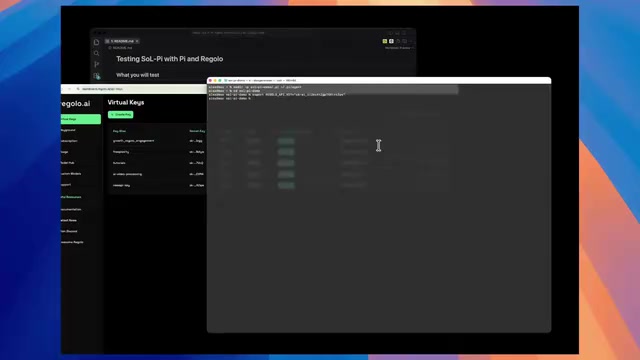
SoL-Pi quantifies AI coding agent token savings through optimized context management and controlled experiments.
This article walks through the complete implementation of SoL-Pi (SOPI), a token cost optimization solution for Pi Agent. It covers three prerequisites (Node.js, Regolo API key, Git), secure key management via environment variables and per-project virtual keys, model mapping configuration, and smoke testing. The core methodology is a controlled "run the same task twice" experiment — using an automated script to execute identical coding tasks under standard and optimized configurations, tracking token consumption phase by phase through real-time logs, with side-by-side results confirming the optimized branch uses significantly fewer tokens.
SoL-Pi in Practice: Pi Agent Automated Research Loop & Regolo Configuration Guide
Token consumption by AI coding agents is often the most overlooked and hardest-to-control cost in real-world usage. SoL-Pi (referred to as "SOPI" in the tutorial) offers a quantifiable solution: by optimizing the agent's context management and model interaction mechanisms, it significantly reduces token usage while completing the same coding tasks. This article, based on a hands-on tutorial, walks through the complete workflow — from environment setup and Regolo key configuration to a cost comparison study.
Why Agent Token Costs Matter
When a coding agent autonomously processes a codebase, it repeatedly reads files, organizes structure, and executes refactoring logic. Every interaction with the model consumes tokens. The more complex the task, the higher the context window occupancy, the more API calls are made, and the greater the cost.
This is precisely where SoL-Pi delivers value — it provides Pi Agent with a dedicated mechanism to optimize communication between the agent and the model, reducing unnecessary call overhead. The tutorial author emphasizes that this approach isn't about vague optimization claims, but about running the same task twice (standard config vs. optimized config) in a controlled experiment to quantify savings with real data.
Tokens are the basic unit of measurement for how large language models process text. Roughly, one English word corresponds to 1–2 tokens, while Chinese characters average 1.5–2 tokens each. Model providers (such as OpenAI and Anthropic) charge based on total input and output token counts. What makes coding agents particularly costly is that they don't just read user instructions — they pack entire code files, function dependencies, and conversation history into the "context window" and send it all to the model at once. This means a seemingly simple refactoring operation can trigger dozens of API calls, each carrying an ever-growing context, with cumulative token consumption potentially reaching several times — or even tens of times — that of manual coding. The larger the context window (e.g., 128K tokens), the higher the cost per call; the more iterative the task, the faster historical information accumulates. This is why "managing context" rather than simply "reducing call frequency" is the key to cost reduction — compressing redundant information carried in each interaction is the fundamental solution.
Environment Setup: Three Prerequisites
Before getting started, confirm that three foundational requirements are in place:
- Node.js: Must be the current stable version. An outdated environment is very likely to trigger dependency conflicts during installation. Check your version in the terminal first.
- Regolo API Key: This is the credential the agent uses to communicate with the model provider.
- Git: Used to clone the SoL-Pi repository and related frameworks.
The author specifically cautions that installation commands and configuration flags should follow the official repository documentation rather than be recalled from memory. Referencing the latest docs avoids troubleshooting costs caused by flag changes. After running the installation command, the system will pull core libraries and build the local workspace — watch the progress bar closely and address any dependency errors. Update the package manager first if necessary.
Regolo Key Configuration: Security First
Key management is a step that's easy to handle carelessly, yet it's critical to account security. The approach demonstrated in the tutorial is worth adopting by any professional developer.
Use Environment Variables — Never Hardcode
Export the API key as an environment variable rather than writing it directly into source files. This fundamentally prevents sensitive credentials from being accidentally committed to repository history.
Environment variables are a key-value storage mechanism at the operating system level. Programs can read them at runtime via methods like
process.env.VARIABLE_NAMEin Node.js, without the value ever appearing in source code. In practice, developers typically write keys into a.envfile and add it to.gitignore, or set session-level variables directly in the terminal usingexport API_KEY=xxx. The core benefit is "decoupling keys from code": even if the codebase is made public or accidentally leaked, attackers cannot directly obtain valid credentials. By contrast, hardcoded keys pushed to platforms like GitHub can be detected and abused by automated scanning bots within minutes, leading to skyrocketing bills or data breaches. For team collaboration, environment variables can also integrate with secrets management services like Vault or AWS Secrets Manager for centralized governance and automatic rotation.
Generate a Dedicated Virtual Key for Each Agent Instance
Go to the Regolo dashboard and generate a unique virtual key specifically for the current agent instance. This "one project, one key" approach offers two benefits:
- Granular auditing: You can track usage for each individual key.
- Revocability: If an agent misbehaves, you can revoke its access independently without affecting other projects.
After generating the key, copy it and store it in a secure environment manager. Never leave it scattered across the filesystem as plain text.
Model Mapping and Configuration Files
Once you have the key, follow the documentation to map the API key to a specific model configuration, directing the agent to use the correct infrastructure. After updating the local model configuration file with the new credentials, run the model validation command to confirm that authentication handshake succeeded and the model settings are correctly applied.
Next, clone the SoL-Pi repository and run the installation script to install framework dependencies. This tool is the core engine of the entire efficiency test — during installation, confirm there are no "missing library" warnings and that all underlying components are correctly linked to the existing Pi Agent installation.
The configuration profile is the agent's operational baseline, defining how it handles code and memory. The author repeatedly stresses that "a clean profile is the secret to stable performance" — even a single typo in a path can prevent the agent from accessing necessary tools.
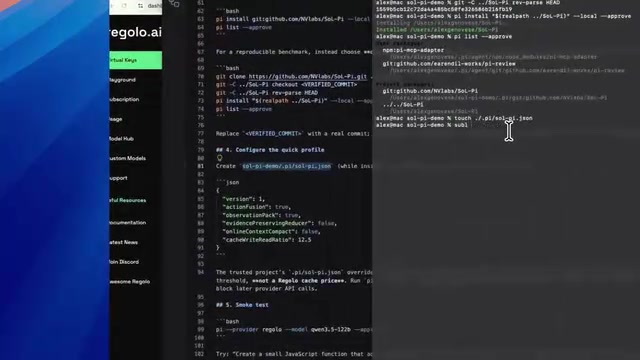
After completing configuration, run a smoke test using the provider command to quickly verify that the model connection is stable. Confirming that the terminal output shows a stable connection before moving into the formal cost study prevents wasting tokens on failed initialization attempts.
Cost Study: Running the Same Task Twice
The methodology for the cost study is straightforward: run the same coding task twice — once with standard performance settings and once with optimized settings — to quantify SoL-Pi's real-world impact.
Once the cost study script is launched, it automatically executes a pre-validated coding task without human intervention, collecting clean, comparable token consumption data and eliminating human error from manual operations.
Observing Agent Behavior Phase by Phase
Real-time logs track every API interaction. The entire task is broken into multiple phases executed sequentially:
- The agent first browses the codebase, deciding when to trigger specific optimization functions.
- During the refactoring phase, it organizes code structure while logging token consumption, demonstrating how it manages the context window.
- During complex logic execution, the logs track whether the optimization mechanism successfully reduces overhead.
- In subsequent phases, performance metrics remain stable, and the logs clearly show changes in interaction patterns.
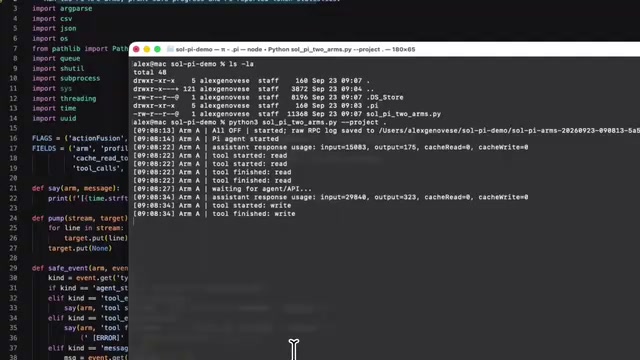
The author notes that compared to the unoptimized baseline, the agent's approach to handling token demands shows a clear change — direct evidence that the configuration is working.
The "controlled experiment" is a cornerstone of the scientific method — by holding all conditions constant except the variable being tested, it isolates the actual impact of a single factor. In the token cost study, the "run the same task twice" design ensures that both runs are identical in terms of task content, codebase state, and model version, with the only variable being whether SoL-Pi's optimized configuration is enabled. This effectively eliminates interference from "different task complexity" or "model version differences." The automated execution script further removes human error from factors like manual operation speed and prompt phrasing, making the data reproducible — the same team running this at different times should reach similar conclusions. This also means the methodology can be replicated and validated by other teams, making it a general-purpose framework for establishing a token cost baseline and evaluating any context optimization strategy, not just in SoL-Pi scenarios.
Data Analysis and Conclusions
Once all tasks have been executed, open the results file for a side-by-side comparison. The data aggregates token counts from both branches (standard vs. optimized).
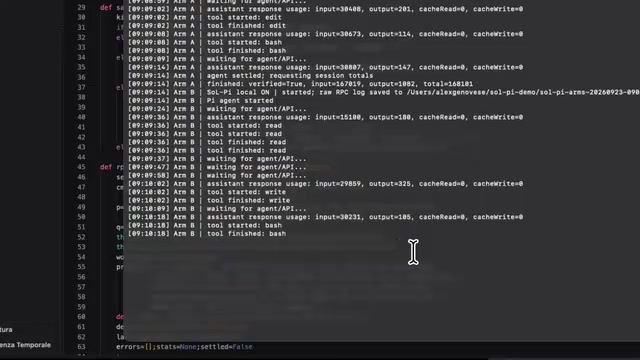
The results confirm: the optimized branch completes the same task with significantly fewer tokens, directly validating the practical value of the SoL-Pi approach. Finally, cross-check the terminal logs once more to confirm data integrity, closing the loop on the entire workflow.
Common Troubleshooting
If errors occur during the process, the tutorial identifies two priority areas to investigate:
- Check API key permissions: Confirm that the virtual key has the specific permissions required to run coding tasks.
- Verify the Node version: Check that it matches the requirements in the official documentation.
The biggest takeaway from this workflow is that reducing AI coding costs isn't about intuition — it's about reproducible controlled experiments and complete log records. For teams that rely on agent-assisted development long-term, establishing a token cost baseline like this is the first step toward precise cost control.
Related articles

CSS Anchor Positioning: A New UI Positioning Approach Without JavaScript
A deep dive into CSS Anchor Positioning: from anchor-name and position-anchor to the anchor() function, position-area shorthand, position-try-fallbacks, anchor-size, and upcoming anchor queries.

New AI Chart Interaction: Continuous Follow-up Questions and Visualization in Conversation
Explore a new AI interaction method for continuously generating charts in conversation. Use the /visualize command to ask follow-up questions and visualize answers in the same chat window, improving data analysis efficiency.

Cursor Merges Into X Subscription: Paid Plans Share Unified Usage Pool, Grok Model Coding Usage Doubled
Cursor joins The X Subscription with a unified usage pool and doubled Grok coding quota. Third-party models shift to API pricing. Existing users can keep or migrate plans.