Sony Xperia 10 VI Breaks Its Promise: The Promised Android 17 Update Is Gone

Sony's Xperia 10 VI fails to deliver on its three major version update promise, cancelling the Android 17 upgrade.
Sony promised three major OS updates including Android 17 for the Xperia 10 VI at launch, but a Sony UK support page notice says the model won't receive Android 17. Mid-range Android phones are often shortchanged on updates due to short chipset support cycles, limited engineering resources, and lower-than-expected sales — Sony is no exception. But since Sony explicitly promised three updates at the point of sale, the broken promise directly harms brand reputation and weakens its mid-range competitiveness, especially as Samsung and Google offer up to 4–7 years of updates. Update promises lack legal binding force, but frequently breaking them erodes ecosystem trust.
Sony's Promise vs. Reality
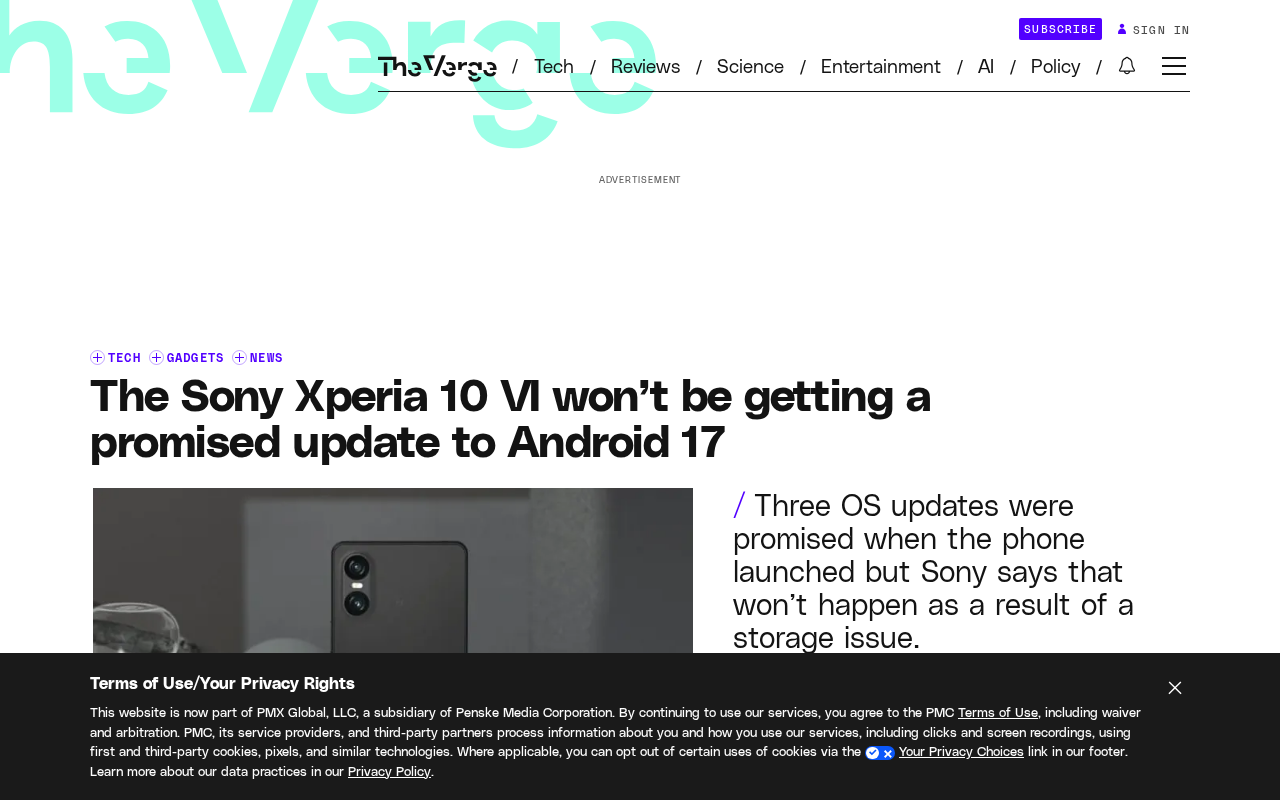
When the Sony Xperia 10 VI launched two years ago, it came with the Qualcomm Snapdragon 6 Gen 1 chip and Android 14, and Sony officially promised three major OS updates — including this year's Android 17. However, according to a recent notice on Sony UK's support page, this mid-range model will not receive the Android 17 upgrade.
For a mid-range phone that isn't exactly cheap, this decision directly undermines users' trust in Sony's system update commitments. At the time, "three major version updates" was one of Sony's key selling points at the launch event, but now it has become a bounced check that cannot be cashed.
Why Mid-Range Phones Often Get Shortchanged on Updates
Sony is not the only manufacturer cutting corners on system updates. Mid-range Android phones, constrained by cost, often find themselves at a disadvantage in terms of chipset platform support cycles and engineering resource allocation. Although the Snapdragon 6 Gen 1 is powerful enough for daily use, Qualcomm's long-term driver support for this platform is not as active as for flagship chips. Manufacturers need to invest significant manpower in adaptation and testing, and when mid-range models sell below expectations, prioritizing cutting updates for these devices becomes a "rational" business choice.
But the problem is that Sony explicitly promised three major version updates at the point of sale. Users made purchasing decisions based on this promise, and now that the promise has fallen through, the damage isn't just to the experience of Xperia 10 VI owners — it's to Sony's brand reputation.
Qualcomm's Snapdragon 6 Gen 1 is a mid-to-low-end mobile platform from Qualcomm, built on a 4nm process with a CPU architecture of 4 big cores + 4 small cores. Compared to the flagship Snapdragon 8 series, the 6 series typically has a shorter driver support cycle. Qualcomm's maintenance of Linux kernel and GPU drivers for mid-to-low-end chips often covers only a shorter period, and BSP (Board Support Package) updates are less frequent. This means that even if phone manufacturers are willing to invest resources, they may be limited by chipmakers ceasing to provide new kernel adaptations and unable to continue upgrading.
A major Android OS upgrade isn't as simple as changing the interface — it involves kernel version changes, HAL (Hardware Abstraction Layer) interface adjustments, Google's VTS/CTS compatibility testing, and re-adaptation of the manufacturer's own drivers. A complete system upgrade requires coordination among chipmakers, Google, and phone manufacturers, and any weak link can cause the project to stall. For mid-range models with limited sales, the adaptation cost per device is extremely high, so they often become the first to be abandoned.
The Real Impact on Users and the Market
Users who have already purchased the Xperia 10 VI will be stuck on Android 16 or earlier versions, unable to enjoy the new features and security improvements brought by Android 17. While security patches may continue for some time, the halt of major version updates means the system's underlying optimizations, privacy controls, and API levels will all fall behind.
From a market perspective, Sony's smartphone business is already in a state of contraction, and this move further weakens its competitiveness in the mid-range market. When manufacturers like Samsung and Google promise 4 to 7 years of updates for some mid-range models, Sony can't even deliver on its own promised three updates — consumers will naturally vote with their feet the next time they upgrade.
Android security updates fall into two categories: one is monthly or quarterly security patches, which mainly fix discovered vulnerabilities and are typically pushed selectively by manufacturers; the other is major version upgrades, which involve underlying changes to the Android Runtime (ART), permission model, privacy sandbox, notification mechanisms, and more. Halting major version updates means the device cannot receive new APIs and privacy enhancements that Google rolls out each year, such as the "Private Space" introduced in Android 15 and the Live Activities improvements in Android 16.
Additionally, Google Play Services will continue to update for a while, so some apps can still run. But once developers raise the minimum API level for their apps, devices stuck on older system versions will be unable to install or update these apps, and will gradually be marginalized within the ecosystem over the long term.
Do Manufacturer Promises Still Carry Any Weight?
This incident once again raises an old question: do phone manufacturers' system update promises actually have any binding force? In most countries and regions, system update promises do not constitute a legally enforceable obligation — they are more of a marketing talking point. It is very difficult for consumers to obtain compensation or a refund because a manufacturer didn't update the system.
For Sony, the cancellation of the Xperia 10 VI update may just be a small step in its smartphone business adjustments, but for the entire Android ecosystem, it's another depletion of trust in "update promises." When users find that promises can be broken at will, future manufacturers' claims of "X years of updates" will be far less convincing.
Currently, globally, most phone system update promises are voluntary corporate statements and do not constitute contract terms with enforceable force. The EU's recent Ecodesign Regulation requires manufacturers to provide a certain number of years of security updates and spare parts supply, but it mainly targets security patches rather than major version upgrades, and the specific implementation details are still being refined.
In the US and most Asian markets, if consumers sue because a manufacturer failed to honor an update promise, they typically need to prove that the promise formed part of the purchase contract and caused actual damages — which is extremely difficult. Therefore, the industry's common practice is to rely on brand reputation and market competition to constrain manufacturer behavior rather than legal enforcement. This also explains why manufacturers like Samsung and Google are willing to proactively promise longer update cycles — using it as a means of differentiated competition — while Sony's move this time is seen as a departure from this competitive trend.
One-line Summary
Sony's Xperia 10 VI fails to deliver on its three major version update promise, cancelling the Android 17 upgrade.
Paragraph Summary
When the Sony Xperia 10 VI launched, it promised three major OS updates including Android 17, but the latest notice on Sony UK's support page shows the model will not receive the Android 17 upgrade. The article points out that mid-range Android phones are often shortchanged on system updates by manufacturers due to short chipset platform support cycles, limited engineering resources, and lower-than-expected sales, and Sony is no exception. However, Sony explicitly promised three updates at the point of sale, and users made purchasing decisions based on that, so the broken promise directly damages brand reputation. This move also weakens Sony's competitiveness in the mid-range market — when rivals like Samsung and Google offer up to 4 to 7 years of updates, Sony can't even deliver on its own promises. System update promises lack legal binding force, but frequently breaking them will erode the entire Android ecosystem's trust in "update promises."
Related articles

WorkBuddy Full Tutorial: Build an AI Office Automation Agent from Scratch
A complete WorkBuddy tutorial: installation, three working modes, multimodal picture book video practice, expert team agent building, and workflow configuration for low-cost AI office automation.

WorkBuddy Agent Complete Guide: From Beginner to Automation in 7 Days
Based on Bilibili's 256-episode WorkBuddy masterclass, this systematically breaks down Tencent's AI office workbench core capabilities: Agent principles, Skill encapsulation, cross-platform connectors, scheduled automation, knowledge bases, and zero-code development, with learning path recommendations.

8 AI Accounts, 7 Failed: An Honest Review of Using AI to Get Work Done
Only 1 of 8 AI-run Bilibili accounts succeeded. We break down the real difference between "performing AI" and "using AI to get work done."