Sorting Algorithm Variants Explained: Semisort, Stable Partition, and K-th Smallest Selection

Exploring sorting variants like semisort, stable partition, and selection to unlock performance gains.
This article explores sorting algorithm variants that go beyond traditional full sorting: Semisort (grouping elements by key without ordering groups), Stable Partition (splitting elements while preserving order), and K-th smallest selection at three granularity levels. Understanding how relaxing constraints reduces computational cost helps engineers choose optimal strategies for real-world problems.
Introduction: Sorting Is Far More Than One Thing
When sorting comes up, most programmers immediately think of classic algorithms like quicksort or merge sort, all aimed at a single goal: arranging data in ascending (or descending) order. But in real-world engineering scenarios, what we actually need is often not "full sorting" — it's one of many "variations on the theme" of sorting.
A recent discussion on the Reddit tech community systematically outlined several variants of this classic problem. These variants might seem like "simplified versions" of sorting, but each has its own elegance — understanding them not only helps us write more efficient code but also deepens our grasp of algorithmic fundamentals.
Semisort: Grouping Over Ordering
What Is Semisort
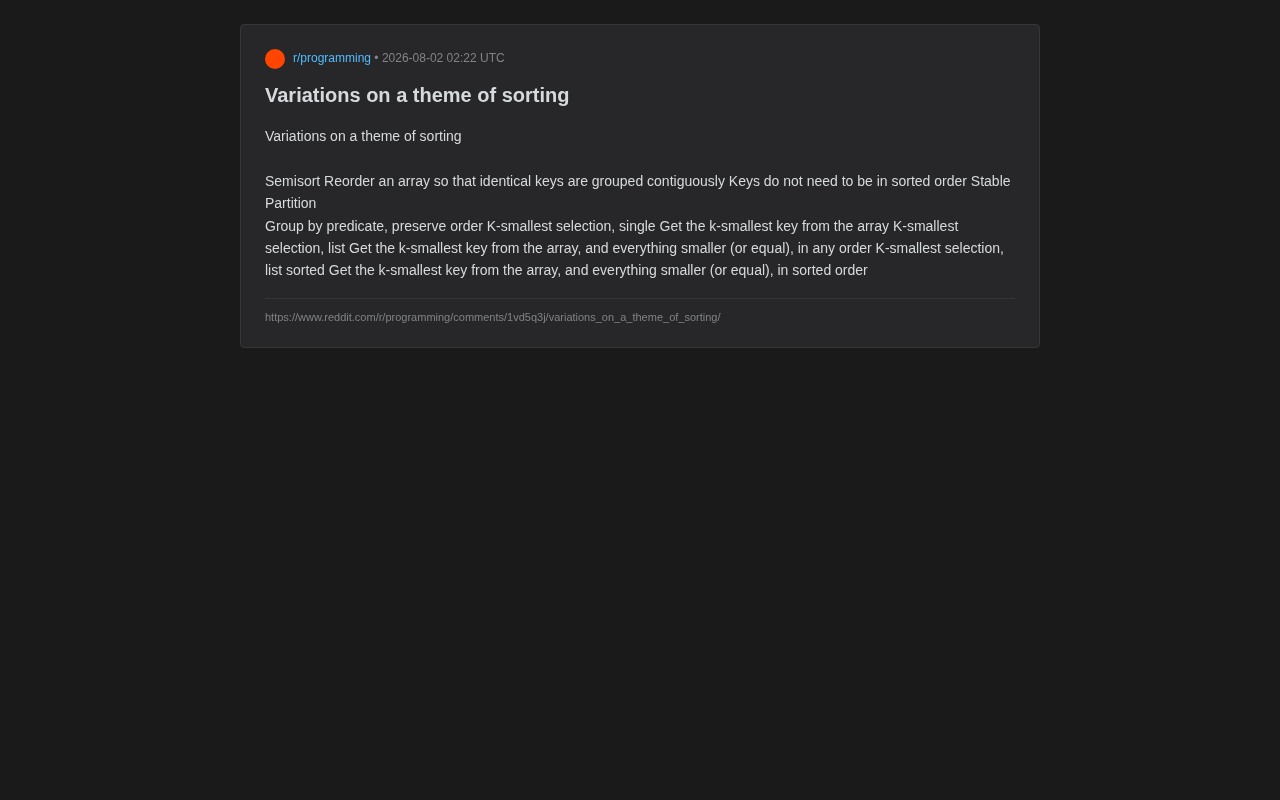
Semisort refers to: rearranging an array so that elements with the same key are physically contiguous, without requiring the keys themselves to be ordered.
In other words, if we have a dataset [3, 1, 3, 2, 1, 2], semisort only requires that all 3s are together, all 1s are together, and all 2s are together. For example, [3, 3, 1, 1, 2, 2] is a valid result, and the order of the groups relative to each other doesn't matter.
Why Semisort Is Useful
The value of semisort lies in: when we only care about "aggregation" rather than "ordering," it's less expensive than a full sort. Typical applications include data redistribution in parallel computing, GroupBy aggregation operations, and edge grouping in certain graph algorithms. By dropping the strong constraint of "keys must be ordered," semisort can employ hash-based strategies and, in many scenarios, achieve performance better than the O(n log n) of comparison-based sorting.
In large-scale parallel processing (such as GPU computing or distributed systems), semisort often serves as a critical intermediate step — it "gathers related data together," paving the way for subsequent reduction or aggregation operations.
Theoretical Background and Significance in Parallel Computing
Semisort has deep roots in theoretical computer science. The lower bound of traditional comparison-based sorting is O(n log n), a hard constraint from information theory — determining the total order of n elements requires at least log(n!) ≈ n log n comparisons. But semisort bypasses this limitation because it doesn't need to determine a total order; it only needs to cluster elements by key value. Within the framework of Radix Sort, if the key range is limited, semisort can be completed in O(n) time. Research published at SPAA (Symposium on Parallelism in Algorithms and Architectures) in 2022 showed that in parallel computing models, semisort's communication complexity can be significantly lower than that of full sorting. This has important implications for data redistribution in distributed systems — when data needs to be remapped from one set of processors to another, semisort provides a theoretically optimal communication scheme.
Stable Partition: Order-Preserving Binary Split
Definition and Characteristics of Stable Partition
The task of Stable Partition is: splitting elements into two groups based on a predicate while preserving the original relative order within each group.
The keyword here is "stable." An ordinary partition operation (like the partition in quicksort) only guarantees that "elements satisfying the condition are on one side, and those that don't are on the other," but the internal order of both groups may be scrambled. Stable partition additionally requires that among the elements satisfying the condition, and among those that don't, the original relative ordering from the source array is maintained.
Application Scenarios for Stable Partition
Stable partition is indispensable in scenarios requiring "filtering without disrupting order." For example, in a UI list, moving "completed" tasks to the bottom while keeping "in progress" tasks at the top, with each group still displayed in its original order. C++'s std::stable_partition is a direct implementation of this operation.
A notable detail: stability usually comes at an additional cost in space or time. Implementing stable partition under memory constraints is itself an interesting algorithmic challenge.
The Space Complexity Challenge of Stable Partition
A naive implementation of stable partition requires O(n) extra space — allocating a new array and placing elements satisfying and not satisfying the predicate separately. However, in embedded systems or memory-constrained environments, in-place stable partition with O(1) extra space becomes a classic hard problem. Known in-place stable partition algorithms (such as recursive methods based on block swaps) use only O(1) extra space but degrade to O(n log n) time complexity. In GCC's libstdc++ implementation, std::stable_partition first attempts to allocate a temporary buffer for O(n) time performance; if memory allocation fails, it falls back to the in-place O(n log n) version — demonstrating the dynamic trade-off between time and space in engineering practice. This "best effort" design philosophy is very common in standard library implementations and reminds us that algorithm selection is often not binary but dynamically adjusted based on runtime conditions.
The K-th Smallest Selection Problem: Three Levels of Granularity
Another major category of sorting variations is "K-smallest selection." The core of this family of problems is: we don't need to sort the entire array — we only care about the smallest elements. Depending on the precision required, this breaks down into three levels.
Single Selection: Just the K-th Smallest Element
The most basic version is "find the K-th smallest key in the array." This is the classic Selection Problem. Using the Quickselect algorithm, we can accomplish this in average O(n) time — much faster than the O(n log n) approach of fully sorting first and then taking the K-th element. This is extremely practical in scenarios like median calculation and percentile statistics.
Quickselect was proposed by Tony Hoare in 1961 and shares the same origin as quicksort but with a different goal. Its core idea is: after partitioning around a pivot, only recurse into the side containing the K-th element, completely discarding the other side. This makes the average-case work follow the recurrence T(n) = T(n/2) + O(n), which solves to O(n). However, the worst case remains O(n²) — degrading when pivot selection is extremely unbalanced. To address this, Blum, Floyd, Pratt, Rivest, and Tarjan proposed the famous Median of Medians algorithm in 1973, which guarantees worst-case O(n) selection by dividing the array into groups of 5 and using the median of medians as the pivot, though with a constant factor of about 5. In practice, Introselect (combining Quickselect and Median of Medians) is typically used to balance average performance and worst-case guarantees. C++'s std::nth_element employs this hybrid strategy.
List Selection: Get All K Smallest Elements
The advanced version is "find the K-th smallest key and all elements smaller than (or equal to) it, in any order." This is essentially a combination of "partition + selection": we split the array into "K smallest" and "the rest," but the internal order of the K smallest doesn't matter.
This variant is very common in Top-K queries, such as "find the 100 lowest-rated products" — we need to know which 100 they are, but don't care about their relative ranking.
Ordered List Selection: K Smallest in Sorted Order
The strictest version is "find the K-th smallest key and all smaller elements, with these elements arranged in order." This corresponds to "partial sort," and C++'s std::partial_sort serves exactly this purpose.
Its typical scenario is a "leaderboard": we need to select the top K entries and know their exact rankings. Implementation usually follows one of two strategies: the heap-based approach — build a max-heap from the first K elements, then scan the remaining elements, replacing the heap top and sifting down whenever a smaller element is found. The heap then contains the K smallest elements, and a final sort yields the ordered result, with total time complexity O(n log k). The alternative is "select then sort" — use Quickselect's approach to find the K-th smallest element and complete the partition (O(n)), then fully sort the first K elements (O(k log k)), totaling O(n + k log k). The latter is better when k is small, but the heap method has advantages in streaming data scenarios because it doesn't require random access to the entire array and can process arriving elements one by one.
Seeing the Essence of Sorting Through Its Variations
Fewer Constraints, More Room for Optimization
Looking at these variants together reveals a clear theme: every relaxed constraint opens a door to optimization.
- Full sorting requires "everything ordered" — cost is O(n log n);
- Partial sorting only requires "the first K ordered" — cost drops to O(n + k log k);
- The selection problem only requires "finding the K-th element" — cost further drops to O(n);
- Semisort doesn't even require "ordered," just "same keys adjacent" — enabling hash-based approaches that break through the comparison sort lower bound.
This progression has deep information-theoretic roots. The O(n log n) lower bound of comparison sorting stems from an elegant argument: n elements have n! possible permutations, each comparison eliminates at most half of the possibilities (gaining 1 bit of information), so at least log₂(n!) ≈ n log₂n - n/ln2 comparisons are needed to uniquely determine the permutation. This lower bound holds for all algorithms based on "pairwise comparison." But when we relax the problem constraints, the amount of information that needs to be determined decreases — the selection problem only needs to determine one element's rank (O(log n) bits), semisort only needs to determine which group each element belongs to — so the theoretical lower bound decreases accordingly. Non-comparison sorts (like counting sort and radix sort) bypass comparison sort limitations from another dimension by exploiting structural information about keys (such as having a bounded number of digits).
This reminds us: before writing a sort, first clarify "what do I actually need." The root cause of many performance issues is using the "sledgehammer" of full sorting to solve a problem that could have been handled by a lightweight variant.
Stability Is an Orthogonal Dimension
Another point worth remembering: "stability" is a dimension independent of "degree of sorting." Whether it's full sorting, partitioning, or grouping, each can require or not require stability. Stability brings more predictable behavior but usually comes with additional cost. In engineering practice, whether stability is needed should be based on business semantics rather than default choices.
Take databases as an example: when a user sorts a table already ordered by "creation time" and then re-sorts by "priority," if the sorting algorithm is stable, records within the same priority level remain ordered by creation time, providing a more consistent user experience. If unstable, the sort result might differ slightly each time, causing visual "jumping." This is why Python's built-in sort (Timsort) and JavaScript's Array.prototype.sort (using TimSort in the V8 engine) both chose stable sorting as their default behavior — for most application scenarios, the predictability that stability brings is more valuable than minor performance losses.
Conclusion
Sorting may seem like a thoroughly studied "old problem," but its variations remain active in every corner of modern software engineering — from Top-K queries in databases, to parallel aggregation on GPUs, to intelligent ordering in UI lists.
The significance of understanding these variants isn't about memorizing every API name — it's about cultivating a mindset of "precisely expressing requirements." When you can accurately say "what I need is a stable partition, not a full sort," you're one step closer to writing truly efficient code.
Key Takeaways
Related articles

MosMos: An AI Voice Writing Tool Built for the Entire Meeting Lifecycle
MosMos is an AI voice writing tool built for the full meeting lifecycle — ranked #2 on Product Hunt. It goes beyond dictation with style-aware drafting, a personal glossary, web search, speaker diarization, and structured meeting notes.

Getting Started with Claude Code: Capabilities and Installation Essentials for This AI Coding Assistant
Claude Code is Anthropic's AI coding agent that reads your full codebase, generates accurate code, and auto-debugs. Compare with Cursor, TRAE, Codex, plus key install requirements.

AINA: An AI Career Coach That Uses a Video Avatar to Uncover Your Job Search Blind Spots
AINA topped Product Hunt with its AI career coach that uses a video avatar to help job seekers find blind spots, polish their profile, and practice interviews.