SpaceX Plans First Starship Orbital Flight Attempt on September 22
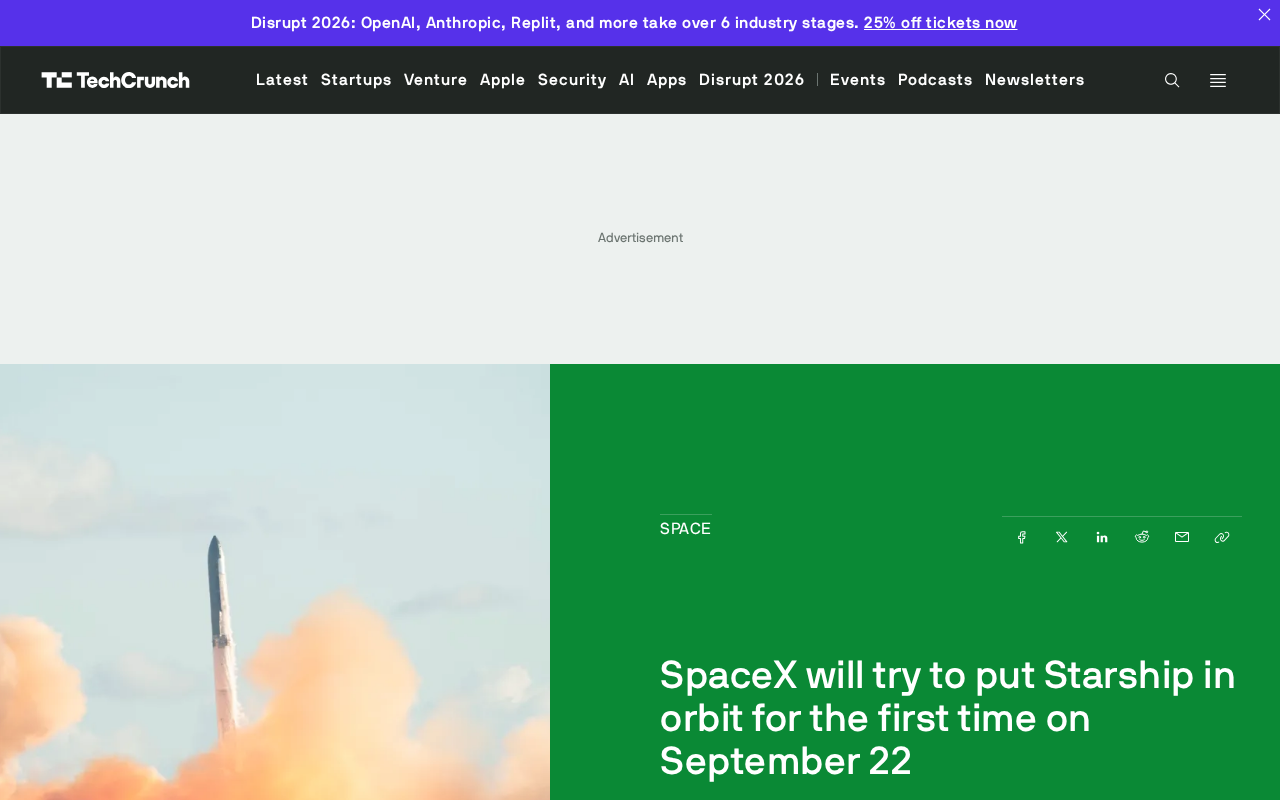
SpaceX targets September 22 for Starship's first orbital attempt, alongside first V3 Starlink satellite deployment.
SpaceX is planning Starship's first orbital flight attempt on September 22, a pivotal milestone for the world's most powerful rocket. Unlike previous suborbital tests, this mission requires reaching orbital velocity and sustaining Earth orbit — far greater demands on propulsion, thermal protection, and flight control. The mission will also attempt to deploy the first batch of V3 Starlink satellites, which offer significantly improved bandwidth and per-satellite performance. Starship's heavy-lift capacity aligns perfectly with Starlink's rapid expansion needs, enabling more and larger satellites per launch. Success would reinforce SpaceX's commercial spaceflight leadership, though technical uncertainty remains high for a first orbital attempt.
SpaceX Starship Eyes Its First Orbital Challenge
According to foreign media reports, SpaceX — the company led by Elon Musk — is planning to make its first orbital flight attempt with Starship on September 22. This marks a critical milestone in the development of what is currently the world's largest and most powerful launch vehicle. Previous Starship test flights have followed suborbital or sub-orbital trajectories; a successful orbital flight would represent a substantial step toward completing a full mission profile.
The difference between orbital and suborbital flight goes beyond altitude — an orbital flight requires the spacecraft to reach sufficient velocity to sustain a continuous orbit around Earth. This places far greater demands on the propulsion system, structural integrity, thermal protection, and flight control. For SpaceX, this is both a test of its iterative development approach over the years and a prerequisite for advancing future deep-space exploration and commercial missions.
The physical requirements of orbital versus suborbital flight are fundamentally different. Suborbital flight simply requires the rocket to loft a spacecraft to a certain altitude before it falls back to Earth. Orbital flight, by contrast, demands that the spacecraft reach approximately 7.9 km/s — the first cosmic velocity — at an altitude of roughly 200 km or more, balancing centrifugal force against gravity to sustain continuous orbit without falling back. Starship uses a two-stage architecture: the first stage, the Super Heavy booster, is equipped with 33 Raptor engines producing roughly 7,500 tonnes of sea-level thrust, while the second stage — the Starship spacecraft itself — carries 6 Raptor engines. Achieving orbital velocity requires precise coordination of stage separation, second-stage engine ignition, and overall trajectory control, making it technically far more demanding than any previous suborbital test.
Simultaneous Deployment of First V3 Starlink Satellites
Another highlight of this mission is that SpaceX will simultaneously attempt to deploy the first batch of third-generation (V3) Starlink satellites into its orbital internet constellation. V3 satellites are expected to offer significant improvements over previous generations in bandwidth capacity and per-satellite performance, representing an important upgrade to the Starlink network.
As the next-generation primary launch platform, Starship's high-capacity payload capability is purpose-built for the large-scale, high-density deployment that the Starlink constellation requires. Compared to the current model of launching satellites in batches via Falcon 9, a single Starship flight can carry more and larger satellites, substantially reducing per-satellite deployment costs and accelerating the pace of constellation buildout.
Starlink is SpaceX's low Earth orbit (LEO) satellite internet constellation, designed to provide high-speed, low-latency broadband access worldwide. First-generation (V1) satellites weighed approximately 260 kg; the V2 Mini variant launched on Falcon 9 weighs around 800 kg; and the full V3 satellites designed specifically for Starship are reported to potentially exceed 1 tonne each, featuring larger phased-array antennas and higher spectral efficiency. The Starlink constellation ultimately plans to deploy tens of thousands of satellites, and the dense deployment requirements make Starship's greater lift capacity indispensable. Starlink is already providing commercial service in multiple countries and regions, with a growing user base — the deployment of V3 satellites will directly raise the network's capacity ceiling.
A Single Mission Carrying Dual Significance
Combining a rocket's first orbital attempt with the deployment of a next-generation satellite constellation in one mission reflects SpaceX's characteristic philosophy of high-efficiency integration. Starship's orbital capability and Starlink's commercial expansion needs are tightly intertwined: Starship needs real payload missions to validate its launch capacity, while Starlink needs greater lift to scale rapidly.
From an industry perspective, a successful mission would further cement SpaceX's leading position in commercial spaceflight and provide additional data to support the commercial operation of reusable heavy-lift rockets. That said, as a first orbital attempt, the mission still carries considerable technical uncertainty, and the actual outcome will depend on in-flight performance.
Key Milestones to Watch
For readers following the progress of spaceflight, several key metrics are worth monitoring in this mission: whether Starship successfully achieves orbit, whether the V3 Starlink satellites are successfully deployed into their target orbits, and how each stage of the rocket performs throughout the flight. These data points will directly influence the pace of subsequent Starship mission scheduling.
It is worth noting that launch schedules are subject to adjustment due to weather, technical reviews, and other factors. All updates should be verified against the latest official information from SpaceX.
Related articles

LynnReal-Omni: 32B Unified Video Diffusion Model Goes Open Source with Multi-Task Coverage in Four Steps
LynnReal-Omni is a 32B unified video diffusion model on MiniMax H3, covering text-to-video, pose guidance, style transfer, restoration in 4 steps. Flash version generates 540p video in 377ms on one H100.

Anthropic Co-Founder: AI 'Kill Switch' May Need to Be Mandatory by Law
Anthropic's co-founder tells the BBC that AI 'kill switches' may need to be legally mandated. We analyze the industry logic, technical challenges, and the tension between regulation and innovation.

The AI Data Center Boom Is Colliding With Cities Scarred by Heavy Industry
The AI data center boom is clashing with post-industrial communities. Philadelphia's case reveals structural conflicts between AI growth, energy use, water, and environmental justice.