SparkyFitness: The Rise of an Open-Source, Self-Hosted Health Tracking App

SparkyFitness hits 4,500 users in its first year as a self-hosted, open-source alternative to commercial health apps.
SparkyFitness is an open-source, self-hosted health tracking platform designed to replace commercial apps like MyFitnessPal and Flo. In its first year, it attracted 4,500 users and 73 contributors. It covers nutrition, exercise, sleep, women's health, GLP-1 medication tracking, and integrates with Apple Health, Garmin, and dozens of other platforms — all with your data staying on your own server.
In a market dominated by commercial subscription-based health apps, an open-source project called SparkyFitness is quietly gaining ground. Built around self-hosting, it aims to replace mainstream apps like MyFitnessPal, Flo, Hevy, and Shotsy. The project recently celebrated its one-year anniversary, with its developer sharing an impressive milestone report on Reddit.
One Year In: 4,500 Users and 73 Contributors
Since its launch, SparkyFitness has attracted over 4,500 users and 73 contributing developers. Growth has been particularly strong recently — the project gained more than 1,000 GitHub stars in just the past month.
For an open-source project that started as a personal initiative and evolved into a "full-time passion project," that growth curve is remarkable. It reflects a genuine market need: users are increasingly frustrated with commercial health apps' privacy practices, subscription fees, and feature lock-ins — and are turning to self-hosted solutions that give them full control over their data.
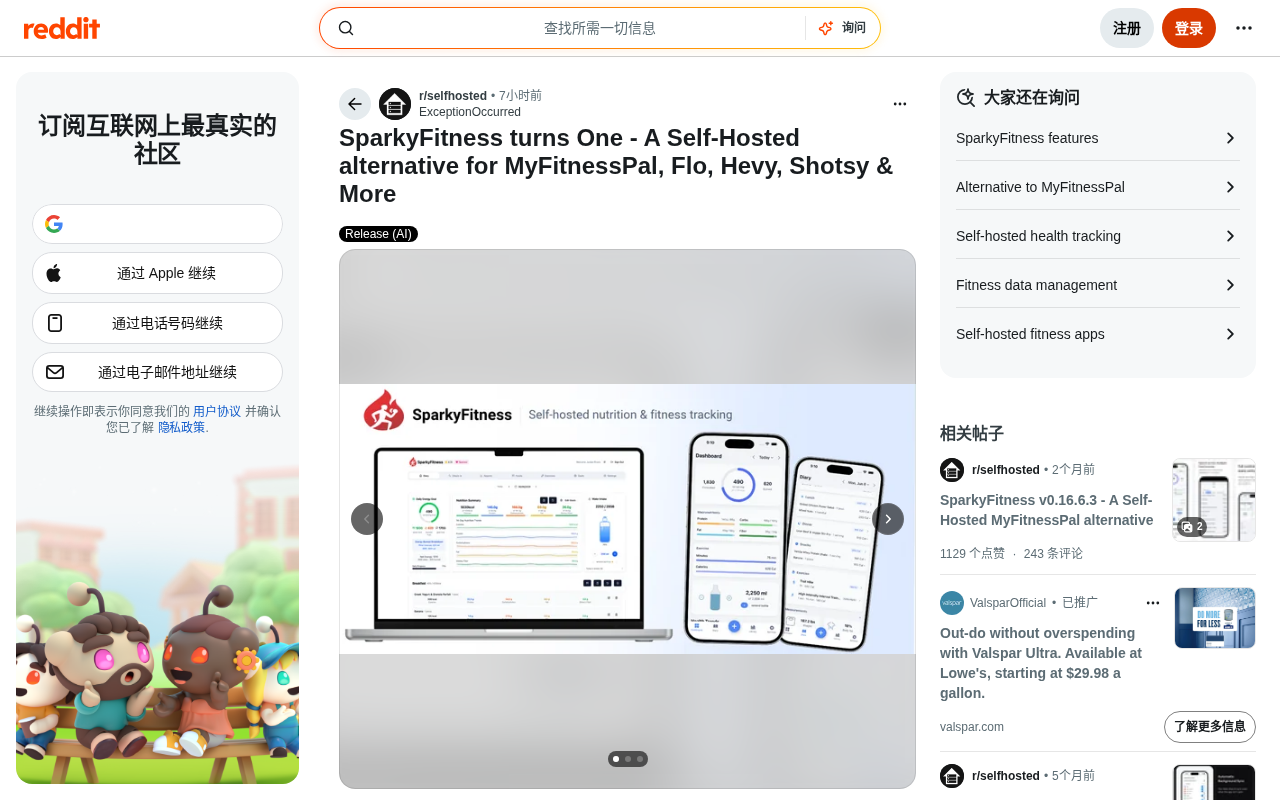
Why Self-Hosting Has Become a Core Demand
Self-hosting means deploying and running software on servers you control — whether that's a home NAS, a cloud VPS, or a local machine — rather than relying on third-party SaaS platforms. The movement grew out of widespread concerns about data sovereignty with cloud giants, and Docker's rise dramatically lowered the technical barrier to entry.
Released in 2013, Docker solved the classic "works on my machine" problem by packaging applications and their dependencies into standardized container images. Combined with Docker Compose, users can spin up a full application stack — database, backend, and frontend — in minutes with a single YAML file. This made server deployment accessible to technically-inclined users with basic Linux knowledge, not just professional sysadmins.
Before Docker, self-hosting was daunting: dependency hell, environment mismatches, and version conflicts kept most enthusiasts away. Low-cost ARM devices like the Raspberry Pi and visual container management tools like Portainer further reduced the cost of running a full service stack to just a few cents of electricity per month. Today, Reddit's r/selfhosted community has over 700,000 members, and the Awesome-Selfhosted project catalogs hundreds of open-source tools that can replace mainstream commercial services.
Health data is among the most sensitive personal information — covering weight, diet, sleep, menstrual cycles, and medication records. Entrusting this to commercial cloud services means accepting their privacy policies, data analytics practices, and advertising. Self-hosted health tracking keeps all data on your own server, fundamentally eliminating the risk of data breaches and misuse. This is SparkyFitness's core competitive differentiator.
The privacy risks of commercial health apps are not hypothetical. In the US, HIPAA primarily regulates healthcare providers and insurers — consumer health apps largely fall outside its scope, leaving health data as a commodity for data brokers. While the EU's GDPR classifies health data as a "special category" requiring higher compliance standards, enforcement varies by country. In 2021, the FTC investigated women's health app Flo for allegedly sharing menstrual data with Facebook and Google without adequate user disclosure. After the US Supreme Court overturned Roe v. Wade in 2022, the privacy of period-tracking app data became a politically charged issue. MyFitnessPal suffered a data breach in 2018, exposing approximately 150 million user accounts. These incidents have fueled awareness of data ownership and driven interest in self-hosted health tools.
Feature Overview: Far Beyond Calorie Counting
SparkyFitness's ambition goes well beyond replacing any single app — it aims to be a comprehensive, all-in-one health management hub. Its feature set is extensive:
- Core tracking: nutrition, exercise, hydration, sleep, fasting, mood, and body measurements;
- Specialized health: menstrual cycle tracking, pregnancy management, medication management, and the recently added GLP-1 weight loss medication tracking;
- Goals and reporting: goal setting, daily check-ins, interactive charts, and long-term trend analysis;
- Multi-user support: multiple user profiles and family member access for household health management;
- AI capabilities: built-in AI chatbot and MCP Server (Model Context Protocol server).
The addition of GLP-1 medication tracking feels particularly timely. GLP-1 (glucagon-like peptide-1) receptor agonists are among the most talked-about drug classes for weight loss and diabetes management, with key drugs including Novo Nordisk's semaglutide (Ozempic/Wegovy) and Eli Lilly's tirzepatide (Mounjaro). Semaglutide alone generated over $21 billion in global sales in 2023, and explosive demand has created corresponding needs for digital management tools.
GLP-1 receptor agonists were originally approved for type 2 diabetes. Their weight-loss mechanism involves mimicking the body's natural GLP-1 hormone: suppressing glucagon secretion, stimulating insulin release, slowing gastric emptying, and acting on hypothalamic appetite centers to induce satiety. Clinical trials show semaglutide can achieve roughly 15% average weight loss. However, these treatments typically last months to years and involve complex dose-escalation protocols (e.g., gradually increasing from 0.25mg to 2.4mg). Users need to systematically log injection sites (rotating between abdomen, thigh, and upper arm to avoid lipohypertrophy), weekly weight changes, and side effects like nausea and vomiting. This type of compound management need is almost entirely absent from traditional health apps — making SparkyFitness's dedicated feature a timely addition.
Also worth highlighting is the built-in MCP Server. MCP (Model Context Protocol) is an open standard released by Anthropic in late 2024, conceptually analogous to LSP (Language Server Protocol) in programming ecosystems — it provides a standardized interface for AI models to connect to any external data source without custom integrations for each use case. MCP uses a client-server architecture: the MCP Server exposes local data (like SparkyFitness health records) to AI models in a standardized format, while MCP Clients (typically AI assistant interfaces) call these capabilities via JSON-RPC.
From a broader perspective, MCP addresses the longstanding "last mile" problem in AI application development: previously, integrating AI models with external data sources required custom plugins or connectors for every scenario. MCP unifies this through three layers of abstraction — Tool Use, Resources, and Prompts. Since its open-source release in late 2024, MCP has gained native support in Cursor, Zed, Continue, and other leading AI editors, with AI vendors beyond Anthropic increasingly following suit.
For SparkyFitness, the built-in MCP Server means user health data can serve as real-time context for any MCP-compatible AI client — enabling natural language queries like "analyze my nutritional intake trends this month" or "give me advice based on my sleep data." This open architecture avoids lock-in to a single AI vendor and signals a shift from passive data recording toward active intelligent assistance.
Security: The Non-Negotiable Foundation for Self-Hosted Services
For authentication, the project supports OIDC, TOTP, Passkey, and MFA. OIDC (OpenID Connect) is an authentication protocol built on OAuth 2.0 that lets users sign in with existing identity providers like Google or GitHub. TOTP (Time-based One-Time Password) is the RFC 6238 standard used by apps like Google Authenticator, generating a six-digit code every 30 seconds from a shared secret and timestamp. Passkey is the consumer-facing implementation of FIDO2/WebAuthn, replacing passwords with device biometrics like fingerprint or face recognition — co-promoted by Apple, Google, and Microsoft. MFA combines these mechanisms into a layered security strategy. Together, these form a defense-in-depth approach well-suited for self-hosted services exposed to the public internet.
Ecosystem Integration: Breaking Down Health Data Silos
SparkyFitness's real moat may be its extensive data integration capabilities. Rather than asking users to abandon their existing devices and services, it acts as a data aggregation hub, syncing from multiple platforms:
- Health platforms: Apple Health (iOS), Google Health Connect (Android), Google Health API;
- Wearables: Garmin Connect, Withings, Polar Flow, Fitbit (being phased out as Google Health API takes over);
- Fitness and nutrition sources: Strava, Hevy, OpenFoodFacts, USDA, FatSecret, Nutritionix, Mealie, Tandoor, Yazio, Wger, Free Exercise DB, and more.
Apple Health (HealthKit) and Google Health Connect both function as on-device health data "buses." HealthKit, introduced in iOS 8 (2014), maintains an encrypted on-device health data store where third-party apps must obtain granular user permission to read or write specific data types like step count, heart rate, or sleep stages. Google Health Connect, launched in 2022, is Google's rebuilt unified health data layer, also running locally on-device. Crucially, neither routes data through developer servers, maximizing user privacy. By integrating with these two aggregation layers, SparkyFitness can access standardized data accumulated across dozens of health apps without needing to individually connect to each vendor's proprietary API.
The wearable device API ecosystem remains highly fragmented, with vendors often building closed ecosystems to protect commercial interests. Garmin offers a relatively mature Connect IQ platform and developer API; Withings has tightened API access multiple times; Apple HealthKit maintains a privacy-first stance keeping data on-device. Fitbit has announced it will gradually migrate its API capabilities to Google Health API — a shift reflecting Google's platform consolidation strategy post-acquisition — which is why SparkyFitness has labeled it as "being phased out." The ever-changing API access policies of these platforms represent ongoing technical debt for projects like SparkyFitness.
On the nutrition database side, OpenFoodFacts is a community-maintained open database containing over 3 million food barcodes and nutritional data from 180+ countries, released under the Open Database License (ODbL). USDA FoodData Central provides official standardized nutritional reference data from the US Department of Agriculture. Both offer free API access and are the go-to data sources for open-source nutrition tracking apps.
This broad integration strategy lets users consolidate health data scattered across a dozen apps into a single platform they control — fundamentally breaking down the data silos between commercial applications.
Noteably, the developer honestly flags the status of some integrations — Strava as "partially tested," Hevy as "untested," and Yazio as using an "unofficial API." This transparency is particularly valuable in open-source projects, helping users set appropriate expectations.
What's Next: Community-Driven Mobile Workout Module
Another key purpose of the developer's post was to gather community feedback on an upcoming mobile workout and training module. The developer shared completed UI mockups and explicitly stated wanting to build the feature "exactly the way users need it."
This "community-driven development" philosophy is what fundamentally distinguishes open-source projects from commercial products. Users aren't just consumers — they're co-decision-makers on product direction. The developer directed the community to GitHub Discussions to submit suggestions, handing feature planning back to the actual users.
Opportunities and Real Barriers in Self-Hosted Health Tools
SparkyFitness's growth story reflects the broader flourishing of the self-hosted software ecosystem. This ecosystem has developed a substantial toolset: Nextcloud for file storage and collaboration, Immich for photo management, Jellyfin as a streaming alternative, Bitwarden/Vaultwarden for password management, and Paperless-ngx for document archiving.
Health management was previously one of the weaker areas in this ecosystem. Before SparkyFitness, open-source health tracking was fragmented: Waistline focused solely on calorie counting; OpenScale handled only scale data; Habitica gamified habit tracking but lacked deep health data support; wger offered fitness plans but had a weak nutrition module. No single project attempted to build a unified platform covering nutrition, exercise, sleep, women's health, and medication management. SparkyFitness's breadth of coverage positions it to potentially become the "Nextcloud moment" for health — a sufficiently complete project that can anchor mainstream user migration.
However, the long-term sustainability of open-source health software deserves serious consideration. Unlike code editors or developer tools, health apps hold years of accumulated sensitive personal data — an abandoned project could leave users with data silos or unpatched security vulnerabilities. Common commercialization paths for open-source projects include hosted SaaS tiers, enterprise licensing, donation/sponsorship models (e.g., Open Collective), and dual licensing. Successful examples include Bitwarden achieving commercial sustainability through enterprise and hosted offerings, and Nextcloud building its business model around enterprise support contracts. SparkyFitness currently operates as a "full-time passion project," which ensures high-quality iteration in the short term, but long-term governance structure and economic sustainability remain open questions — factors that should matter as much as feature richness when choosing a self-hosted solution.
Challenges remain. Self-hosting requires technical capability to deploy and maintain servers; mobile experience still lags behind commercial apps; and integration stability depends on upstream platform API policies. But for privacy-conscious users who enjoy tinkering, SparkyFitness is a serious option worth considering.
Summary
In one year, SparkyFitness grew from zero to 4,500 users, 73 contributors, and over 1,000 new GitHub stars in a single month. It has proven the market potential for open-source health tools. More than just an alternative to commercial apps, it represents a philosophy of data ownership — the belief that users have the right to full control over their most private health information. For those tired of subscription fees and privacy compromises, this is a direction worth watching. Interested readers can explore the GitHub repository directly.
Related articles

Gaussian Process Bandit Optimization: Exploration Strategies and Inference Regret Guarantees
Cumulative regret guarantees in Bayesian optimization fail to reflect final recommendation quality. This article examines a new study that provides inference regret guarantees for Gaussian process bandit optimization through exploration query strategies and fill distance analysis, validated on hyperparameter optimization and control tasks.

The Most Detailed Codex Guide on Bilibili: From Installation to Real-World Practice
The most detailed Codex guide on Bilibili: from app store installation to daily work mode configuration, with a real coffee shop project demonstrating file organization, data extraction, dashboard creation, and other practical tasks. Learn to use Plan Mode and desktop pets to leverage Codex efficiently.

Appearance Compensation in Volume Rendering: Why RGB Accuracy Cannot Guarantee Density Correctness
Volume rendering research reveals that volumetric data perfectly reproducing external RGB views may still contain density errors: appearance compensation can double central density and keep external rays unchanged even when L2 error exceeds 14.52%. Density recovery depends on appearance capacity, spatial resolution, and measurement design.