SpeakON Agent: Driving Agents with Natural Voice to Get Real Work Done

SpeakON Agent uses natural voice to drive Agents, balancing automation and control through Action review and confirmation.
SpeakON Agent is an AI Agent product that ranked third on Product Hunt, focused on turning natural voice into real work. Its chain covers voice understanding, Notes context access, tool connection, and Action generation, with the core design that the Agent prepares Actions for user review and confirmation instead of executing directly. The article analyzes voice as a work entry point and the tradeoffs of the confirmation step.
In an increasingly crowded AI Agent landscape, most products remain stuck in the "input box + workflow" interaction paradigm. SpeakON Agent, which ranked third on Product Hunt, tries a different approach: letting users express intent the way they speak in everyday life, with the Agent understanding context, connecting tools, and generating reviewable, confirmable Actions to complete tasks.
Designing the chain from "speaking" to "doing"
SpeakON Agent positions itself as turning "natural voice into real work." According to its Product Hunt page, it can understand the user's Notes, connect to the tools the user already uses, and prepare Actions for the user to review and confirm.
This chain has three key stages:
- Voice understanding: not simple speech-to-text, but converting vague spoken expressions into structured intent;
- Context access: reading Notes so the Agent knows what the user is doing and what they left behind previously;
- Tool connection and Action generation: calling external tools and producing operation items pending confirmation.
What's interesting is the design of the final stage: the Agent doesn't execute directly but rather "prepares Actions for you to review and confirm." This addresses, to some extent, the most criticized problem with current Agent products—the uncontrollable risk that comes with automatic execution.
Structured intent refers to parsing vague, elliptical, context-dependent spoken statements (such as "send that thing from earlier to Old Wang") into machine-parseable field combinations, typically including action type, target object, parameters, and constraints. The difference from plain speech-to-text is that transcription only restores literal content, whereas structured intent must combine conversation history, user notes, and entity recognition to fill in unstated references and temporal information in speech, outputting a task description that can be directly consumed by the tool invocation layer. The quality of this step directly determines whether subsequent Action generation is accurate, and it is also the technical threshold that distinguishes voice Agents from voice assistants.
Notes context access typically manifests in engineering as a combination of retrieval-augmented generation (RAG) and memory mechanisms: the Agent retrieves snippets relevant to the current intent from the user's notes and history, injecting them into the model as prompt context so it understands "what the user is doing." Unlike general-purpose chatbots, these products need to handle cross-session long-term memory and privacy boundaries, and the relevance of context selection directly affects the accuracy of intent understanding.
Why "voice + Agent" is worth watching
Voice interaction is not a new concept, but over the past few years it has mostly remained in shallow assistant scenarios (checking the weather, setting alarms, playing music). Only once underlying models gained task planning and tool-calling capabilities did voice truly have the potential to become a "work entry point."
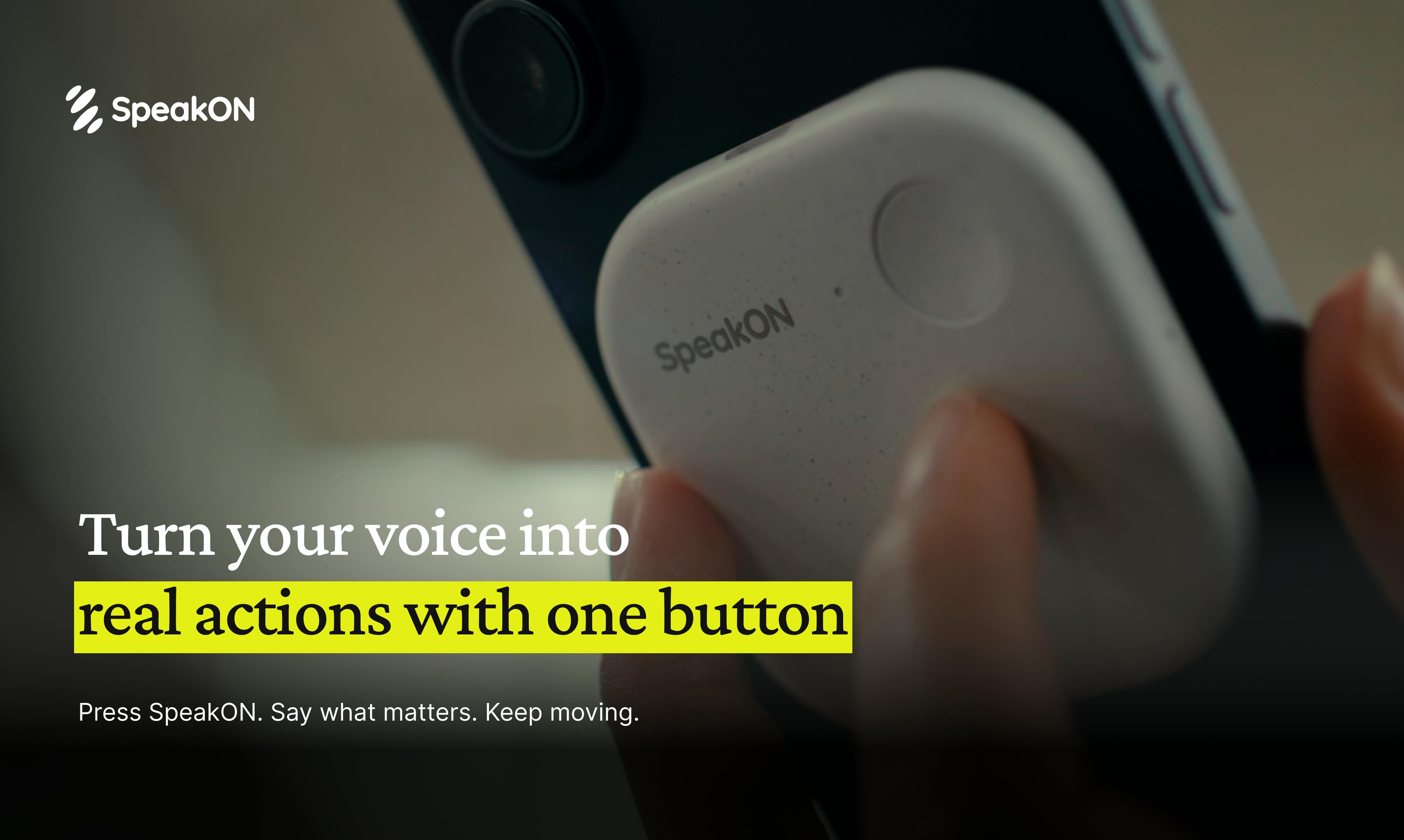
SpeakON Agent targets productivity scenarios rather than entertainment or information queries. This aligns with its Product Hunt categories (Productivity, Hardware, Artificial Intelligence)—the Hardware tag suggests the product may be combined with a specific hardware form factor, but the original material did not disclose details, so its hardware form and usage cannot yet be confirmed.
The value of voice as an input method lies in lowering the cost of expression. For users who are on the move, have their hands full, or simply don't want to type, saying a sentence is far more natural than opening an app, finding the input box, and composing a prompt.
Review-and-confirm mechanism: a realistic compromise for Agent deployment
SpeakON Agent explicitly writes "review and confirm" into its product description. This choice reveals the team's judgment about Agent reliability: as long as models cannot fully guarantee correct actions, "human gatekeeping" in human-AI collaboration remains necessary.
This design has a dual effect on experience. The benefit is that users retain control, especially when operations involve sending messages, modifying documents, or calling business systems, where the cost of mistaken execution is high; the cost is that the flow is split into multiple steps, and the "seamless" feel of voice input is interrupted by the confirmation step.
How to make the confirmation step sufficiently lightweight is key to whether such products can retain users. The material does not provide details of the confirmation interface, so its interaction efficiency cannot be evaluated.
Human-in-the-loop is a pattern in AI system design where humans intervene in decisions at key points, commonly seen in high-risk automation scenarios. In the Agent context, it typically takes the form of a three-stage "propose—review—execute": the model only generates a draft action to be executed, and tools are actually invoked only after user confirmation. This pattern is the opposite of "fully automatic execution"; the cost is additional interaction rounds, and the benefit is reducing irreversible consequences of mistaken operations. It is also a common engineering compromise for current Agent products at a stage where reliability is insufficient.
Market feedback and competitive position
On Product Hunt, SpeakON Agent received 139 votes and 16 comments, ranking third for the day. This result shows the product gained community attention at its launch moment, but the vote and comment counts also indicate it is still at an early stage and has not yet generated large-scale discussion.
From a competitive standpoint, combining voice input with Agent execution is becoming a direction explored by multiple teams. SpeakON Agent's differentiation is not in speech recognition itself but in the entire chain of "Notes understanding + tool connection + Action review." Whether this chain can be polished to be smooth enough determines whether it is a "voice version of a to-do tool" or a true Agent workbench.
Takeaways for practitioners
SpeakON Agent offers an observation sample: the interaction entry point for Agent products is expanding beyond the text box. Voice is one such entry point, but the core proposition is the same—how to obtain the maximum understanding of intent and context from the Agent with minimal user input.
At the same time, the "Action preparation + human confirmation" model is worth referencing by more teams. It preserves the efficiency of automation while providing a buffer for errors. At a stage when Agent reliability has not yet earned unconditional trust, this compromise may win over users more effectively than pursuing full automation.
The product's ultimate success still depends on execution quality: the accuracy of speech recognition, the depth of Notes understanding, the breadth of tool connections, and the convenience of the confirmation step. Public data supporting these dimensions is currently lacking, and validation must wait for feedback from actual use.
One-line Summary
SpeakON Agent drives Agents with natural voice, using an Action review-and-confirm mechanism to balance automation and controllability.
Paragraph Summary
SpeakON Agent is an AI Agent product that ranked third on Product Hunt for the day, focused on turning natural voice into real work. Its chain includes voice understanding, Notes context access, and tool connection and Action generation. The core design is that the Agent does not execute directly but prepares Actions for user review and confirmation, addressing the pain point of uncontrollable automatic execution. The article analyzes the value of voice as a work entry point in lowering expression costs, and also notes that the confirmation step may interrupt interaction fluidity; the product's success depends on whether the confirmation interface is sufficiently lightweight. The product received 139 votes and 16 comments and is at an early stage of attention; its categories include a Hardware tag, but the hardware form factor is not disclosed.
Related articles

AI Comic Drama with WorkBuddy from Scratch: A Step-by-Step Skill Pack Installation Guide
Learn how to create AI comic dramas with WorkBuddy from scratch. This guide covers installation, Skill pack import and invocation, plus a script generation demo with manual revision tips to get you through the first step from script to storyboard.

WorkBuddy Agent Runs the Entire GEO Database Mining Pipeline with a Single Prompt
WorkBuddy agent automates GEO database mining: from data search and curation to batch correction, differential analysis, co-expression networks, feature gene screening, and immune infiltration—a single prompt generates a complete bioinformatics report, greatly lowering the barrier to bioinformatics analysis.

PC Memory Wasted? Hacker News Debates Centralized Data Centers
Hacker News users argue that personal computer memory is wasted and should be centralized in data centers, sparking debate on centralized vs. distributed computing resource allocation. This article analyzes the logic behind the claim, the costs of centralization, and new tensions in memory resource allocation in the AI era.