SpecOpt: An Agentic Framework for Optimizing Drug Molecule Target Specificity

SpecOpt uses residue-aware contact analysis and LLM reasoning to systematically improve the target specificity of existing drugs.
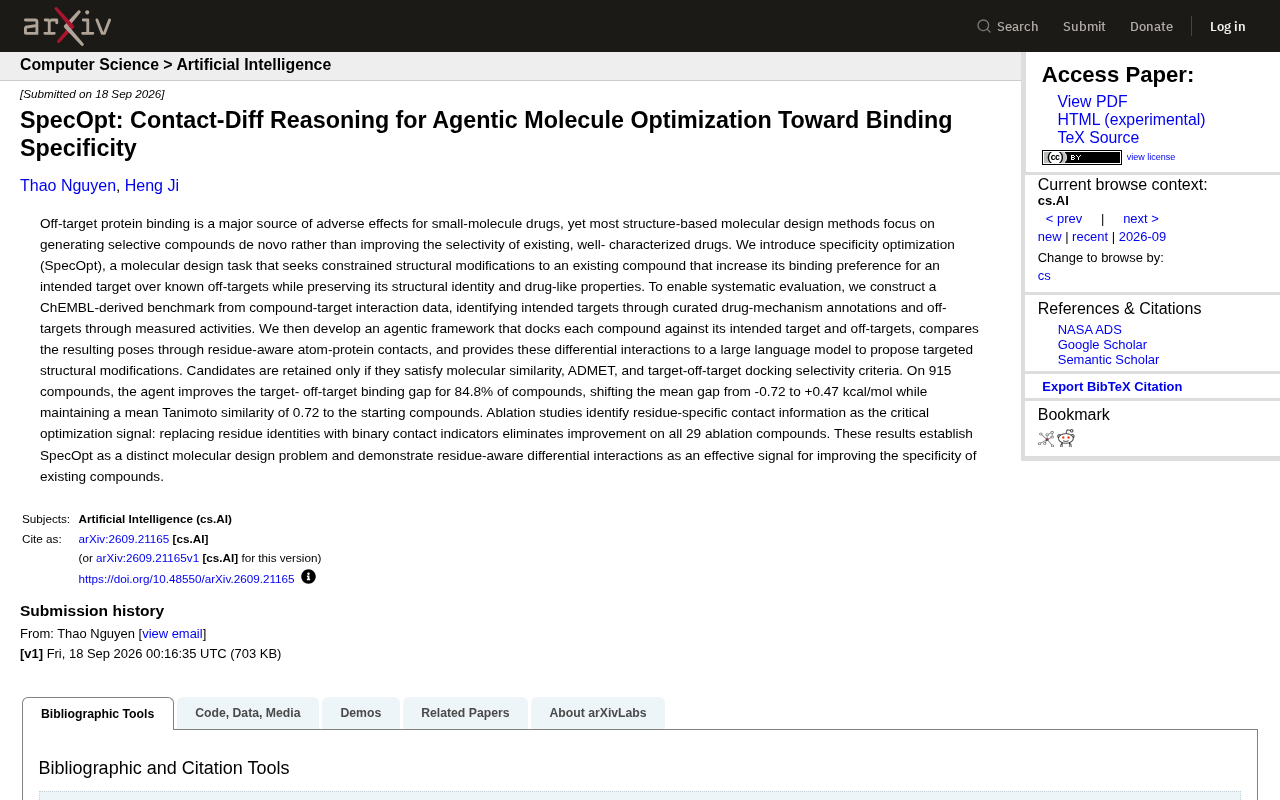
SpecOpt is an AI agentic framework specifically designed to improve the target specificity of existing drugs, filling a methodological gap beyond de novo molecular design. Its core pipeline docks compounds to both intended targets and off-targets, extracts residue-aware differential contact information, feeds this into an LLM to generate targeted structural modifications, and filters candidates by molecular similarity, ADMET properties, and docking selectivity. Tested on 915 ChEMBL compounds, 84.8% showed improved target-vs-off-target binding gaps (average shift from -0.72 to +0.47 kcal/mol) while maintaining an average Tanimoto similarity of 0.72. Ablation studies confirm that residue-specific contact information is the decisive signal — removing it eliminated improvements across all 29 test compounds.
Off-target binding of small-molecule drugs is one of the leading causes of adverse effects. Traditional structure-guided molecular design methods tend to focus on de novo generation of entirely new selective compounds, overlooking a more practical challenge: how to improve a mature drug's binding preference for its intended target while preserving its structural identity. A new paper on arXiv introduces the SpecOpt framework as a systematic exploration of exactly this gap.
What Is Specificity Optimization (SpecOpt)?
SpecOpt (specificity optimization) is defined as a novel molecular design task: applying constrained structural modifications to existing compounds so that they preferentially bind to an intended target over known off-target proteins, while retaining their original structural characteristics and drug-like properties.
This stands in sharp contrast to mainstream approaches. Most existing methods focus on generating entirely new selective molecules, whereas SpecOpt focuses on improving well-characterized existing drugs. This shift has clear practical implications — making incremental refinements to drugs with known safety and pharmacokinetic profiles carries far less risk and cost than developing entirely new molecules from scratch.
Benchmark Dataset and Evaluation Framework
To enable systematic evaluation of this task, the researchers constructed a dedicated benchmark using compound–target interaction data from ChEMBL. Intended targets were identified through curated drug-mechanism annotations, while off-target proteins were determined from experimentally measured activity data.
The value of this data construction approach lies in transforming "specificity" from an abstract concept into a quantifiable, reproducible evaluation standard. Only with a well-defined list of intended targets and off-targets can one meaningfully measure whether a given modification achieves greater selectivity.
ChEMBL is a large open bioactivity database maintained by the European Bioinformatics Institute (EMBL-EBI), containing experimental binding activity data (primarily in the form of IC₅₀, Ki, Kd, etc.) for over 2.3 million compounds across more than 10,000 targets. Its drug mechanism annotation module specifically curates the primary targets and modes of action for approved drugs, with data subject to manual review for high reliability. Using this module to identify intended targets — combined with raw activity data to confirm off-target proteins — yields a benchmark that is both biologically meaningful and large-scale reproducible. This approach of combining public databases with mechanism annotations also provides a scalable foundation for future research to validate the SpecOpt method more broadly.
How the Agentic Framework Works
The core of SpecOpt is an agentic framework whose workflow can be broken down into several key steps:
Docking and Pose Comparison
The framework first docks each compound to both its intended target and its off-target protein, then compares the resulting binding poses through residue-aware atom-protein contacts. This step generates differential interaction information — specifically, the differences in contact patterns between the compound's binding at the intended target versus the off-target protein.
Molecular docking is one of the core techniques in computational chemistry, used to predict the three-dimensional binding conformation of a small-molecule ligand with a protein receptor and estimate binding energy. Docking programs typically search through the ligand's rotational, translational, and conformational degrees of freedom within the protein binding pocket to find the lowest-energy binding pose, scoring these poses using estimated binding free energy (in kcal/mol) — more negative values indicate stronger predicted binding. Residue-aware atom-protein contact analysis goes a step further: it not only records whether a ligand atom contacts the protein, but specifically annotates which amino acid residue is involved (e.g., Asp189, His57). This level of detail is critical for identifying differences in binding between the intended target and off-target proteins — two proteins may have similar pocket geometries, yet the chemical properties of key residues (charge, hydrophobicity, hydrogen bond donors/acceptors) often differ subtly, and these differences are precisely where specificity optimization can intervene.
LLM-Driven Structural Modification
These differential interactions are then provided to a large language model (LLM), which proposes targeted structural modification suggestions. In other words, the LLM serves as a "chemical reasoning engine," using contact differences to determine where and how to modify the molecule.
Multi-Filter Quality Control
Not all generated candidate molecules are retained — only those satisfying three criteria simultaneously are accepted: molecular similarity, ADMET (absorption, distribution, metabolism, excretion, toxicity) properties, and target-versus-off-target docking selectivity. This filtering mechanism ensures that optimized molecules improve specificity without drifting too far from the original drug or losing drug-likeness.
Tanimoto similarity (also known as the Jaccard coefficient) is the most widely used molecular similarity measure in cheminformatics, calculated based on molecular fingerprints. Molecular fingerprints encode a compound's structural features as binary bit strings; the Tanimoto coefficient equals the number of bits that are "1" in both fingerprints divided by the total number of bits that are "1" in at least one fingerprint, ranging from 0 to 1. A Tanimoto score ≥ 0.85 is generally considered highly similar, while ≥ 0.7 indicates that the core scaffold is largely preserved. ADMET is a comprehensive framework for evaluating drug-likeness of candidate molecules, covering oral absorption, tissue distribution, metabolic stability, excretion rate, and toxicity prediction. Simultaneously assessing ADMET during lead optimization effectively avoids the common pitfall of "improving selectivity at the cost of pharmacokinetics," and is an important quality control step in modern AI-assisted drug design.
Results: 84.8% of Compounds Show Improvement
On a test set of 915 compounds, the SpecOpt agent improved the target-versus-off-target binding gap for 84.8% of compounds. In concrete terms, the average binding gap improved from -0.72 kcal/mol to +0.47 kcal/mol — the shift from negative to positive means the molecule's binding preference shifted from favoring the off-target to favoring the intended target.
Notably, this improvement was achieved while maintaining an average Tanimoto similarity of 0.72 between optimized molecules and their starting compounds. This demonstrates that modifications are restrained, preserving the parent molecule's core scaffold in keeping with the "maintain structural identity" design principle.
Ablation Studies Reveal the Key Signal
The most illuminating findings in the paper come from ablation studies. The researchers investigated exactly what information drives the optimization effect, with the conclusion pointing squarely to residue-specific contact information.
When specific residue identities were replaced with binary contact indicators (i.e., only marking "contact present or absent" without identifying which residue), the improvement effect completely disappeared across all 29 ablation compounds. This controlled comparison clearly demonstrates that the LLM needs to know exactly which residues the molecule interacts with in order to make meaningful structural judgments. Simply knowing that "a contact exists" is far from sufficient.
Significance and Outlook
SpecOpt's contribution can be understood on two levels. First, it establishes "improving the specificity of existing drugs" as an independent molecular design problem, filling a gap beyond de novo design. Second, it demonstrates that residue-aware differential interactions are an effective signal for improving compound specificity, providing a clear methodological direction for future research.
Combining structural docking, contact analysis, and LLM reasoning into an agentic pipeline also represents an increasingly common paradigm for AI in drug design — one where LLMs don't generate molecules from nothing, but instead reason based on structured physicochemical evidence. For pharmaceutical R&D, tools capable of making precise improvements to known drugs may ultimately prove more practically valuable than pursuing entirely new molecular entities.
Related articles

Automate Job Search with AI Agents and Residential Proxies for Precise Matching
Build an AI Agent with MCP and residential proxies to bypass recruitment site anti-scraping and geo-restrictions, scrape thousands of DevOps jobs, then have Claude score and rank each against your resume. Includes proxy comparison experiments, project structure, and cost analysis—filtering only, no auto-submission.

The AI Task Assistant That Knows When to Back Off: A Cure for Activation Struggles
One Small Step is an AI assistant for task initiation struggles, using agentic decisions for guilt-free reminders, timely retreat, and cross-platform task management. The developer shares real test results on 13 tasks and architectural trade-offs.

FastAPI: A High-Performance Python Framework and a Production-Ready API Development Powerhouse
FastAPI is a high-performance web framework based on Python type hints, supporting async and automatic OpenAPI docs. With over 100k GitHub stars, this article analyzes its core strengths, production readiness, and selection advice.