Speechka: Real-Time Voice Translation in 44 Languages — Using Your Own Voice
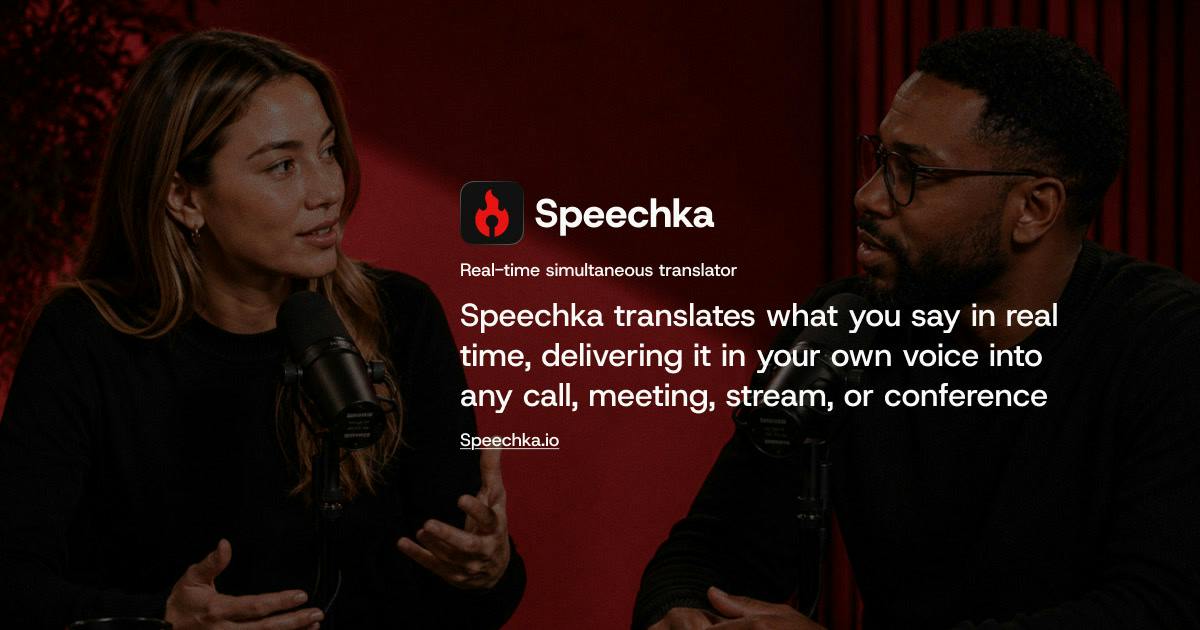
Speechka translates your speech into 44 languages in real time — using your own voice.
Speechka is a real-time voice translation tool that recently launched on Product Hunt. Its key differentiator is voice cloning technology that delivers translations in the speaker's own vocal timbre, rather than a generic synthetic voice. It supports 44 languages and targets meetings, livestreams, presentations, and conferences, with macOS and Windows clients plus a no-install browser version. It earned 81 upvotes and ranked #12 on Product Hunt. While its "sounds like you" positioning offers clear differentiation, key details like translation accuracy, latency, and privacy handling have yet to be publicly disclosed.
Speechka: Real-Time Voice Translation in 44 Languages — Using Your Own Voice
Cross-language communication has long been one of the core pain points of global collaboration. Traditional real-time translation tools typically output translations in mechanical, unfamiliar synthetic voices, stripping conversations of their personal character and emotional nuance. Speechka, which recently launched on Product Hunt, aims to fix that — it not only translates your speech in real time, but delivers the output in your own voice.
The Value Proposition: Translation That Sounds Like You
Speechka's core pitch is captured in its tagline: "Real-time voice translation that sounds like you." Users simply speak naturally, and Speechka translates their speech into the target language in real time — then delivers it in the user's own vocal timbre. The platform currently supports 44 languages.
This sets Speechka apart from most translation tools on the market. Standard voice translation solutions typically output a generic TTS (text-to-speech) voice, and listeners can immediately tell it's a machine speaking. Speechka uses voice cloning technology to preserve the speaker's vocal characteristics, making cross-language conversations feel closer to the real person — and reducing the sense of distance that often accompanies machine-translated speech.
Voice cloning is one of the most significant breakthroughs in speech AI in recent years. At its core, it uses deep learning models to extract a speaker's vocal characteristics — including pitch, resonance, and speaking rhythm — to build a personal voice model, which is then used to synthesize speech for any given text. Early approaches required hours of recordings to train a usable model, but modern techniques (such as those underlying VALL-E, ElevenLabs, and similar systems) can achieve "zero-shot" or "few-shot" cloning from just seconds to minutes of audio. Speechka combines this technology with a real-time translation pipeline: speech recognition (ASR) converts audio to text, machine translation converts that text to the target language, and then the cloned voice model handles speech synthesis (TTS) — all within a very short timeframe to deliver a "real-time" experience. Each step in this pipeline introduces potential error accumulation, which means the overall quality is highly dependent on the calibration of each individual component.
Use Cases: Built for Real-Time Communication
According to the product page, Speechka is designed for a variety of real-time communication scenarios:
- Meetings and calls: Natural communication across multilingual teams
- Livestreams: Real-time output for audiences speaking different languages
- Presentations: Sharing products or technical content across language barriers
- Conferences: Bridging language gaps at international events
What these scenarios have in common is an extremely high demand for low latency — excessive translation delays directly disrupt the flow of conversation. Speechka prominently emphasizes "real-time" as a core selling point, suggesting investment in low-latency processing, though the official materials don't provide specific latency figures.
Platform Support and Accessibility
Speechka has a relatively low barrier to entry. It offers desktop clients for both macOS and Windows, and also supports full-featured use directly in the browser — no installation required.
This "just open your browser" approach lowers the cost of trying the product. Users can evaluate translation quality and voice cloning performance without downloading anything, which is convenient for anyone who wants to quickly assess whether it meets their needs. For ongoing, stable use cases like daily meetings, the desktop client offers better system integration.
Real-time speech translation involves a fundamental trade-off between latency and quality. Waiting for the speaker to finish a complete sentence before translating (sentence-level translation) yields higher quality but introduces noticeable delay. Translating word-by-word or phrase-by-phrase (streaming translation) reduces latency but makes it harder to preserve natural word order and semantic completeness — especially in languages like German or Japanese where verbs appear at the end of sentences. The industry generally considers 1–3 seconds to be the acceptable latency range for conversational use; anything beyond 3 seconds noticeably disrupts the flow of dialogue. Implementing real-time speech processing in the browser also requires WebRTC or the WebAudio API, and latency performance can vary significantly across different network conditions and device capabilities — which is one reason desktop clients typically deliver a more consistent experience.
Product Hunt Performance and Market Observations
On Product Hunt, Speechka received 81 upvotes and 5 comments, ranking #12, and was listed under the Languages, Meetings, and Artificial Intelligence categories. It was posted by maker Dmytro Ivanchenko.
By the numbers, this is a new product with moderate traction. The space it's entering is far from empty — real-time translation already has many competitors — but the differentiation of preserving personal vocal identity has genuine value. As voice cloning and real-time speech processing technologies mature, "speaking a foreign language in your own voice" is moving from concept to usable product.
It's worth maintaining realistic expectations: the official materials don't yet disclose key details such as translation accuracy, which languages are supported for voice cloning, or how user privacy is handled. For a product that involves voice cloning, how voiceprint data is stored and secured is a critical concern for users. Those interested are encouraged to try the browser version first before making a judgment about whether it fits their actual needs.
Summary
Speechka represents an evolutionary direction for real-time translation tools: moving from "understandable" to "sounds like you." Its core selling points are 44-language support, cross-platform availability (including a no-install browser version), and personal voice cloning — targeting real-time communication scenarios like meetings, livestreams, and presentations. While publicly available information is still limited, its differentiated approach is worth watching.
Products involving voice cloning deserve special attention on the privacy front. Voiceprints are classified as biometric data in many jurisdictions and are subject to strict privacy regulations including GDPR (EU) and CCPA (California), which require explicit consent for collection and storage. Voice cloning technology also carries risks of misuse in deepfake audio scenarios, and some countries and platforms have begun enacting legislation or guidelines to address this. When using products like this, users are advised to consider: whether voiceprint data is uploaded to servers or processed locally only, data retention periods, whether deletion can be requested, and any clauses in the terms of service regarding secondary use of voice data.
Related articles

Amphibious Transforming Drone: Beyond 100x Power Savings, What Are the Real Needs?
Is the amphibious transforming drone just a gimmick? Starting from the 100x power difference of the M4 Morphobot, explore real application scenarios and thesis topic ideas, analyzing boundary conditions where pure drones and pure ground robots both fail.

Warhound Raises $200 Million: Genetically Engineered "War Dogs" Paired with Anduril Gear
Warhound raises $200M, backed by Ben Lamm and Palmer Luckey, to genetically engineer dogs for military and law enforcement use and equip them with Anduril gear. This article analyzes its technology direction, funding logic, and ethical controversy.

Claude API Comes to Google Cloud: IAM Integration and SDK Access Guide
Anthropic hosts the full Claude API on Google Cloud with IAM-controlled permissions and unified billing. This guide covers the Vertex AI and Anthropic-hosted entry points, IAM role configuration, and SDK access.