Spent $266 Using 4 AIs to Hack a Tablet: GLM-5.3 Cracked the Reverse Engineering in One Day
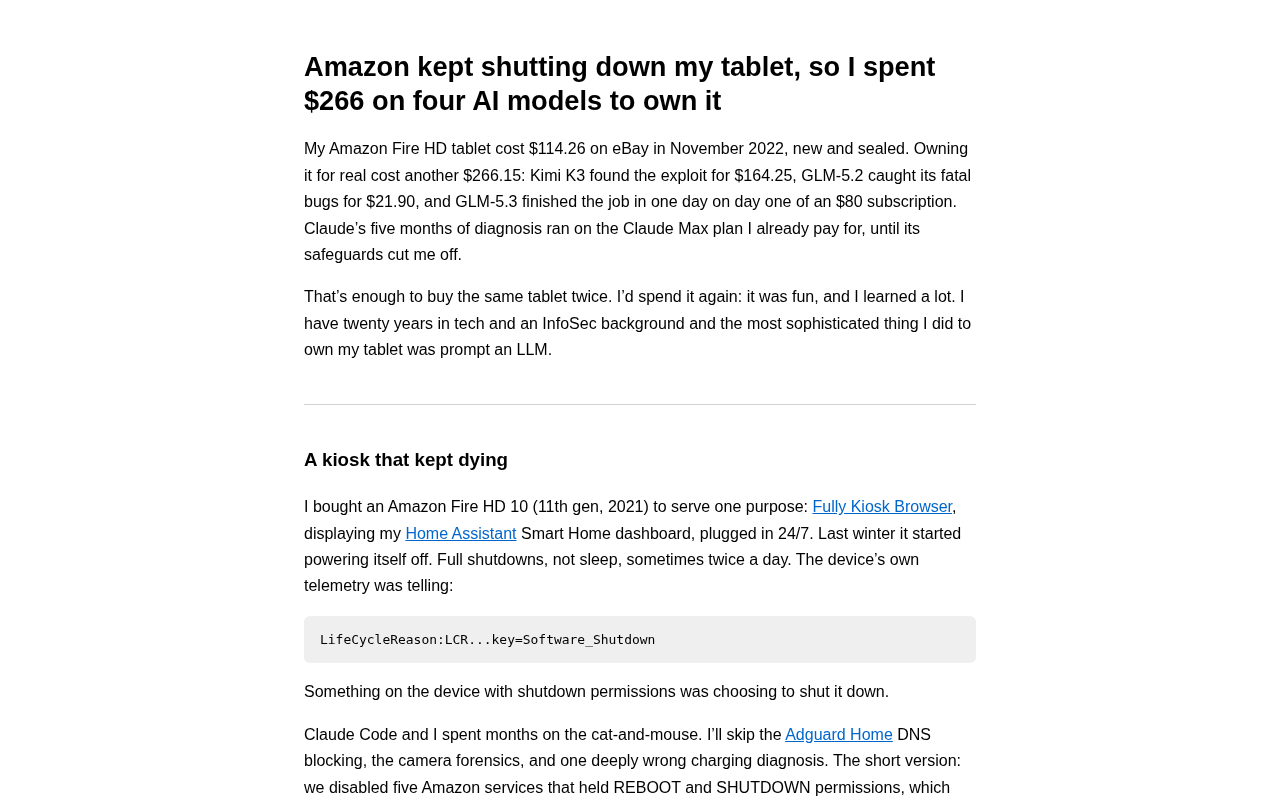
A geek used 4 AI models and $266 to crack his own tablet, with GLM-5.3 finishing the job in one day.
A Hacker News post went viral about a user who spent $266 and tried four different AI models to reverse-engineer his own locked tablet. Zhipu AI's GLM-5.3 completed the task in just one day. The story highlights AI's growing power in reverse engineering, the deepening crisis of digital ownership in consumer electronics, and the contentious debate over where AI safety boundaries should be drawn.
A Geek Experiment About "Digital Ownership"
A recent post that hit the Hacker News front page sparked widespread discussion — garnering 619 upvotes and 268 comments. Hacker News is a tech community founded in 2007 by Y Combinator, Silicon Valley's renowned startup accelerator, and is one of the most influential tech discussion platforms in the world. The platform uses an algorithm-driven content ranking system, so a post receiving 600+ upvotes and making it to the front page signals extremely high interest and resonance within the tech community. The author told a story that's remarkably characteristic of our era: he spent $266 and used four different AI models, all just to "truly own" a tablet he had purchased. The climax of the story? GLM-5.3, a model from Zhipu AI, completed the reverse engineering task in a single day — something the other models couldn't pull off.
The reason this story resonated so strongly is that it hits squarely on an increasingly sharp contradiction in consumer electronics: When you pay for a device, what do you actually own? The hardware itself, or merely a "usage license" hemmed in by layer upon layer of manufacturer restrictions?
Why "Owning" a Device Has Become So Difficult
Modern tablets and smart devices are widely plagued by ecosystem lock-in. Manufacturers maintain ultimate control over devices through locked bootloaders, encrypted system partitions, uninstallable bloatware, and remotely controlled firmware updates. A bootloader is the low-level software that runs first when a device starts up. On modern smart devices, the bootloader is typically encrypted and locked by the manufacturer, only allowing officially signed system images to load. Unlocking the bootloader requires obtaining the manufacturer's key or exploiting security vulnerabilities to bypass the verification mechanism — this is the core technical barrier at the heart of the 'digital ownership' debate.
Users who want to root, flash custom ROMs, install custom systems, or remove certain feature restrictions often face formidable technical hurdles. Root access is the highest administrator privilege in Unix/Linux systems, and it's locked by default on mobile systems like Android. Gaining root access (commonly known as 'rooting' or 'jailbreaking') means users can modify system files, uninstall bloatware, and install custom ROMs. However, in recent years, as manufacturers have strengthened protections through hardware security modules and verification mechanisms like SafetyNet, rooting has become significantly harder, and many apps now detect root status and refuse to run.
For non-professional developers, these operations used to be nearly impossible — requiring deep understanding of device hardware architecture, firmware signing mechanisms, exploit chains, and extensive reverse engineering knowledge. Reverse engineering is the technique of analyzing compiled binary files to understand how they work without access to source code. This typically involves using disassembly tools to convert machine code back into assembly language, combined with dynamic debugging to observe program behavior at runtime. A typical firmware cracking project might require analyzing hundreds of megabytes of binary code, identifying encryption algorithms, finding vulnerabilities in signature verification logic, and writing exploit code. This is the real cost behind the "$266" and "four AI models" in the author's story: it includes potential hardware wear, tool purchases, and the compute costs consumed through trial and error across multiple AI services.
AI Is Becoming a New Weapon for Reverse Engineering
The most noteworthy aspect of this case is what it reveals about the growing capability of AI models in reverse engineering and low-level technical tasks. In the past, cracking device locks required experienced security researchers spending days or even weeks; now, a large language model with strong code comprehension and reasoning abilities can assist in analyzing firmware, writing exploit scripts, and interpreting obscure error messages — all through conversation.
The author clearly took a "shop around" approach, trying four different AI models in succession to help complete the task. This practice is increasingly common among AI users today — different models have different strengths in code generation, long-context understanding, and domain-specific knowledge, so users select the best tool for a specific task or have multiple models cross-verify results.
Why GLM-5.3 Stood Out
The turning point of the story was GLM-5.3 — a large model from China's Zhipu AI — ultimately completing the task "within a single day." Zhipu AI is an artificial intelligence company spun out of the KEG Lab at Tsinghua University. GLM-5.3 was released in 2024, featuring a 1M-token ultra-long context window, enhanced code generation capabilities, and bilingual Chinese-English optimization. Architecturally, GLM uses a hybrid pre-training approach combining bidirectional attention and autoregression, which gives it strong performance in understanding complex technical documentation and generating structured code. This detail sparked heated discussion in the Hacker News comments about the capabilities of Chinese-developed large models.
Reverse engineering and low-level system cracking are tasks that demand extremely well-rounded model capabilities, requiring:
- Deep technical reasoning ability: Understanding complex firmware logic and security mechanisms
- Accurate code generation ability: Producing exploit scripts that can run directly
- Long-context processing ability: Digesting large volumes of logs, disassembled code, and technical documentation
- Fewer "safety alignment" restrictions: Many Western models refuse to assist with such "cracking" operations for compliance reasons
The last point is particularly crucial. Safety alignment refers to training AI models through techniques like Reinforcement Learning from Human Feedback (RLHF) to refuse harmful or illegal requests. But the gray areas are enormously controversial: Is helping a user crack a device they legally purchased considered 'harmful'? Companies like OpenAI and Anthropic tend toward stricter restrictions, refusing any operation that might violate a manufacturer's terms of service; while some open-source models or models from non-US companies may be more flexible. Behind this difference lies a divergence in values: Should we prioritize protecting corporate commercial interests, or prioritize respecting users' control over their own property? This is likely one of the key reasons the author needed to try multiple models — and why GLM-5.3 ultimately came out on top.
Three Layers of Reflection This Case Provokes
The Deepening Dilemma of Digital Ownership
The fact that the author was willing to spend $266 and significant time to "own" a tablet he had already purchased is itself a silent protest against the modern consumer electronics ecosystem. As "buying" increasingly resembles "renting," the tug-of-war between users and manufacturers over device control will only intensify.
This also explains why the Right-to-Repair movement has been gaining increasing global support in recent years. The Right-to-Repair movement advocates that users should have the right to repair their purchased electronics themselves or through third parties, and demands that manufacturers provide repair manuals, sell parts, and refrain from using software locks to prevent repairs. The movement achieved major breakthroughs after 2021: multiple U.S. states passed Right-to-Repair legislation, and the EU enacted laws in 2023 requiring manufacturers to make products repairable. The software-level lock-in discussed in this article is essentially an extension of the Right-to-Repair debate into the digital realm, embodying the fundamental contradiction of 'who really owns what I bought.'
AI Is Dramatically Lowering Technical Barriers
The most far-reaching significance of this story is that AI is democratizing capabilities that once belonged only to a handful of experts. Reverse engineering, vulnerability discovery, system cracking — these high-barrier skills can now be gradually accomplished by ordinary enthusiasts with AI assistance. This is both exciting and a source of new security concerns: the same capabilities could also be used for malicious purposes.
The Debate Over AI's Safety Boundaries
When different AI models show varying degrees of willingness to cooperate on the same "gray area" task, a pointed question surfaces: To what extent should AI assist users in operations that may violate manufacturer terms but involve the user's own legally owned property? Does helping a user root a device they bought cross a line? Behind this lies differing philosophies among model developers about the scope of "safety alignment" — and it's a real-world issue that future AI governance must confront.
Conclusion
$266, four AIs, one tablet — this seemingly absurd geek experiment is actually a microcosm of our era. It showcases AI's astonishing practical value in specialized technical fields like reverse engineering, reflects the deep anxiety over digital ownership in consumer electronics, and raises serious discussions about the boundaries of AI capability.
As large model capabilities continue to climb, similar cases of "AI-assisted cracking" will only become more frequent. For ordinary users, this means greater device autonomy; for manufacturers, it means rethinking the relationship between products and users. And for the entire AI industry, finding the balance between empowerment and restraint will be an unavoidable question that demands an answer.
(Note: This article is based on Hacker News community discussions. Specific technical details are subject to the original author's description.)
Related articles

Plembfin: Open-Source Watch Status Sync Tool for Plex/Emby/Jellyfin
Plembfin is a self-hosted open-source tool that syncs watch status, playback progress, and replay records across Plex, Emby, Jellyfin, and Trakt using a local SQLite coordination hub with Docker deployment.

Video Multilingual Dubbing API in Practice: A Selection and Cost Guide for Localization at Scale
An in-depth analysis of video multilingual dubbing APIs — covering voice cloning, audio separation, lip sync, and cost comparisons of ElevenLabs, HeyGen, and Rask AI for scalable video localization.

Localdock: $9 One-Time Payment, Turn Local Projects into HTTPS Public URLs Instantly
Localdock assigns real HTTPS addresses to local development projects, supports cross-device access with zero client installation. One-time $9 payment, ideal for indie developers and small teams to quickly share local projects. Detailed comparison with ngrok and competitors.