Spiking Neural Networks in Symbiosis with ANNs: A New Heterogeneous Federated Learning Framework HNFL
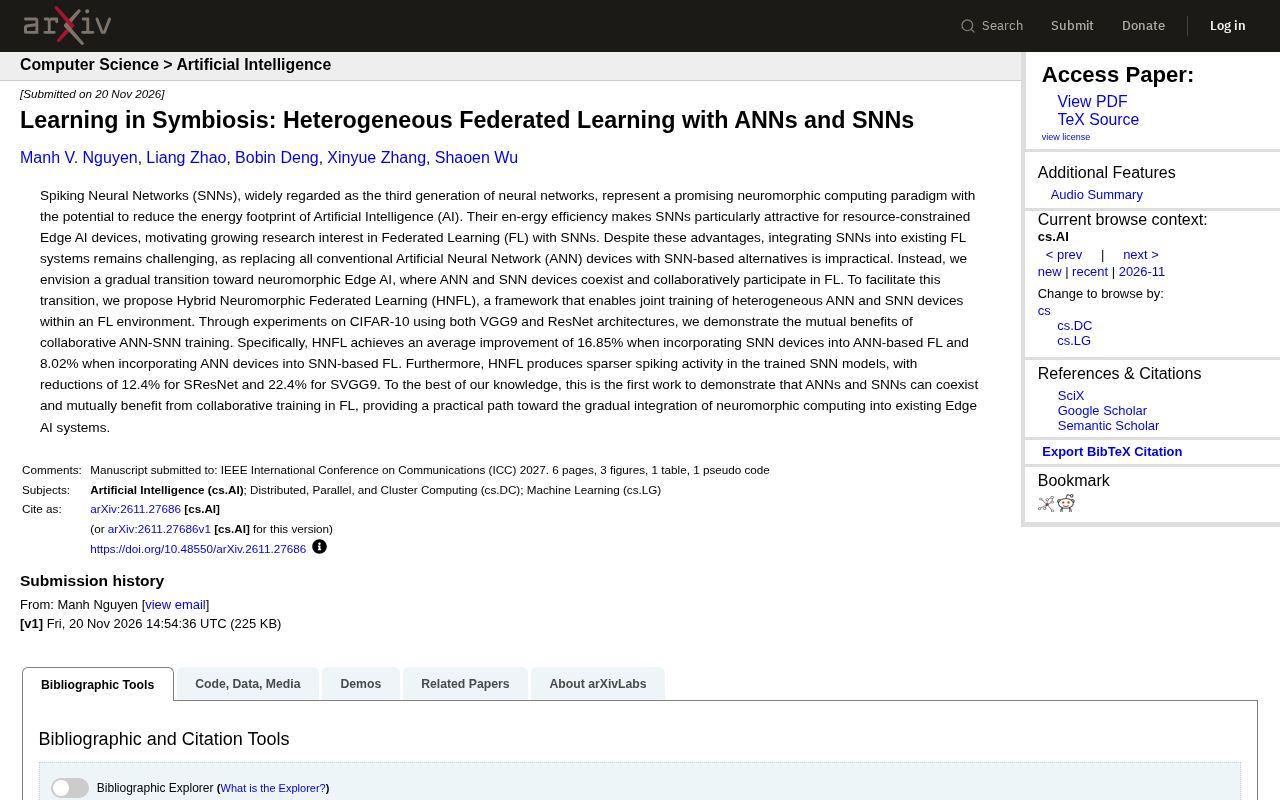
HNFL lets ANNs and SNNs coexist and benefit each other in federated learning, with SNNs gaining accuracy and sparsity.
The article introduces the Hybrid Neuromorphic Federated Learning (HNFL) framework, which addresses the practical difficulty that SNNs cannot directly replace ANNs. HNFL allows heterogeneous ANN and SNN devices to train jointly in the same federated environment without either side changing its network form. Experiments on CIFAR-10 with VGG9 and ResNet show that SNNs in ANN-based federated learning improve by 16.85% on average, while ANNs in SNN-based federated learning improve by 8.02%; collaborative training also makes SNN spiking activity sparser (SResNet down 12.4%, SVGG9 down 22.4%). The authors propose a shift from "substitutive evolution" to "symbiotic evolution," providing a practical basis for gradually introducing neuromorphic computing into edge AI, while noting that more complex scenarios, communication overhead, and heterogeneous aggregation details remain to be validated.
Spiking Neural Networks (SNNs) are regarded as the third generation of neural networks. Their event-driven sparse activation mechanism has drawn considerable attention in the field of neuromorphic computing, and they are widely believed to have the potential to significantly reduce the energy consumption of artificial intelligence. This energy-efficiency advantage makes SNNs particularly attractive for resource-constrained edge AI devices, and it has also fueled growing research interest in combining federated learning (FL) with SNNs.
Reality, however, is less romantic. Replacing all traditional Artificial Neural Network (ANN) devices in existing federated learning systems with SNNs overnight is neither realistic nor economical. A more pragmatic path proposed by researchers is to let ANN and SNN devices coexist and collaborate within federated learning, gradually completing the transition toward neuromorphic edge AI. Around this idea, a framework called Hybrid Neuromorphic Federated Learning (HNFL) has been proposed, which systematically validates for the first time the feasibility of heterogeneous ANN-SNN joint training.
Why SNNs Are Hard to Directly Replace ANNs
The core characteristic of SNNs is that they use discrete spikes to transmit information. Neurons fire a spike only when the membrane potential exceeds a threshold, giving them inherent sparsity and low-power potential. But this also means that their training methods, data representations, and gradient propagation mechanisms are fundamentally different from mainstream ANNs. In federated learning scenarios, the model structures, communication content, and aggregation strategies of participating devices all need to be coordinated in a unified way. Forcing all devices to adopt homogeneous SNNs would exclude a large number of existing ANN devices.
The authors' judgment is that the evolution toward neuromorphic edge AI should be gradual, and that ANN and SNN devices will coexist within the same federated learning system for a considerable period of time. HNFL is a training framework designed for exactly this coexistence — it allows heterogeneous ANN and SNN devices to train together in the same federated environment without requiring either side to first change its network form.
The Basic Working Mechanism of Spiking Neural Networks
Neurons in SNNs typically adopt the Leaky Integrate-and-Fire (LIF) model: each neuron maintains a membrane potential, accumulates it upon receiving input, fires a spike when it exceeds the threshold, and then resets the membrane potential. Since spikes are binary (present or absent) and computation and communication events are generated only when spikes are fired, SNN computation is inherently event-driven and sparse. This stands in sharp contrast to ANNs, where every neuron performs dense multiply-accumulate operations on every forward pass.
The training difficulty lies in the non-differentiability of spikes. ANNs rely on backpropagation to differentiate continuous activation functions, whereas the firing process in SNNs is a step function whose gradient is almost everywhere zero. A common solution is the surrogate gradient method: use real spikes during forward propagation, and approximate the derivative of the step function with a smooth function during backpropagation, so that gradients can flow backward. This mechanism is the key to end-to-end training of SNNs, and it also determines that SNN and ANN parameters do not correspond one-to-one in semantics.
The Standard Aggregation Paradigm of Federated Learning
The classic federated learning algorithm FedAvg requires all clients to use models with the same structure, so that the server can perform element-wise weighted averaging of the parameters uploaded by clients. This homogeneity assumption is a direct obstacle in ANN-SNN mixed scenarios: the two types of models differ in the number of layers, the number of channels, and the meaning of parameters, so they cannot be simply averaged. Heterogeneous federated learning therefore requires new aggregation strategies — for example, aggregating only shared submodules, aligning at the representation level, or transferring information between models through knowledge distillation. HNFL addresses exactly this class of heterogeneous aggregation problems.
How HNFL Achieves Heterogeneous Collaborative Training
The key to HNFL lies in handling the heterogeneity of the two networks at the federated aggregation level. Traditional federated learning assumes that client models have identical structures and can be directly weighted-averaged at the parameter level; but ANN and SNN model structures and parameter semantics do not correspond. HNFL designs a joint training mechanism adapted to heterogeneous models, enabling the two types of devices to retain their respective local characteristics while sharing global knowledge, so that SNN devices can benefit from representations learned by ANN devices and vice versa.
Experiments were conducted on the CIFAR-10 dataset, and both VGG9 and ResNet architectures were tested to verify the generality of the framework across different network structures. This cross-architecture experimental design demonstrates that HNFL is not a trick tuned for a specific model, but a generally applicable approach to collaborative training.
Experimental Evidence of Bidirectional Benefits
Experimental results quantify the benefits brought by this symbiotic relationship. After incorporating SNN devices into ANN-based federated learning, the average performance improvement reached 16.85%; conversely, incorporating ANN devices into SNN-based federated learning yielded an average improvement of 8.02%. The magnitudes of improvement differ between the two directions, but both are clearly positive, indicating that knowledge transfer between heterogeneous devices is bidirectional rather than one-sided.
Even more noteworthy is the change in the sparsity of the SNN models themselves. After training, the SNN models exhibited sparser spiking activity, with SResNet's spiking activity reduced by 12.4% and SVGG9 by 22.4%. Sparser spikes mean fewer neuron firings, which is highly consistent with the original goal of SNNs to achieve low energy consumption. In other words, collaborative training with ANNs not only improves task performance but also makes SNNs better along the energy-efficiency dimension, rather than trading sparsity for accuracy.
How to Measure the Sparsity of SNNs
The sparsity of SNNs is usually measured by the spiking rate or average spike count — that is, the proportion of time steps in which each neuron fires a spike on average under a given input. A lower firing rate means that neurons remain at rest most of the time, and at the hardware level fewer bits need to be flipped and fewer events need to be transmitted, resulting in correspondingly lower energy consumption. Since the energy consumption of SNNs mainly comes from spike events (especially address events during cross-chip communication), improvements in sparsity can be directly translated into energy-efficiency gains.
Therefore, "SResNet spiking activity reduced by 12.4% and SVGG9 by 22.4%" is not merely a change in training metrics, but implies an actual reduction in energy consumption during inference. It is worth noting that this sparsification emerges naturally after collaborative training with ANNs, rather than being forcibly imposed through additional sparsity regularization terms. This suggests that the dense representations of ANNs play a certain regularizing or knowledge-guiding role in joint training, helping SNNs learn more concise and event-like representations.
Implications for Edge AI Deployment
The value of this work lies not just in a few percentage points of improvement, but in providing an actionable migration path. For edge deployers already running ANN-based federated learning systems, HNFL means they can begin introducing SNN devices and benefit from them without waiting for the SNN ecosystem to fully mature or replacing all devices at once. SNN devices can quickly improve their performance by leveraging knowledge accumulated by ANN devices, while ANN devices can also gain complementary benefits from the sparse representations of SNNs.
According to the authors, this is the first work to demonstrate that ANNs and SNNs can coexist and mutually benefit within federated learning. It shifts the narrative of neuromorphic computing from "substitutive evolution" to "symbiotic evolution," providing a practical basis for existing edge AI systems to gradually absorb neuromorphic computing capabilities. As SNN hardware and training algorithms mature in the future, this heterogeneous collaborative framework may become a standard form during the transition period.
Remaining Open Questions
The evidence provided by HNFL so far is concentrated on VGG9 and ResNet architectures on CIFAR-10; more complex tasks and larger-scale federated scenarios have not yet been covered. Details of the aggregation mechanism between heterogeneous models, communication overhead, and stability under different non-IID data partitions are all directions that need further validation before actual deployment. In addition, the trade-off between improved SNN sparsity and improved accuracy deserves further characterization across more network structures.
One-line Summary
HNFL framework enables ANNs and SNNs to coexist and benefit each other in federated learning, with SNNs achieving higher accuracy and greater sparsity.
Paragraph Summary
The article introduces the Hybrid Neuromorphic Federated Learning (HNFL) framework, which addresses the practical difficulty that SNNs cannot directly replace ANNs. HNFL allows heterogeneous ANN and SNN devices to train jointly in the same federated environment without either side changing its network form. Experiments on CIFAR-10 with VGG9 and ResNet architectures show that incorporating SNNs into ANN-based federated learning yields an average improvement of 16.85%, while incorporating ANNs into SNN-based federated learning yields an average improvement of 8.02%; moreover, collaborative training makes SNN spiking activity sparser (SResNet reduced by 12.4%, SVGG9 by 22.4%). The authors accordingly propose a shift from "substitutive evolution" to "symbiotic evolution," providing a practical basis for gradually introducing neuromorphic computing into edge AI, while noting that more complex scenarios, communication overhead, and heterogeneous aggregation details still require validation.
Related articles
New Claude Sonnet Model Tested: Performance Approaches Opus with Less Thinking
Anthropic quietly tests a new Sonnet model in Claude Code—performance approaches Opus 5.5 with far fewer thinking tokens, plus Codex transfer optimization, xAI's low-level rewrite, Google Antigravity updates, and the AI science understanding gap.

Building a Reasoning Model from Scratch: Making Complex AI Algorithms Accessible
Mike Finley, author of Build a Reasoning Model from Scratch, shows how a few hundred lines of code, single-sample training, and code reuse make complex AI algorithms like RL and verifiers accessible to all.

11-Hour Free Course: Build a Reasoning AI from Scratch, Runs on an Ordinary Laptop
Sebastian Raschka released an 11-hour free video course teaching you to build a reasoning AI from scratch in Python. Covers verifiers, sampling, self-refinement, RL, and distillation; early chapters run on a laptop.