Spotify's Conversational Recommendation Agent in Practice: Synthetic Data and Self-Optimization Loops

Spotify solves cold-start for conversational recommendation agents with synthetic data and self-optimization, achieving +14% listening volume.
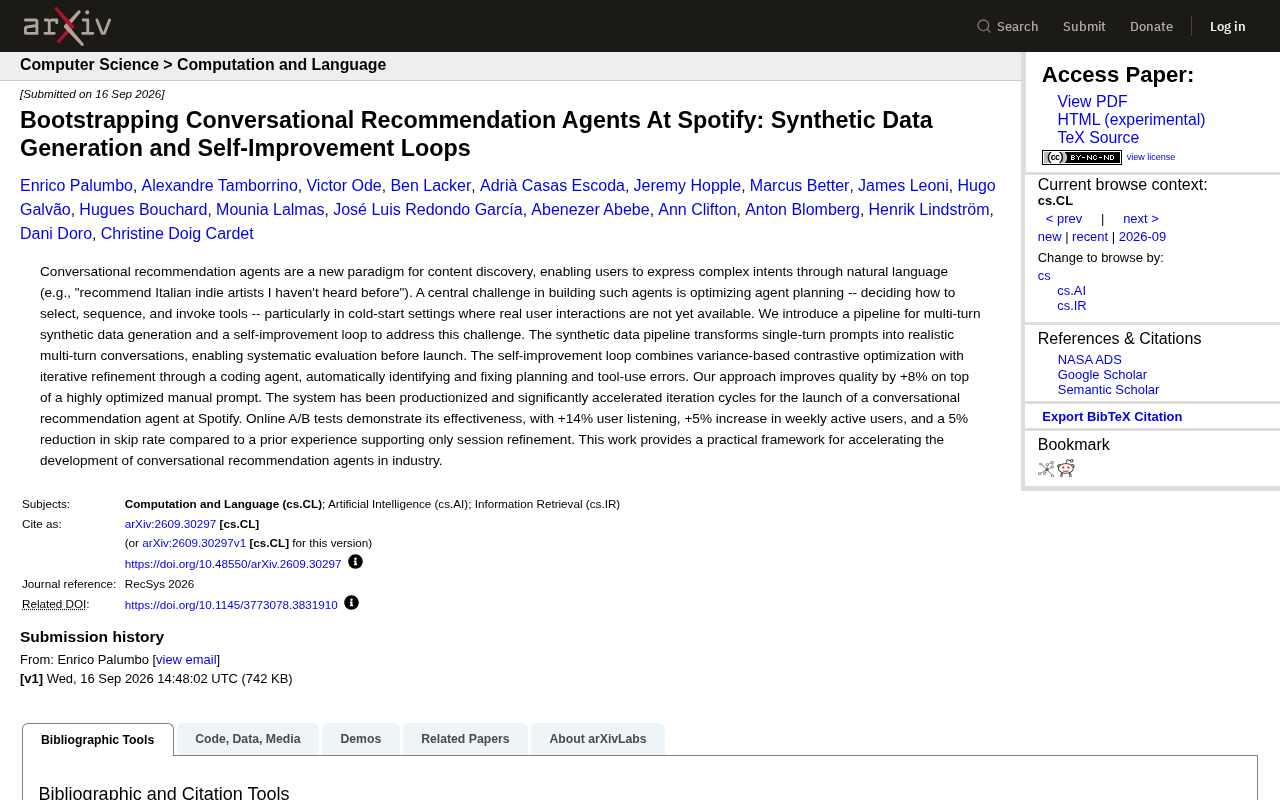
Spotify's arXiv paper reveals a complete engineering approach for bringing a conversational recommendation agent to production, centered on overcoming the cold-start challenge of having no real data available. The solution has two parts: a multi-turn synthetic data pipeline that expands single-turn prompts into realistic multi-turn dialogues for pre-launch evaluation, and a self-optimization loop combining variance-based contrastive optimization with coding agent-driven iterative refinement to automatically detect and fix tool-use planning errors. The method delivers an additional 8% quality gain on top of an already heavily hand-optimized baseline, with live A/B tests showing +14% listening volume, +5% weekly active users, and a 5% reduction in skip rate.
Conversational Recommendations: A New Paradigm for Content Discovery
When users want to find music, traditional recommendation systems rely on behavioral signals like clicks, plays, and skips to infer intent. Conversational recommendation agents rewrite this entirely in natural language — users can directly express complex, specific needs like "recommend some Italian indie artists I haven't heard before." This isn't simple keyword matching; it requires the system to understand semantics, decompose intent, and invoke the right combination of tools to complete retrieval and recommendation.
In a newly published arXiv paper, Spotify shares their complete methodology for bringing a conversational recommendation agent to production. The core of this approach addresses an unavoidable real-world challenge: how do you optimize an agent's planning capabilities during the cold-start phase when no real user interaction data exists?
The Agent Planning Problem: A Cold-Start Dilemma
The critical capability of a conversational recommendation agent lies in "planning" — deciding which tools to select, in what order to invoke them, and how to combine them to respond to user intent. The more complex this decision chain, the more room there is for error.
The problem is that optimizing planning ability typically relies on large volumes of real multi-turn conversation data for evaluation and fine-tuning. But before a product launches, that data simply doesn't exist. Teams are left either manually iterating on prompts or risking a live launch to collect data afterward — both paths are slow and unpredictable.
Spotify's answer is to bypass the dependency on real data: use synthetic data to move evaluation earlier in the process, then use an automated loop to make optimization self-running.
"Planning" in agent systems specifically refers to the LLM's ability to dynamically determine tool invocation order and parameters based on user intent — often called "tool-use planning" in the research community. Unlike static function calls, conversational recommendation scenarios involve a wide variety of tools — potentially including keyword search, similarity retrieval, user profile queries, popularity filtering, and more — which the agent must combine in real time across each turn of dialogue. The cost of planning errors is twofold: a wrong tool selection or incorrect invocation order not only degrades recommendation quality in the current turn, but also corrupts context accumulation in subsequent turns, causing multi-turn conversations to drift further off course. This is precisely why single-turn evaluation fails to reflect true agent capability — multi-step dependency errors have a compounding effect.
Synthetic Data Pipeline: Turning Single-Turn Prompts into Real Conversations
The first part of the solution is a multi-turn synthetic data generation pipeline. Its purpose is to expand single-turn prompts into multi-turn dialogues that closely resemble real-world scenarios.
The value of this step is that it lets teams conduct systematic evaluation before a product launches. Real user conversations are often multi-turn and progressive — starting with a vague request, then adding constraints and refining direction based on recommendations. Testing with only single-turn data provides no way to verify how an agent will perform in actual multi-turn scenarios. The synthetic data pipeline fills this gap, making it possible to quantitatively evaluate agent quality before going live.
Quality control of synthetic data is a critical challenge in AI system evaluation — if synthetic dialogues deviate too far from the distribution of real user behavior, evaluation results lose their reference value. Industry practitioners typically control quality through several methods: using a small number of real seed conversations to guide generation style (few-shot steering), having an independent LLM score generated dialogues for naturalness and intent plausibility as a filter, and tracking coverage statistics for specific user behavior patterns (such as adding constraints or changing direction). Spotify's paper does not fully disclose its quality control details, but the credibility of synthetic data ultimately requires cross-validation against real A/B results — the +14% listening volume mentioned in this paper is exactly that cross-validation, demonstrating an effective correlation between evaluation signals from the synthetic phase and real business metrics.
Self-Optimization Loop: Letting a Coding Agent Fix Its Own Bugs
The second part of the solution — and the more interesting part — is a self-improvement loop. It combines two techniques:
- Variance-based contrastive optimization: By comparing samples with different performance levels, it identifies problems in planning and tool invocation.
- Coding agent-driven iterative refinement: A coding agent automatically locates and fixes errors in planning and tool usage.
In other words, the system can automatically discover "where the agent made the wrong decision" and then automatically generate a fix and iterate. This transforms what was once a tedious process of engineers manually debugging and manually revising prompts into an optimization loop that can continuously run on its own.
According to the paper, this approach achieves an additional 8% quality improvement on top of a baseline that was already heavily hand-optimized. That number might seem modest, but consider that the baseline was already the result of manual fine-tuning — squeezing out another 8% on top of that demonstrates the automated loop is finding optimization space that humans couldn't cover.
"Variance-based contrastive optimization" is a method for identifying instability in model behavior: by sampling multiple times for similar inputs and observing output variance — high variance indicates the model makes unstable decisions in that type of situation, i.e., a systematic weakness exists. By contrasting "high-quality planning samples" with "low-quality planning samples," the algorithm can pinpoint which tool invocation patterns or decision paths caused the divergence in outcomes. This shares roots with traditional contrastive learning methods like DPO (Direct Preference Optimization), but here the application is not fine-tuning model weights — it's automatically modifying the instruction logic within prompts. The coding agent then takes over, translating the identified error patterns into concrete prompt modification patches, completing the "identify problem → generate fix → validate result" loop entirely without human intervention.
Live A/B Testing: Business Metrics That Speak for Themselves
The most compelling part of the paper is that this system has been truly productionized and powers Spotify's conversational recommendation agent in production. Compared to the previous experience that only supported session refinement, the live A/B test delivered a striking set of results:
- User listening volume +14%
- Weekly active users +5%
- Skip rate down 5%
The drop in skip rate is particularly noteworthy — it directly reflects how well recommended content aligns with user intent. The less users skip, the more accurate the recommendations. All three metrics improving simultaneously means this isn't a superficial boost in engagement metrics, but a substantive improvement in recommendation quality.
Critically, the team emphasizes that this approach significantly accelerated the iteration cycle. Being able to evaluate and optimize before real data exists during the cold-start phase effectively moves the product development clock forward considerably.
Implications for the Industry
The significance of Spotify's framework lies not only in building a functional music recommendation agent, but in providing a reusable engineering paradigm: synthetic data solves the evaluation problem; the self-optimization loop solves the iteration problem.
For any team looking to bring conversational agents to production, cold-start is a shared pain point. This paper demonstrates a pragmatic path forward — rather than waiting for real data to accumulate, proactively construct an evaluation environment and build automated mechanisms for discovering and fixing errors. As coding agent capabilities mature, this model of "agents optimizing agents" may well become the standard approach for building complex AI systems in industry.
Of course, the specific technical details in the paper (such as the implementation of contrastive optimization and synthetic data quality control) warrant further study, but based on the disclosed business results, the effectiveness of this approach in real-world scenarios has been validated.
Related articles

Free Unlimited Claude Code Solution: Agnes AI + CC Switch Setup Guide
No paid subscription needed — pair the free AI platform Agnes AI with the open-source tool CC Switch to provide a backend for Claude Code, enabling unlimited free calls to text, image, and video models. This guide covers the full setup, test results, and usage boundaries.

A Complete Zero-Cost Guide to Getting Started with Claude Code for Beginners in China
A beginner's guide to Claude Code for users in China: two installation methods (command line and IDE plugin), full configuration steps for replacing the official API with the free domestic LongCat model, and a hands-on demo of building a small tool with natural language, plus tips.

When the NSA Gets Involved: The AI Supply Chain Crisis Behind Open-Source CVEs and API Key Hijacking
Multiple open-source projects disclosed severe CVEs in one day, PHP flaws alarmed the FBI, and Railway and OpenCode were breached with API keys stolen. This article breaks down the vulnerability window, AI-accelerated exploitation, and the AI supply chain crisis behind the API key black market, with a developer defense checklist.