Spring AI 1.0 Practical Guide: A Java Developer's Fast Track to Building AI Applications

Spring AI 1.0 lets Java developers build production-grade AI apps using the Spring stack they already know.
Spring AI 1.0 stable release enables Java developers to build AI applications without leaving the Spring ecosystem. This guide covers core capabilities including LLM integration, streaming chat, RAG knowledge bases, and Agent design patterns, along with three hands-on projects and practical solutions to real enterprise challenges like memory management, tool routing, MCP security, and RAG retrieval optimization.
Why Java Developers Should Pay Attention to Spring AI
As AI technology advances at a rapid pace, a clear trend is emerging: a growing number of traditional enterprises and individual entrepreneurs are finding themselves in need of AI application development capabilities. AI application development is becoming the newest growth sector in the IT industry — a well-crafted AI application can even reshape the dynamics of an entire industry.
For Java developers, the good news is that Spring AI has officially released its 1.0 stable version. Spring AI is an AI integration framework led by the Pivotal/VMware team, built on top of the Spring ecosystem. Its design philosophy draws inspiration from LangChain's architecture in the Python world, but has been deeply adapted for Java enterprise development.
The Connection Between LangChain and Spring AI: LangChain was released in 2022 by Harrison Chase and quickly became the de facto standard for Python AI application development. Its core contribution was abstracting capabilities like LLM invocation, memory management, tool calling, and chain orchestration into reusable components. Spring AI takes this further by integrating Spring's dependency injection, configuration management, and auto-wiring mechanisms, allowing AI components to be declared and used just like ordinary Spring Beans. For engineers already familiar with Spring development, this means extremely low migration costs and high engineering consistency.
Spring AI uses a unified Abstraction Layer to hide the API differences between various AI service providers. Developers only need to program against Spring AI's standard interfaces to seamlessly switch between underlying model vendors. This means developers can finally build AI applications using the Spring tech stack they know best — without switching to the Python ecosystem or learning an unfamiliar framework from scratch — dramatically lowering the barrier for Java engineers entering the AI field.
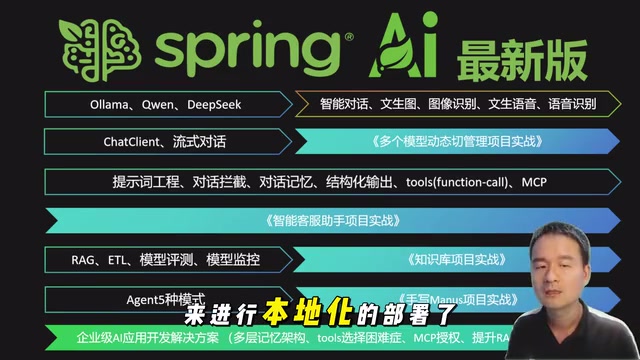
Meanwhile, the performance and deployment costs of current open-source large models are already sufficient to support enterprise-level on-premise deployments. For developers, "rebuilding traditional applications with AI" or "empowering existing applications with AI" is becoming a highly promising technical direction.
Spring AI Core Capabilities Overview
LLM Integration and Model Selection
The first step in Spring AI development is selecting and integrating a large model. The framework supports a wide range of mainstream models:
- Local LLMs: Suited for enterprises with strict data security requirements that need private on-premise deployments. Local deployment solutions typically rely on inference runtimes like Ollama, supporting open-source models such as Llama, Qwen, and Mistral running on consumer-grade GPUs or even CPUs. Data never leaves the local network, satisfying data sovereignty requirements in highly regulated industries like finance and healthcare.
- Cloud-based LLMs: Covers standardized integration with mainstream domestic models such as Tongyi Qianwen and DeepSeek. These models have notable advantages in Chinese semantic understanding and industry knowledge coverage, and their API pricing is generally lower than overseas services like OpenAI, offering excellent cost-effectiveness.
Full support from model selection to integration is critical for real-world project deployment. In enterprise scenarios, model selection often requires balancing multiple factors including performance, cost, and data compliance.

Support for Multiple Intelligent Application Scenarios
Building on top of basic model integration, Spring AI supports a rich set of intelligent application scenarios:
- Intelligent conversation
- Text-to-image generation
- Image recognition
- Text-to-speech and speech recognition
Through ChatClient, developers can easily implement Streaming dialogue, significantly improving the user interaction experience. Streaming output is based on Server-Sent Events (SSE) or WebSocket protocols, allowing model-generated content to be pushed to the frontend token by token in real time, rather than waiting for a complete response. This greatly improves perceived response speed. SSE is a lightweight unidirectional push extension of the HTTP protocol — compared to WebSocket, it is simpler to implement and naturally suits the token-by-token output pattern of large models. It is the standard frontend interaction protocol used by mainstream AI chat products today, including ChatGPT and Claude's web interface. These capabilities form the core modules of modern AI applications.
Three Hands-On Projects: From Prototype to Production
The best path to learning Spring AI is a three-stage structure: "concept explanation → hands-on project → deep-dive into principles." After mastering each set of core concepts, you implement a complete production-grade project, effectively avoiding the trap of "understanding the theory but unable to put it into practice."
Project 1: Multi-Model Dynamic Switching Management System
After covering integrations with various large models, the first hands-on project is a Multi-Model Dynamic Switching Management System. In production environments, applications often need to dynamically dispatch different underlying models based on scenario requirements, cost constraints, or service availability — and this project is designed exactly for that real-world business need.
Typical business scenarios for multi-model dynamic switching include: using a lightweight model (e.g., GPT-4o-mini) for simple Q&A to save on token costs while using a heavy-weight model (e.g., GPT-4o) for complex reasoning tasks; or automatically failing over to a backup model when the primary model service becomes unavailable to ensure service continuity. Spring AI's ChatModel abstraction interface makes this kind of runtime switching possible without modifying business logic.

Project 2: Intelligent Customer Service Assistant
Centered around Spring AI's core capabilities — Prompt Engineering, conversation interception, conversation memory, structured output, Tools calling, and MCP (Model Context Protocol) — the second project builds a complete intelligent customer service assistant.
Prompt Engineering is a technical methodology for guiding large models to produce desired outputs through carefully designed input text. Core techniques include Few-Shot Learning, Chain-of-Thought, and structured output constraints. Few-Shot Learning works by providing 2–5 input-output examples in the prompt, allowing the model to infer task patterns and significantly improve output format consistency. Chain-of-Thought technique activates the model's step-by-step reasoning by appending phrases like "Let's think step by step" to the prompt, with particularly strong results on math and logic tasks. In Spring AI, the PromptTemplate class provides templated prompt management with support for variable injection and version control — the engineering foundation for building maintainable AI interaction logic.
MCP (Model Context Protocol) is an open protocol released by Anthropic in late 2024, designed to standardize interactions between large models and external tools and data sources. Think of it as a "USB standard" for the AI world, fully decoupling tool development from model development. Before MCP, every AI application had to implement its own serialization and deserialization logic for tool calls against different model APIs. MCP defines a unified tool description schema (based on the JSON Schema standard) and a standardized call/response message format, allowing the same tool implementation to be invoked directly by any model that supports the MCP protocol — greatly improving the reusability of the AI tooling ecosystem. Spring AI's MCP integration allows Java developers to extend AI applications with external capabilities like database queries, API calls, and file operations in a standardized way, while maintaining production security through a unified permission control mechanism.
Intelligent customer service is one of the most typical and widely deployed AI application scenarios today. The use case is well-defined, the ROI is clear, and it represents a priority entry point for enterprise AI transformation.
Project 3: RAG Knowledge Base System
The third hands-on project is a knowledge base system built on RAG (Retrieval-Augmented Generation), covering the complete engineering pipeline including ETL data processing, model evaluation, and monitoring — making it the most comprehensive practical application of RAG technology.

RAG (Retrieval-Augmented Generation) is a technical paradigm proposed by Meta AI Research in 2020 and is the mainstream solution for addressing large model "hallucination" and knowledge freshness issues. The root cause of hallucination in LLMs is that model parameters are frozen after training, leaving the model unaware of events after its training cutoff, enterprise-specific private knowledge, etc. — and when uncertain, it tends to generate content that sounds plausible but is factually incorrect. RAG fundamentally addresses this structural flaw by injecting external knowledge in real time during the inference phase.
The typical engineering pipeline includes: document chunking → embedding (vectorization) → storing in a vector database → real-time retrieval at query time → assembling a prompt → LLM generates the response. The quality of the chunking strategy directly impacts retrieval quality: chunks that are too large introduce noise, while chunks that are too small lose semantic context. In practice, sliding window or semantics-based recursive chunking strategies are commonly used.
On the engineering implementation side, Embedding converts text into high-dimensional numerical vectors (typically 768 or 1536 dimensions), where semantically similar content is closer together in the vector space. This property allows semantic similarity computation to be reduced to vector dot products or cosine similarity operations. Vector databases (such as Milvus, Pinecone, and pgvector) are optimized for approximate nearest neighbor (ANN) retrieval of high-dimensional vectors. The mainstream algorithm HNSW (Hierarchical Navigable Small World Graph) achieves millisecond-level retrieval across billions of vectors while maintaining over 95% recall by constructing a multi-layer graph index. pgvector, as a PostgreSQL extension, supports storing and retrieving vectors directly within a relational database, significantly reducing the operational overhead for enterprises adopting vector retrieval. Spring AI has built-in support for a unified VectorStore interface for mainstream vector databases, greatly simplifying data-layer development in RAG systems. For enterprises, this is a key technical foundation for building trustworthy AI applications.
Going Deeper: Agents and Enterprise-Level Challenges
Five Design Patterns for Intelligent Agents
Spring AI also systematically covers the five design patterns for Agents, paired with a Multi-Agent hands-on project. These five mainstream patterns typically include: ReAct (Reasoning + Acting loop), Plan-and-Execute, Multi-Agent Collaboration, Reflection (self-reflective correction), and Tool Use. They were systematically summarized by AI researchers including Andrew Ng and serve as the design basis for mainstream Agent frameworks like AutoGPT and LangGraph.
The ReAct (Reasoning + Acting) pattern, jointly proposed by Princeton University and Google Research in 2022, significantly improves task completion rates on complex tasks by having the model alternate between reasoning steps (Thought) and tool-calling actions (Action), continuously refining its reasoning based on observed results (Observation) returned by tools. Compared to pure Chain-of-Thought (reasoning without action), the ReAct pattern allows the model to call external tools at any point during reasoning to obtain real-time information, breaking through the temporal limitations of parametric knowledge. The Plan-and-Execute pattern separates task execution into a dedicated planning phase (where a Planner model generates a structured list of sub-tasks) and an execution phase (where an Executor model completes each sub-task in sequence). This is suited for complex tasks requiring long-horizon planning and effectively reduces the cognitive load of any single inference step.
Agents move AI from passive response to active planning and task execution — they can autonomously break down goals into sub-tasks, call external tools, evaluate intermediate results, and dynamically adjust execution paths. This is the most exciting frontier in AI today. A deep understanding of different Agent architecture patterns is an essential foundation for building complex AI applications.
Four Real-World Challenges in Enterprise AI Development
Real production deployment often only begins after the introductory tutorials end. Spring AI provides targeted solutions for high-frequency pain points in enterprise-level development:
- Multi-layer memory architecture: Designing storage and retrieval mechanisms for conversational memory. Conversation memory is typically divided into short-term memory (message history within the context window) and long-term memory (vectorized summaries of historical sessions). Coordinating the two directly affects the coherence of multi-turn conversations and token consumption costs. While mainstream LLMs' context windows have expanded to 128K or even millions of tokens, simply stacking all historical messages causes inference costs to grow linearly. Sensible memory compression and summarization strategies are a must for production systems.
- Tool selection at scale: How to accurately dispatch the right tool when the number of available tools grows. Once there are more than a dozen available tools, the model's tool selection accuracy drops significantly, requiring the introduction of Tool Routing or hierarchical dispatch strategies. One effective approach is building a semantic vector index of tools and using vector retrieval to pre-filter the Top-K relevant tools before each call, keeping the candidate set within a range the model can reliably handle.
- MCP permission management: Authorization and security control for Model Context Protocol, preventing AI applications from accessing sensitive resources beyond their intended scope during autonomous task execution. Production-grade MCP deployments require fine-grained tool-level permission controls (e.g., allowing database reads but not writes), rate limiting, and comprehensive audit logs — security mechanisms that are a basic requirement for enterprise compliance.
- RAG retrieval accuracy optimization: Improving final answer quality through strategies like hybrid retrieval (vector retrieval + keyword retrieval) and Reranking. Hybrid retrieval combines the fuzzy matching capability of semantic vector retrieval with the precise matching capability of BM25 keyword retrieval, fusing dual-path rankings via the Reciprocal Rank Fusion (RRF) algorithm. The reranking stage introduces a Cross-Encoder model to perform fine-grained re-ranking of initial results, trading higher computational cost for higher contextual relevance — one of the most effective techniques for improving RAG system accuracy.
The ability to solve these problems is the core dividing line between a "demo project" and a "production-grade AI application."
Conclusion: A New AI Development Opportunity for the Java Ecosystem
The official release of Spring AI 1.0 stable marks a turning point: Java developers can now fully participate in the AI application development wave using the tech stack they already know. From LLM integration and intelligent scenario implementation, to RAG knowledge base construction and Agent development, to systematic solutions for enterprise-level deployment challenges, Spring AI provides a relatively complete engineering solution.
For Java engineers looking to transition into or expand their AI skill set, "rebuilding traditional systems with AI" is becoming a clearly visible technical growth opportunity. Seizing this wave of AI application development is a career direction well worth serious investment right now.
Key Takeaways
Related articles
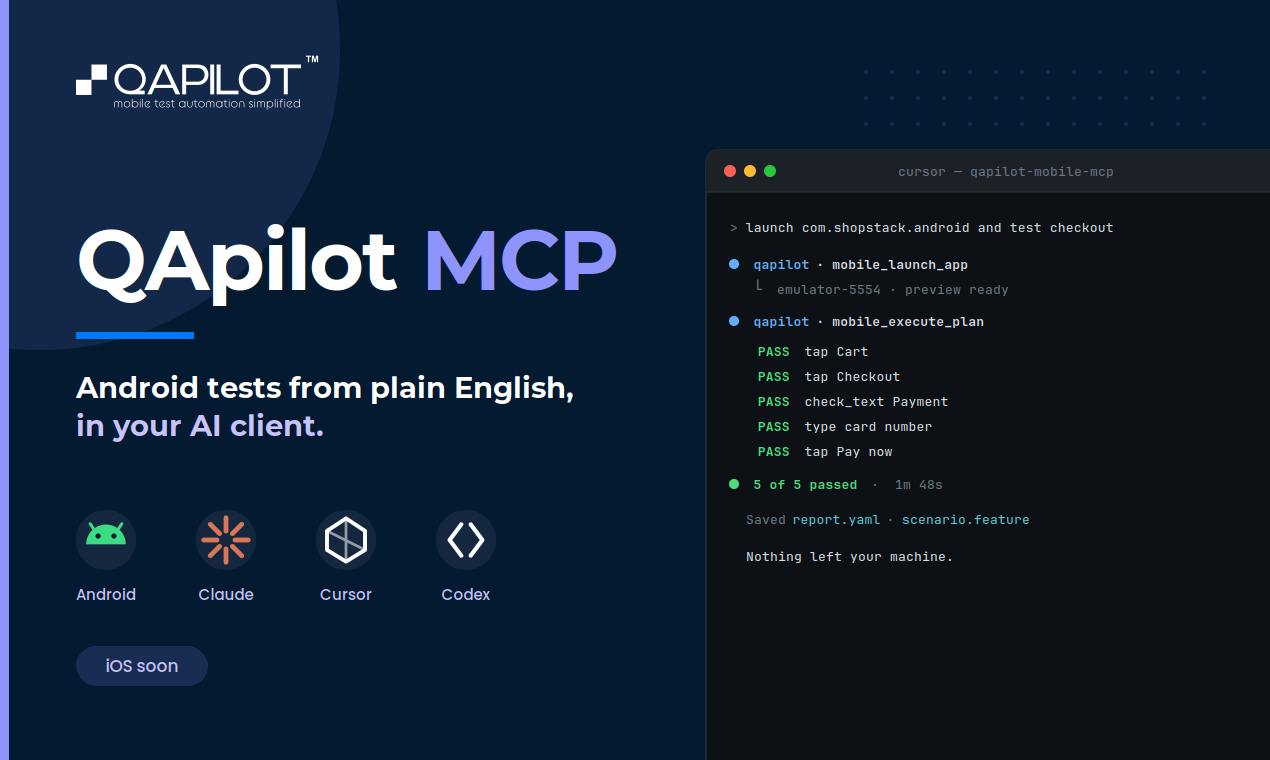
QApilot MCP: Test Android Apps in Natural Language Inside Your AI Coding Assistant
QApilot MCP lets developers test Android apps in natural language inside Claude, Cursor, and Codex — no Appium code needed. Auto-generates reusable Gherkin test cases.
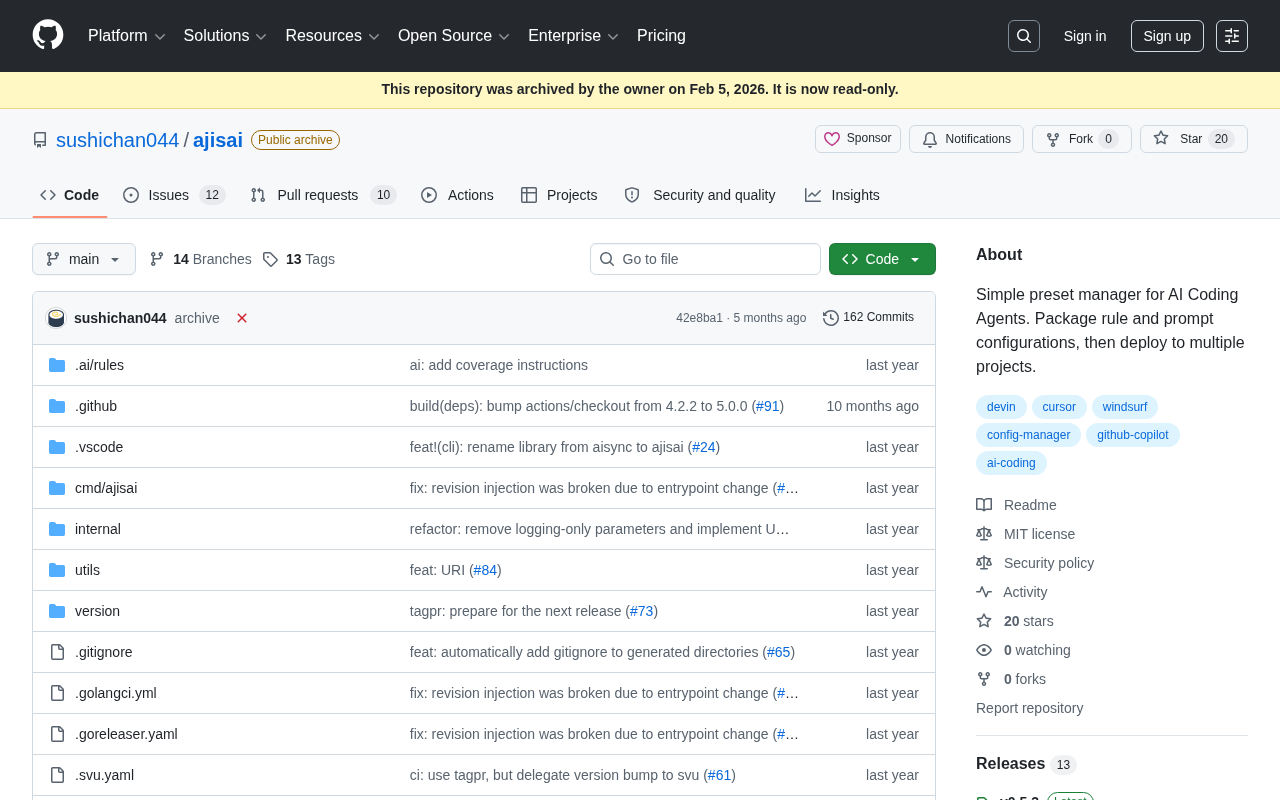
ajisai: A Preset Management Tool for Unifying Rules and Prompts Across AI Coding Assistants
ajisai is a Go-based preset manager for AI coding assistants like Cursor and Claude Code. Package rules and prompts once, deploy everywhere. Early-stage but promising.
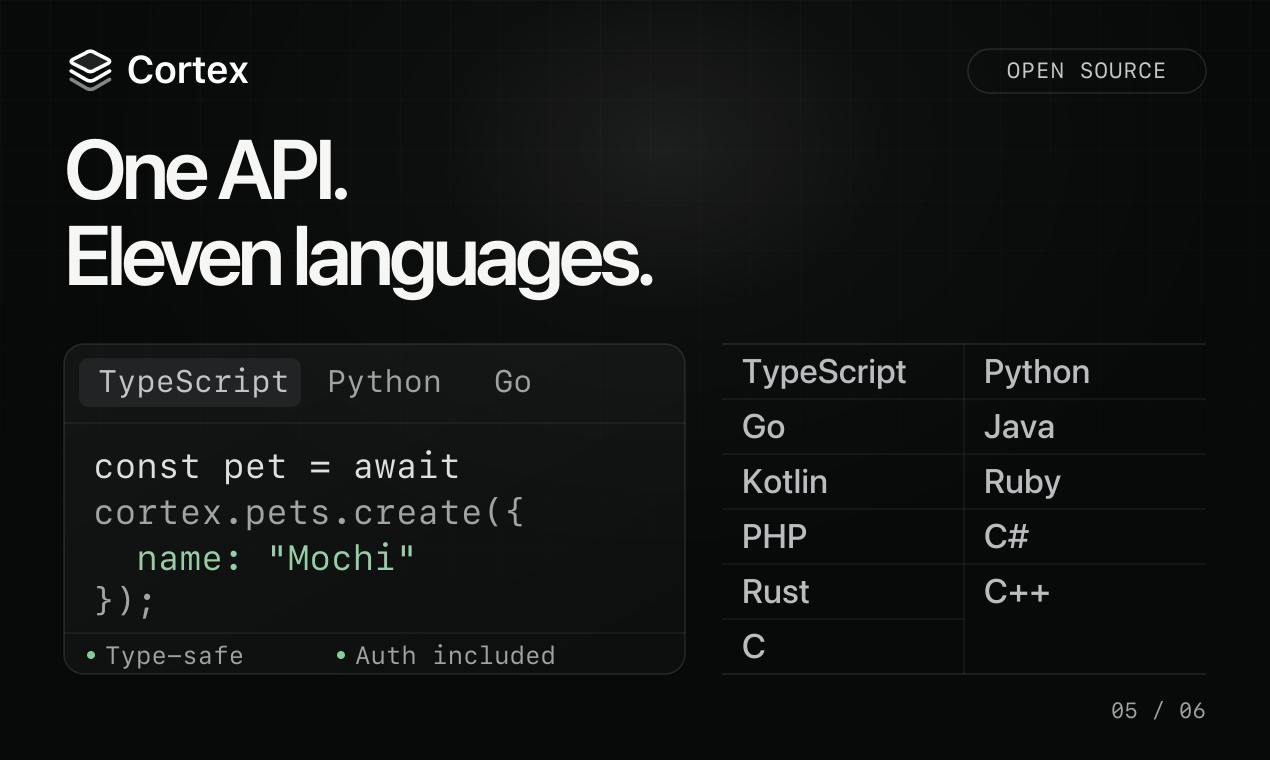
Cortex: Convert API Specs into Docs, SDKs, and MCP Servers in One Click
Cortex is an open-source tool that converts OpenAPI, GraphQL, gRPC and more into interactive docs, typed SDKs in 11 languages, and MCP servers for AI agents.