Spring AI Practical Guide: Building a RAG + MCP Intelligent Engine with Java

Spring AI lets Java developers build RAG, real-time search, and MCP-powered AI apps using familiar Spring patterns.
This article introduces a hands-on Spring AI course for Java backend developers, centered on bridging the gap between AI engineering and the Java ecosystem. It covers three enterprise AI scenarios: a Redis-backed RAG knowledge base, privacy-first local real-time web search, and MCP-based Agent interactions that let LLMs autonomously operate databases through conversation. The system uses SSE for streaming responses and session memory for conversational continuity, and can be deployed as a microservice or AI platform component. Prerequisites include Java, Spring Boot, and MySQL basics; no frontend experience required. RAG, MCP, and Agent tool-calling are fast becoming core backend skills, and Spring AI offers Java teams a low-friction path to production AI.
Why Java Developers Should Pay Attention to Spring AI
The explosion of AI technology is reshaping the software development landscape, yet many backend developers face a real dilemma: they know large language models are powerful, but they're not sure how to deploy them in actual projects. This disconnect is especially pronounced for engineers deeply rooted in the Java ecosystem — most AI application toolchains have historically been Python-centric, effectively locking Java developers out.
Spring AI was created specifically to bridge this gap. As a framework within the Spring ecosystem focused on AI integration, it enables Java code to seamlessly connect with LLMs like OpenAI, embedding AI capabilities into existing systems using familiar Spring engineering patterns. This means developers who know Spring Boot and MyBatis can integrate LLM capabilities into their business applications with minimal additional learning.
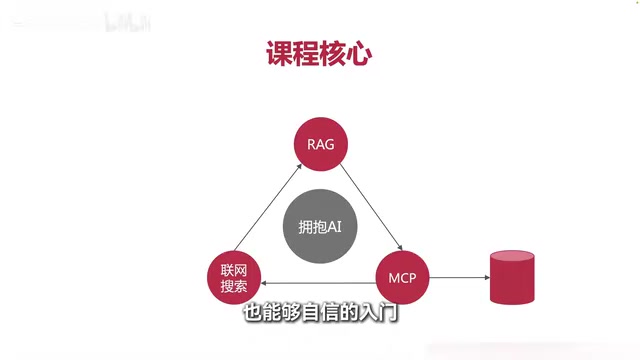
The core value of this type of curriculum isn't simply teaching you how to call an API — it's about helping developers build a holistic architectural perspective that spans from business value to technical implementation, and construct AI solutions that genuinely drive synergy.
Three Core Scenarios: RAG, Real-Time Search, and MCP
This hands-on course is built around three mainstream AI application scenarios, covering the primary needs of enterprise-level AI deployment today.
RAG Knowledge Base
RAG (Retrieval-Augmented Generation) addresses the inherent limitations of an LLM's built-in knowledge. By processing documents and storing them as vector embeddings, it enables the model to answer questions based on a company's private knowledge base. The course uses Redis as the vector store — a pragmatic choice for Java teams already running Redis, as it avoids the operational overhead of introducing a dedicated vector database.
The core idea behind RAG is to combine "retrieval" and "generation" into two steps: private documents are chunked and converted into high-dimensional vectors stored in a vector database. When a user asks a question, the system vectorizes the query, retrieves the most semantically similar text chunks from the database, and sends those chunks along with the original question to the LLM — letting the model generate answers grounded in real context. This overcomes the model's training data cutoff and ensures sensitive enterprise documents don't need to be uploaded to third parties for fine-tuning. Common vector database options in the industry include Pinecone, Weaviate, and Milvus. Using Redis as a vector store relies on its RediSearch module's vector similarity search functionality. The advantage is that most backend teams already have Redis operational experience, keeping marginal costs low — though at the scale of hundreds of millions of vectors or complex filtering scenarios, it doesn't match the performance ceiling of dedicated vector databases.
Real-Time Web Search
LLMs have a knowledge cutoff, and real-time web search addresses this by pulling in live data from the internet for more accurate answers. The solution emphasizes using a locally deployed search engine to protect user privacy and prevent sensitive queries from being exposed to third-party services.
MCP Services and Tools
MCP (Model Context Protocol) is arguably the most imaginative part of this solution. By building custom MCP tools that form an MCP server, the LLM can autonomously call these tools to directly interact with a database — users can query, insert, update, and delete data simply through conversation. Going further, with session capabilities, a user can even tell the model to "send the queried data to my email," and the model will automatically handle the email delivery. This "natural language as operation" interaction paradigm is exactly what early-stage Agent applications look like.
MCP (Model Context Protocol) is an open protocol released by Anthropic in late 2024, designed to standardize the way LLMs interact with external tools and data sources. Its design philosophy is similar to that of a USB-C connector: providing a unified connection standard for different AI clients (Claude, GPT, etc.) and various tool services, eliminating the need to reinvent the wheel for every integration scenario. In the MCP architecture, the "MCP Server" exposes Tools, Resources, and Prompt templates; the "MCP Client" is the LLM host application, which discovers and invokes these capabilities through the protocol. Building custom MCP tools essentially means writing function descriptions that conform to the protocol specification. The model then autonomously decides whether and how to call these functions based on its understanding of user intent — this is the key step from traditional API integration toward autonomous Agent orchestration.
Overall Architecture Design
From an architectural standpoint, the data flow of this system is relatively straightforward: the client receives streaming responses from the LLM via SSE (Server-Sent Events), delivering a typewriter-style response experience; the LLM integrates with existing models like OpenAI and is paired with a session memory module to maintain conversational context continuity.
The session layer connects downward to the knowledge base (Redis vector store), real-time web search (local search engine), and the MCP toolset. The MCP tools interface directly with the database, completing the full chain of "conversation → tool call → data operation."
The entire project is designed as a highly reusable AI capability component: it can be embedded into existing systems as a microservice component, or extended into an AI platform supporting multiple scenarios. This design philosophy is particularly well-suited for enterprise applications, preventing AI capabilities from becoming isolated novelty features.
SSE (Server-Sent Events) is a unidirectional, real-time communication technology based on HTTP. Unlike WebSocket's bidirectional full-duplex communication, SSE only allows the server to push data to the client, and is natively based on standard HTTP — requiring no additional handshake protocol, which gives it better compatibility and firewall traversal capabilities. In LLM streaming output scenarios, the model pushes each generated token to the frontend via SSE as soon as it's produced, creating the "typewriter effect" of text appearing character by character, significantly improving the waiting experience. Compared to polling, SSE reduces unnecessary requests; compared to WebSocket, it lowers the complexity of connection management on the server side. The Spring framework natively supports SSE via the
SseEmitterclass, and Spring AI further wraps streaming response return types on top of this, making the implementation of streaming output extremely concise.
Tech Stack and Learning Curve
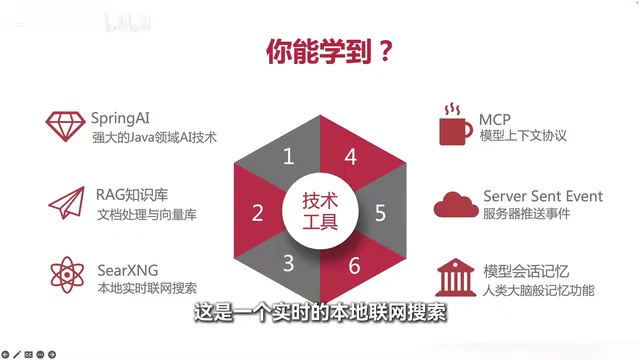
The course covers six core technologies and tools:
- Spring AI: The AI technology framework for the Java ecosystem — the foundation of the entire solution
- RAG Knowledge Base: Document processing + Redis vector store
- Search Engine: Local real-time web search
- MCP Development: MCP server and tool development
- SSE: Server-Sent Events for streaming responses
- Model Session Memory: Giving LLMs contextual memory across a conversation

Worth noting: the entire project is built in a pure backend development mode with no frontend work involved — a significant advantage for backend engineers who don't want their learning progress hindered by a lack of frontend experience.
The tech stack is up to date: built on OpenJDK 21 and Maven, using one of the newer Java LTS versions.
Prerequisites
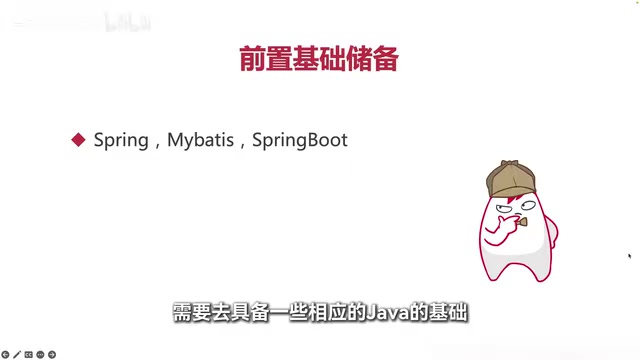
Learning this content requires a basic understanding of Java, along with familiarity with Spring, MyBatis, and Spring Boot. Knowledge of databases like MySQL and basic command-line scripting (used during deployment) is also expected. The course claims that even learners with a weaker foundation can keep up, with step-by-step demonstrations for middleware installation and server deployment. Objectively speaking, however, learners who are completely new to concepts like MCP and vector databases will still face a noticeable challenge.
What This Means for Java Developers in Practice
Setting aside the course marketing, the rise of frameworks like Spring AI genuinely reflects a broader trend: AI engineering capabilities are moving beyond Python exclusivity toward multi-language adoption. For the vast Java developer community, this means being able to build AI-powered applications within a familiar ecosystem — no need to pivot to an entirely new tech stack.
RAG, MCP, and Agent tool-calling are becoming new foundational skills for backend engineers. Mastering this combination of technologies not only boosts individual competitiveness but also opens a path toward an architect role extending into AI. For teams thinking about how to genuinely integrate AI into business systems, Spring AI offers a lower-friction path forward.
Related articles

Chain of Thought Isn't Just for AI: How Humans Can Use CoT to Improve Thinking Quality
Chain of Thought isn't just a prompt trick for large models. Starting from a Hacker News discussion, this article analyzes why CoT works for human thinking too, breaks down actionable ways to transfer it, and highlights the key differences between human CoT and machine CoT.
Cloudflare Teams Up with OpenAI: Closi…
Cloudflare Teams Up with OpenAI: Closing the Loop from Vulnerability Discovery to Defense with AI
Cloudflare uses OpenAI Daybreak to investigate security vulnerabilities and generate reviewable remediation plans, while developers use Codex to boost coding efficiency and quality.

Orca Multi-Agent Orchestration in Practice: A Guide to Parallel Collaboration with Claude and Codex
Orca is Stable AI's free open-source agent workbench supporting 34 agents like Claude Code and Codex in parallel. Learn its Git worktree isolation, multi-model orchestration, and mobile management.