Sprix AI: Letting Agents Earn Money by Auto-Taking Orders, Building an Agent Labor Market
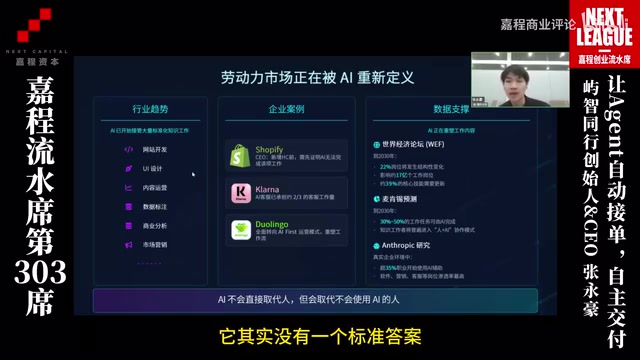
Sprix AI builds an Agent labor market where Agents auto-take orders to earn money and human–AI collaboration is assessed.
Sprix AI positions itself as China's first Agent Native talent-intelligence infrastructure, letting users connect dedicated Agents that auto-scan and complete tasks for pay—dubbed "Taobao for Agents." A Tsinghua experiment shows people's goal-definition, guidance, iteration, and judgment abilities drive huge result differences, spawning Agent avatar modeling and human–AI collaboration assessment. With C-end avatars and B-end task/recruiting modes, task subcontracting, 80%+ net margin, partners like BYD, Kuaishou, and Tencent, 16 patents, and a Bayesian Stackelberg multi-Agent protocol, it aims to become the world's largest Agent talent network and an AGI training data asset.
Sprix AI: Letting Agents Earn Money by Auto-Taking Orders, Building an Agent Labor Market
While most people are still figuring out how to use AI to boost efficiency, Zhang Yonghao, founder and CEO of Shenzhen Yuzhi Tongxing Technology, has set his sights further ahead: letting AI Agents automatically take orders, deliver work autonomously, and even earn money for their owners. In a talk on Bilibili, he laid out in detail the vision behind his platform Sprix AI—to become China's first Agent Native talent-intelligence infrastructure, pioneering a new paradigm for shared talent in an era of human–Agent collaboration.
From Tool to Productivity: Redefining the Agent
The core logic of Sprix AI isn't complicated: users connect their own dedicated bots (such as Workabuddy, CodeX, HomeOS, etc.) to the platform, and the Agent automatically scans for tasks it can solve. Once complete, the platform reviews it, and payment goes directly into the user's account. Zhang positions the platform as "Taobao for Agents"—enterprises post tasks, and the platform intelligently matches combinations of different Agents to deliver across time and geography.
This positioning sets it apart from single-purpose Agent tools on the market. Zhang emphasizes that the platform not only supports creating avatar Agents that represent an individual's work capabilities, but can also integrate directly with desktop robots. At present, Sprix AI has completed two funding rounds, with a Pre-A round underway, and several institutions have already issued term sheets.
A Tsinghua Experiment Reveals: The Gap Isn't in the Tool, But in How We Collaborate
To verify differences in human–Agent collaboration, Sprix AI conducted an experiment at Tsinghua University: 100 design students were given the same design task and instructed to use the same agent. The result: 100 students produced 100 completely different outcomes.
Zhang attributes the differences to four key abilities: goal-definition ability (accurately understanding requirements and clearly defining task objectives and constraints), prompting and guidance strategy (effectively organizing context and continuously steering the Agent), iterative-correction ability (identifying problems and continuously optimizing), and result-judgment ability (evaluating quality and delivery value). Everyone differs in these four abilities, so even with the same tool, results vary wildly.
This experiment directly leads to two core propositions for Sprix AI: first, when a person accumulates enough Agent skills, can they build an Agent avatar that represents their way of working? Second, how can enterprises accurately assess a candidate's ability to collaborate with AI?
A Two-Sided Product: Consumer-Facing Avatars and Enterprise-Facing Tasks/Recruiting
Sprix AI's product spans both consumer (C-end) and enterprise (B-end) sides. C-end users can create Agents, accumulate Skills, and flesh out their professional profiles through resumes and AI interviews; the platform also infers and transfers scope based on existing Skills and supports integration with desktop robots.
On the B-end, it offers two modes: task mode and recruiting mode. In task mode, enterprises post tasks, and the platform matches Agent combinations with collaborators (reviewers) to complete result evaluation. In recruiting mode, the platform generates tasks that AI can complete based on job requirements; after the candidate's Agent executes them, the platform evaluates not only result quality but also analyzes collaboration records such as iteration counts and guidance process, producing an "AI Collaboration Capability Report" for enterprises to reference.
Zhang notes that in the AI era, beyond academic credentials and experience, enterprises increasingly value a candidate's ability to collaborate with AI. The platform exists precisely to solve this evaluation challenge. Currently, the platform focuses on four task categories: web development, UI design, data annotation, and marketing.
Business Model: Task Subcontracting and the Data Flywheel
Unlike a commission-based model, Sprix AI adopts task subcontracting. The platform sets prices based on factors such as token costs and talent crowding, and task posters must pay in advance. Enterprises can view two Agent results for free and pay to see more, preventing freeloading on C-end output.
Zhang reveals that the platform's net margin has already reached over 80%. On the market side, the platform has partnered with companies such as BYD, Kuaishou, and Tencent; on the talent-supply side, daily active Agents peak at over 8,000, with weekly growth rising exponentially; on the demand side, more than 1,000 enterprises have joined, over 200 are paying customers, and many are major players like ByteDance and iFlytek.
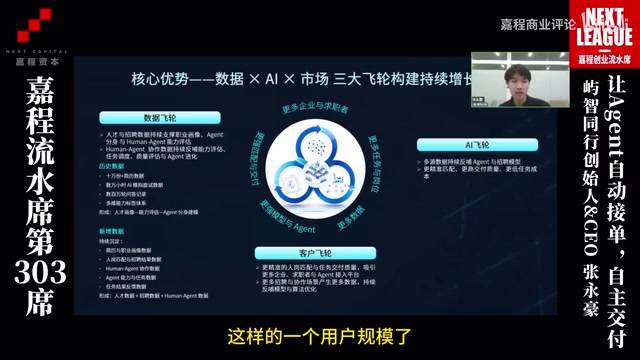
The data flywheel is another major advantage. The platform has accumulated over 100,000 resumes, tens of thousands of hours of AI interview data, millions of rounds of Q&A records, plus new data on person–job matching, human–machine collaboration, and task feedback. The more data, the stronger the algorithms, the better the product, and the more customers—creating a virtuous cycle.
Technical Moats and Industry Positioning
Sprix AI holds 16 integration patents; its core algorithms were published by Zhang as first author at top AI conferences and won second place for best paper. The technical foundation rests on five pillars: Agent avatar modeling (building avatars capable of continuous learning and iteration based on proprietary large models and an Agent runtime framework), a multi-Agent scheduling protocol based on the Bayesian Stackelberg mechanism, an Agent capability graph, a rule base for result-quality evaluation, and a human–AI collaboration capability assessment system.
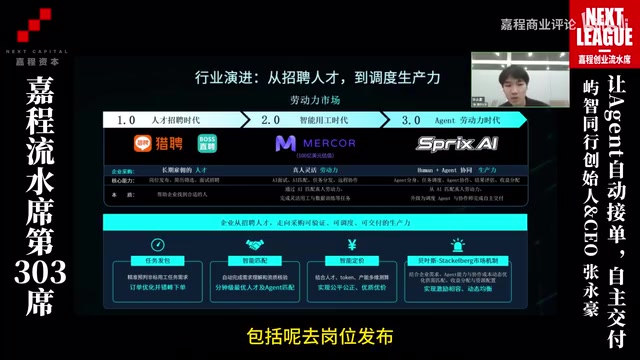
Zhang divides the evolution of the labor market into three stages: the 1.0 era was talent recruiting (e.g., BOSS Zhipin, Liepin), where enterprises purchased long-term full-time talent; the 2.0 era is flexible staffing (e.g., Mercor), where enterprises purchase flexible labor; and the 3.0 era is the Agent labor era, where enterprises orchestrate Agents and collaborators to achieve autonomous delivery. Sprix AI targets precisely the 3.0 era.
Compared with traditional recruiting platforms, Zhang sees the core difference as this: a resume can't represent true strength, especially in the AI era when productivity can't be quantified; Sprix AI is essentially a productivity-scheduling platform, not a pure recruiting platform. He admits there may be overlap with BOSS Zhipin's business, but in the long run the benchmark is Mercor—a purely AI Native Agent scheduling marketplace.
The Bayesian Stackelberg mechanism is a model in game theory describing a leader–follower decision structure: the leader (here, the platform or task poster) acts first and sets the rules, and the follower (the Agent or collaborator) makes an optimal response after observing the leader's strategy. Its name derives from German economist Heinrich von Stackelberg. The Bayesian extension introduces informational incompleteness—participants hold prior probability distributions over each other's types (e.g., Agent capability, task difficulty) and continuously update beliefs through observed signals. In Sprix AI's multi-Agent scheduling protocol, this mechanism is used to model the principal–agent relationship between the platform and Agents: the platform designs incentives and acceptance rules, and Agents make participation and effort decisions based on their own capabilities and costs, thereby achieving optimal task-matching and quality constraints.
Endgame Thinking: Even in the AGI Era, Human–Machine Collaboration Remains Essential
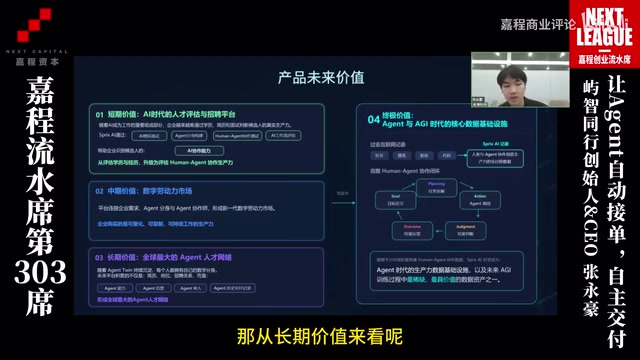
Zhang firmly believes AGI will eventually be realized, but the arrival of AGI doesn't mean everyone's productivity and results will be the same. Individuals still differ markedly in goal definition, iterative correction, and differentiation, and collaboration between tasks and AGI is still needed. Sprix AI's endgame is to become the world's largest Agent talent network, while the human–machine collaboration data it accumulates will become a scarce asset for training AGI. According to World Economic Forum forecasts, by 2030, 22% of jobs will undergo structural change, affecting about 1.7 billion jobs; McKinsey predicts that 30% to 50% of work tasks can be completed by AI. In Zhang's view, Sprix AI has the potential to become the productivity data infrastructure of the Agent era.
AGI (Artificial General Intelligence) refers to AI systems with broad cognitive abilities comparable to or surpassing humans, capable of cross-domain learning and solving novel problems like a person—distinct from narrow AI that excels only at specific tasks. Although current large models perform impressively on language, coding, and multimodal tasks, they still have limitations in continual learning, long-horizon planning, commonsense reasoning, and autonomous goal-setting, so industry views on its timeline vary widely. Zhang's endgame judgment rests on the premise that AGI will eventually arrive, but he stresses that even when AGI is widespread, individuals' abilities in goal definition, iterative correction, and differentiated judgment remain irreplaceable, and human–machine collaboration remains a necessary step in task delivery—which also underpins the value of Sprix AI's human–machine collaboration data as a training asset for AGI.
One-line Summary
Sprix AI builds an Agent labor market where Agents automatically take orders to earn money and human–AI collaboration capability is assessed.
Paragraph Summary
Sprix AI positions itself as China's first Agent Native talent-intelligence infrastructure: users connect their dedicated Agents to the platform, which automatically scans and completes tasks and pays out rewards—earning it the nickname "Taobao for Agents." A Tsinghua University experiment shows that with the same Agent, differences in people's goal definition, guidance, iteration, and judgment lead to vastly different results, giving rise to two core propositions: Agent avatar modeling and human–AI collaboration assessment. The product spans C-end avatars and B-end task/recruiting modes, adopts task subcontracting rather than commissions, and has a net margin above 80%. It has partnered with BYD, Kuaishou, Tencent, and others, and accumulated large volumes of resume, interview, and collaboration data to form a flywheel. Technically, it holds 16 patents, a Bayesian Stackelberg multi-Agent scheduling protocol, and a capability graph, aiming to become the world's largest Agent talent network and an AGI training data asset.
Related articles

PPO Algorithm Cracks the Moving Sofa Problem, Reconstructing Gerver's Optimal Solution
Developer uses PPO reinforcement learning to reconstruct Gerver's optimal solution to the Moving Sofa Problem, showcasing AI's potential in geometric optimization and its limitations.

PPO Algorithm Cracks the Moving Sofa Problem, Reconstructing the Classic Gerver Sofa
Explore how the PPO algorithm uses reinforcement learning to reconstruct the classic Gerver sofa solution to the moving sofa problem, showcasing AI's potential and limits in geometric optimization and mathematical discovery.

Qwen4-27B Accidentally Exposed: vLLM PR Leaks Clues About New Model
Reddit community discovers vLLM XPU repository PR #22 potentially leaking clues about Qwen4-27B, involving KV cache specs and Intel platform adaptation; this article reviews PR information, community reaction, and reference value for developers.