SQLAlchemy 2.1.0 Released: The Continued Evolution of Python's Premier ORM

SQLAlchemy 2.1.0 released, continuing the 2.x series' push toward modern type annotations and async support.
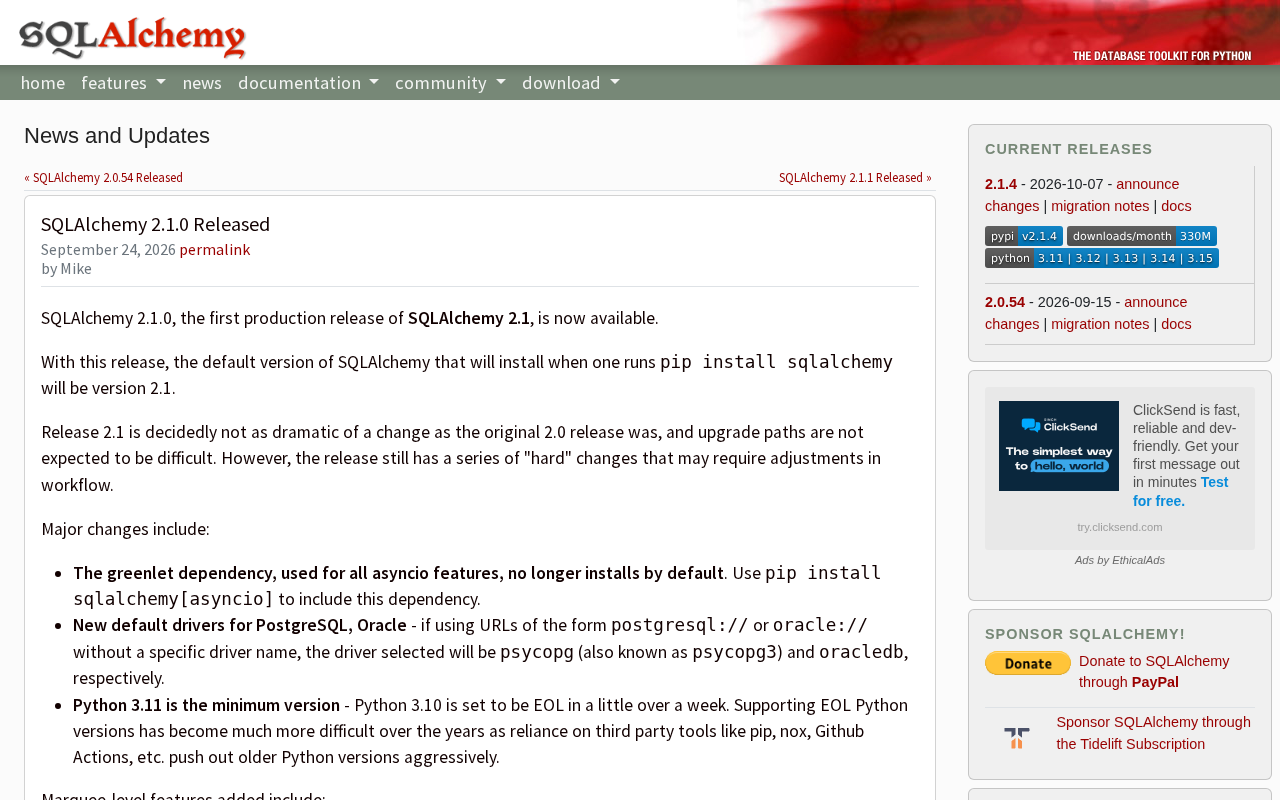
SQLAlchemy 2.1.0 has been officially released, continuing the modernization foundation laid by 2.0: a unified Core/ORM query interface, declarative type annotation support via `Mapped[]`, and improved asyncio capabilities. Widely used in Flask, FastAPI, and other web framework data layers, this minor release focuses on async improvements, driver compatibility, and query performance. Teams still on version 1.4 are encouraged to reassess their migration plans.
SQLAlchemy, the most mature and widely used database toolkit and object-relational mapping (ORM) framework in the Python ecosystem, has released version 2.1.0. The announcement sparked discussions across technical communities including Hacker News. For developers who rely on SQLAlchemy to build their data layers, every major version update is worth paying attention to.
SQLAlchemy's Place in the Python Ecosystem
SQLAlchemy is far more than a simple ORM. It consists of two core components: the lower-level SQLAlchemy Core, which provides an abstraction layer for SQL expression building that lets developers construct type-safe SQL queries using Python code; and the upper-level ORM, which builds on top of Core to offer full object mapping capabilities, binding database tables to Python classes.
This layered design is what makes SQLAlchemy suitable both for high-performance scenarios that require fine-grained SQL control and for rapid application development. From the data layers of web frameworks like Flask and FastAPI to data engineering pipelines and backend services, SQLAlchemy is effectively the de facto standard for relational database operations in Python.
The core abstraction in SQLAlchemy Core is the SQL Expression Language, which maps SQL constructs like SELECT, JOIN, and WHERE into composable Python objects. This is fundamentally different from concatenating raw SQL strings: the expression language preserves the structural information of a statement at the Python level, allowing dialect adaptation (generating different syntax for PostgreSQL, MySQL, SQLite, and others), parameter binding, and SQL injection protection to all be handled uniformly within the framework. The ORM layer on top introduces the Unit of Work pattern, where the Session object tracks state changes across all managed objects and automatically generates the minimal sequence of INSERT/UPDATE/DELETE operations at commit time — no manual management of individual write statements required.
The Technical Direction of the 2.x Series
Starting with version 2.0, SQLAlchemy underwent a landmark architectural upgrade. 2.0 unified the query interfaces for Core and ORM, introduced the new select() style API, and significantly enhanced support for Python type hints. Developers can now use declarative syntax like Mapped[] for better IDE auto-completion and static type checking.
2.1.0 continues this modernization trajectory as the next step in the 2.x series. Minor version updates like this typically focus on several areas: further improvements to asyncio support, compatibility updates for new database drivers, query compilation performance optimizations, and fixes for lingering issues from earlier API changes. For projects already on 2.0, upgrading to 2.1.0 is generally a low-cost migration.
Mapped[] is the declarative type annotation syntax introduced in SQLAlchemy 2.0, built on Python's PEP 484 type system. When defining models, writing name: Mapped[str] allows the framework to infer column types, nullability, and relationship loading strategies without any additional metadata. This design enables static analysis tools like mypy and Pyright to understand the attribute types of ORM objects, providing precise auto-completion in IDEs and catching type mismatches early. Compared to the 1.x approach of relying on Column() and runtime reflection, the new syntax truly integrates data model definitions with the Python type system — and is one of the signature changes of the 2.x "modernization" effort.
Practical Considerations When Upgrading
While a minor version increment implies relatively controlled breaking changes, upgrading any core dependency in a production environment still warrants careful evaluation. Here's what developers should prepare before upgrading:
- Review the official migration documentation: The SQLAlchemy team is known for thorough documentation, and the changelog clearly marks deprecations and behavioral changes.
- Run your full test suite: Behavioral changes in the ORM layer often hide in the details of query generation and session management — solid test coverage is a prerequisite for a safe upgrade.
- Pay close attention to async-related changes: If your project uses async features like
AsyncSession, keep a close eye on any API adjustments in that area.
For projects still on version 1.4, the release of 2.1.0 is also an opportunity to reassess migration plans. Version 1.4 once served as a transitional release toward 2.0 with a compatibility mode, but staying on an older version long-term means missing out on the type support and performance improvements in newer releases.
Version 1.4 historically played a special role as a "dual-mode transition" release: it supported both the legacy Query API and the new select() style simultaneously, and offered a future=True flag to let developers preview 2.0 semantics ahead of time — designed to allow large codebases to migrate in stages rather than all at once. However, as the 2.x series has matured, security fixes and feature updates for 1.4 have gradually wound down. For projects still using the old-style session.query(Model).filter(...) patterns, the main migration effort involves rewriting queries to the select(Model).where(...) style and adapting to the new recommended usage of session context managers. SQLAlchemy provides official migration guides and helper tools like sqlalchemy-migrate to reduce the risk of this process.
Conclusion
The release of SQLAlchemy 2.1.0 reflects the continued vitality of this long-standing project. As asynchronous programming and typed Python development become increasingly mainstream, SQLAlchemy continues to solidify its position as foundational data layer infrastructure through steady, reliable version iteration. For teams that depend on it, staying aware of version updates and planning upgrades thoughtfully is an important part of keeping a healthy tech stack.
Note: This article is based on publicly available release information. For specific feature changes and upgrade details, please refer to the official SQLAlchemy release notes.
Related articles

From Photons to Production: An Open-Source Computer Vision Engineering Reading Path
Reddit user open-sources a computer vision engineering reading path with 16 chapters from image formation to production deployment, emphasizing primary sources, dependency order, and reproducible benchmarks to help engineers understand why models fail and build reliable vision systems.

Prompt Failures? The Truth About Why AI Agents Struggle in Production—and How to Fix It
A Reddit developer built Agents with Copilot and Gemini but faced unstable behavior. This article analyzes three gaps in prompt engineering for Agent scenarios and offers three practical paths to reliable Agent deployment, including structured prompts, workflow-first approaches, and building an evaluation loop.

Tesla Robotaxi to Open Private Vehicle Access Next Year: Promise or Pipe Dream?
At its Q3 earnings call, Tesla said owners can add their cars to the Robotaxi fleet next year. We analyze the technical basis, Musk's missed deadlines, business logic, and competition.