SRCoT: A Closed-Loop Retrieval-Reflection-Correction Architecture for Edge LLMs
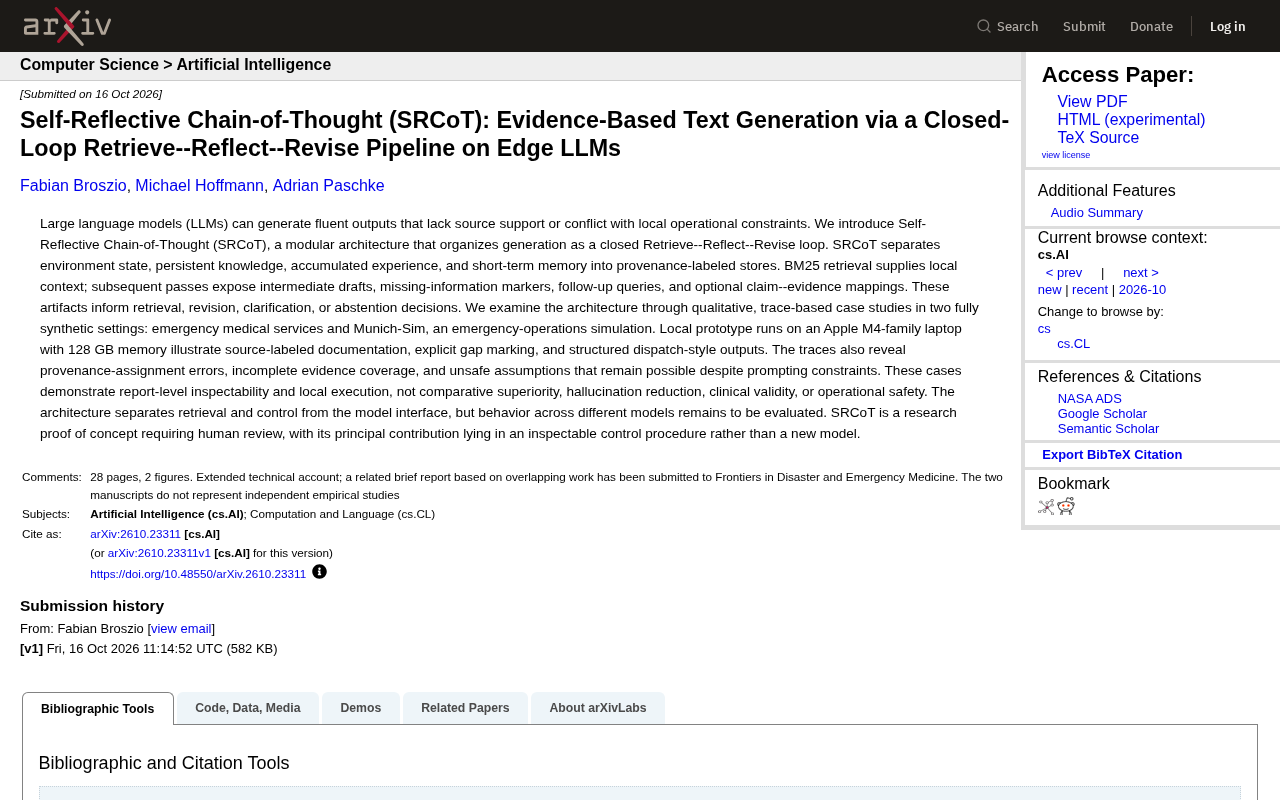
SRCoT uses a retrieval-reflection-correction loop to make edge LLM outputs traceable and auditable, but it is only a proof of concept.
The paper proposes the Self-Reflective Chain-of-Thought (SRCoT) architecture, organizing edge LLM generation into a retrieval-reflection-correction closed loop. It separates environmental state, persistent knowledge, accumulated experience, and short-term memory into four layers of source-labeled storage, uses BM25 retrieval for local context, and drives decisions to continue retrieving, revise, clarify, or abstain by exposing intermediate drafts, missing-information markers, follow-up queries, and claim-evidence mappings. Trace-based qualitative case studies are conducted in two synthetic scenarios—emergency medical services and Munich-Sim—with the prototype running on an Apple M4 laptop. The paper explicitly limits its conclusions: it only demonstrates report-level auditability and local execution capability, not comparative advantage, hallucination reduction, or operational safety; the traces also expose failure modes such as source misattribution, incomplete evidence coverage, and unsafe assumptions.
Large language models can generate fluent text, but these outputs often lack source grounding or conflict with local operational constraints. A new paper proposes the Self-Reflective Chain-of-Thought (SRCoT) architecture, which attempts to make the generation process of edge LLMs traceable and auditable through a closed-loop "retrieval—reflection—correction" workflow.
Core Design: Four-Layer Storage with Source Labeling
The core idea of SRCoT is to decompose the generation process into multiple modules and store information categorized by source. The architecture separates environmental state, persistent knowledge, accumulated experience, and short-term memory into storage units with source labels. BM25 retrieval provides local context, and subsequent rounds expose intermediate drafts, missing-information markers, follow-up queries, and optional claim-evidence mappings.
These intermediate artifacts directly influence the next decision: whether to continue retrieving, revise the draft, request clarification, or choose to abstain. This design separates retrieval and control logic from the model interface, making the entire reasoning chain visible to developers.
BM25 retrieval is a classic sparse retrieval algorithm that scores document-query relevance based on term frequency (TF) and inverse document frequency (IDF), incorporating document length normalization and tunable parameters k1 and b to balance term-frequency saturation and length penalty. It does not rely on vector embeddings, is computationally lightweight, and is highly interpretable, so it is often used as the preferred baseline for local context retrieval on resource-constrained edge devices. SRCoT's choice of BM25 over dense retrieval aligns with its positioning of "local execution, visible process": retrieval results map directly to specific document terms, making it easier to trace sources in subsequent claim-evidence mappings.
Edge LLM refers to large language models deployed on end devices (such as laptops, phones, or edge servers) rather than in the cloud. Constrained by VRAM, compute power, and energy consumption, edge models typically have smaller parameter counts, limited context windows, and often cannot access external networks. This brings two direct constraints: first, retrieval must rely on local knowledge bases; second, the generation process lacks the multi-turn self-correction capability of large cloud models. SRCoT's closed-loop design and four-layer storage essentially compensate for the model's own limitations under these constraints through explicit process control.
Trace-Based Experiments in Two Synthetic Scenarios
The study examines the architecture through trace-based qualitative case studies, all in fully synthetic settings: one is emergency medical services, and the other is an emergency operations simulation environment called Munich-Sim. The local prototype runs on an Apple M4-series laptop with 128GB of memory, demonstrating source-labeled documents, explicit gap markers, and structured scheduling-style outputs.
Interestingly, the paper explicitly delineates the boundaries of its conclusions: these cases demonstrate report-level auditability and local execution capability, not comparative advantage, hallucination reduction, clinical validity, or operational safety. Such self-limitation is uncommon in research papers and suggests the work remains at the proof-of-concept stage.
Trace in systems and software engineering refers to the structured record left by an execution process, including the inputs, outputs, intermediate states, and decision rationale of each step. In LLM contexts, traces typically record retrieved documents, generated drafts, triggered tool calls, and final outputs, thereby supporting post-hoc auditing and fault localization. SRCoT's use of "trace-based qualitative case studies" as its evaluation method means it does not pursue statistically significant performance comparisons, but rather demonstrates through step-by-step records how the architecture operates in real workflows and where it fails—consistent with the paper's self-limited conclusions.
Munich-Sim is a synthetic simulation environment for emergency response and disaster management, used to reproduce operational workflows such as dispatch, resource allocation, and information reporting under controlled conditions. Choosing synthetic scenarios over real data avoids privacy and ethical restrictions in the medical and emergency domains, while allowing researchers to precisely control environmental states and injected gaps to observe the architecture's behavior under "incomplete information" conditions. This also explains why the paper can only claim to demonstrate auditability, not clinical validity or operational safety.
Exposed Failure Modes Are Equally Valuable
The traces also reveal problems that can still occur despite prompt constraints: source misattribution, incomplete evidence coverage, and unsafe assumptions. The existence of these failure modes precisely illustrates that the value of a closed-loop architecture lies not in eliminating errors, but in making errors localizable and auditable.
For scenarios that require locally deployed LLMs with traceability requirements for outputs—such as emergency dispatch or medical documentation assistance—this auditability may be more important than raw generation quality. But the paper also acknowledges that the architecture's behavior across different models remains to be evaluated.
Positioning: An Auditable Control Workflow
SRCoT's main contribution is an auditable control procedure rather than a new model. It is a research proof-of-concept that requires human review. For developers concerned with edge LLM deployment, retrieval-augmented generation, and the auditability of AI outputs, this architecture offers a design paradigm worth referencing: make retrieval, reflection, and correction an explicit closed loop rather than hiding them in the model's implicit reasoning.
One-line Summary
SRCoT uses a retrieval—reflection—correction loop to make edge LLM outputs traceable and auditable, but it is only a proof of concept.
Paragraph Summary
The paper proposes the Self-Reflective Chain-of-Thought (SRCoT) architecture, organizing the generation process of edge LLMs into a "retrieval—reflection—correction" closed loop. The architecture separates environmental state, persistent knowledge, accumulated experience, and short-term memory into four layers of source-labeled storage, uses BM25 retrieval to provide local context, and drives decisions to continue retrieving, revise, clarify, or abstain by exposing intermediate drafts, missing-information markers, follow-up queries, and claim-evidence mappings. The study conducts trace-based qualitative case studies in two synthetic scenarios—emergency medical services and Munich-Sim—with the prototype running on an Apple M4 laptop. The paper explicitly limits its conclusions: it only demonstrates report-level auditability and local execution capability, not comparative advantage, hallucination reduction, or operational safety; the traces also expose failure modes such as source misattribution, incomplete evidence coverage, and unsafe assumptions.
Related articles

iPhone Duo Review Controversy: Why Apple's First Foldable Is Said to 'Should Be Called an iPad'
The Vergecast debates the iPhone Duo review controversy: is a 7 fair? Why are apps struggling? Why critics say it 'should be called an iPad'? We unpack Apple's first foldable's positioning mismatch and first-gen compromises, plus AI security flaws and agentic shopping.

Meta vs. Publishers: The AI Data Battle Over Terms of Service Changes and the Future of the Internet
Meta changed its business account terms to allow AI training on linked website data, sparking backlash from publishers and creators. Industry groups demanded negotiations, forcing Meta to remove 'training' wording and delay the effective date. The dispute reveals the deeper battle over data authorization and the future of the internet in the AI era.

When Outside Xbox Meets Blood on the Clocktower: A Legion Match in Minecraft
Outside Xbox guests Ellen and Mike play Minecraft Blood on the Clocktower in a Legion game. How can three good players fight an evil majority amid information noise? This article breaks down Legion mechanics, information-role mind games, and the endgame reversal.