Staats: An Agent-Native Website Analytics Tool That Needs No Dashboard

Staats replaces analytics dashboards with AI Agent conversations for developer-centric site insights.
Staats is an Agent-native website analytics tool that eliminates traditional dashboards and cookies. Instead, it lets coding Agents directly interpret site data, measure the impact of deployments, and provide evidence-backed optimization suggestions. By aligning analytics with deployment cycles and using conversational queries, Staats represents a growing trend of designing tools for AI Agents rather than human interfaces.
When Analytics Tools Meet AI Agents
Website analytics tools have been around for over two decades. From early log analysis to Google Analytics to various cookie-free, privacy-friendly solutions, their core delivery format has never really changed — a dashboard stuffed with charts and numbers. Users are left to interpret the data themselves, identify trends, spot problems, and ultimately decide what to do next.
Staats, a new product that recently appeared on the Product Hunt rankings, is trying to break this convention. Its tagline is refreshingly rebellious: "Ask your coding agent how your site is doing." On launch day, the product received 70 upvotes, ranking 12th on the daily leaderboard, and was categorized under Analytics, SaaS, and Artificial Intelligence.
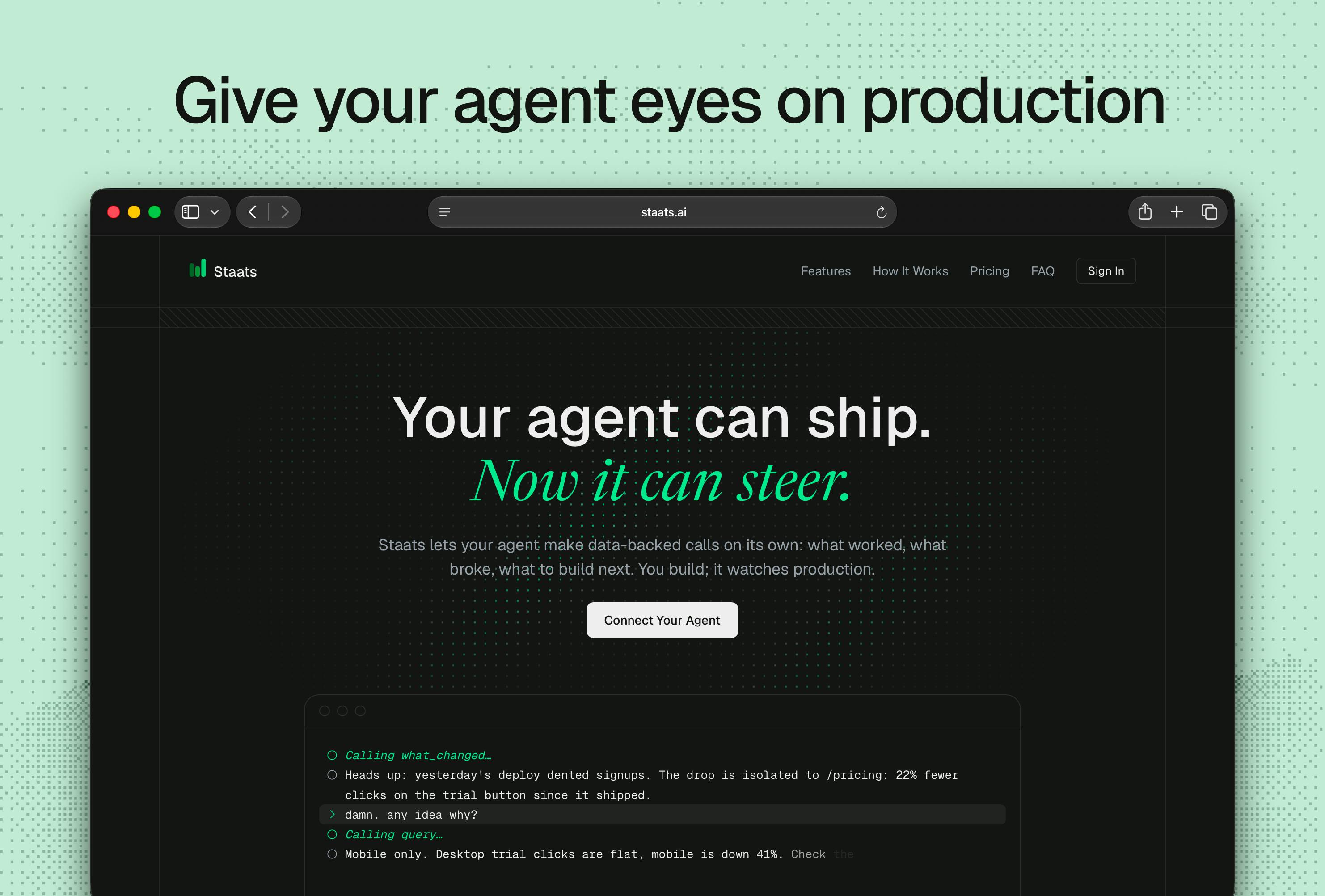
Staats positions itself as an "Agent-native" website analytics tool. It requires no cookies, relies on no traditional dashboards, and instead exposes data in a way that AI coding assistants can directly understand and invoke. In other words, its target users aren't entirely human — they're the coding Agents that are already deeply embedded in developer workflows.
Core Features of Staats
According to its official description, Staats' capabilities can be summarized in three actions: measure deploys, flag changes, and suggest next moves — and every suggestion comes with evidence.
Tying Website Analytics to the Deployment Cycle
Traditional analytics tools focus on traffic dimensions — page views, bounce rates, conversion funnels. A distinctive feature of Staats is that it directly links data changes to "deployments" as a development activity. After you ship a new version, it can measure the impact of that deployment and identify which metrics changed significantly.
This design philosophy is clever: what developers care most about usually isn't "how is the website doing overall," but rather "did that change I just made make things better or worse?" Aligning analytics data with code deployment cycles essentially translates website analytics from operations language into engineering language.
Conversational Analytics With No Charts to Read
Staats explicitly claims "No dashboard, no charts to read." This is a bold choice in the analytics space. It assumes users already have a coding Agent (such as an AI assistant integrated into their IDE or terminal), and completely outsources the "interpretation" step of data analysis to AI.
You don't need to stare at line graphs to judge trends. Instead, you simply ask your Agent: "How is my site doing lately?" The Agent calls Staats' data, combines it with context, and delivers evidence-backed conclusions and recommendations. This interaction model transforms analytics from a "visual interpretation task" into a "conversational query task."
Why Agent-Native Is a Product Direction Worth Watching
Staats reflects a trend that's rapidly taking shape: more and more tools are being designed for AI Agents rather than human interfaces. As coding Agents like Claude Code, Cursor, and GitHub Copilot become deeply embedded in developers' daily workflows, the "consumer" of tools is shifting from humans to AI.
From UI-First to API-and-Context-First
Over the past decade, SaaS product competition was largely a UI/UX competition — whoever had the more beautiful, more readable dashboard had the advantage. But under the Agent-native paradigm, this logic gets upended. Agents don't need beautiful charts; they need structured, semantically clear, directly reasonable data interfaces.
This means the focus of product design shifts from "how to help humans understand quickly" to "how to help Agents understand accurately and provide reliable recommendations." Staats' emphasis on "suggest next moves with evidence" is a direct embodiment of this principle — it doesn't just provide raw data, but ensures the Agent's conclusions are well-supported, preventing AI from making things up.
Cookieless Data Collection: A Natural Move for Privacy and Compliance
It's worth noting that Staats uses a cookieless data collection approach. Against the backdrop of increasingly strict privacy regulations like GDPR and CCPA, and the gradual phase-out of third-party cookies, cookieless analytics has already become standard for next-generation analytics tools like Plausible and Fathom. Staats aligns with the industry mainstream on this front while also reducing the compliance burden.
Opportunities and Challenges Facing Staats
Staats' approach undoubtedly addresses a real pain point: developers are long tired of cumbersome analytics dashboards, and AI Agents are perfectly suited to play the role of "data translator." For indie developers and small teams who already use coding Agents as their primary tools, the experience of "casually asking and instantly knowing how your site is doing" is extremely appealing.
But this direction also faces clear challenges. First is the trust problem: when analytical conclusions are entirely generated by AI, how do users verify whether the Agent's judgments are accurate? Staats' emphasis on "with evidence" is precisely aimed at addressing this concern, but the transparency and traceability of the evidence chain will directly determine the product's credibility.
Second is the dependency problem: Staats' value is highly dependent on users already owning and being proficient with coding Agents. For traditional teams that haven't yet adopted AI workflows, this product actually has a higher barrier to entry. It's essentially betting that the future where "every developer has an Agent by their side" will arrive soon.
Finally, there's the boundary of deep analysis: conversational queries are great for quickly obtaining conclusions, but for complex analytical scenarios requiring multi-dimensional cross-referencing and long-term trend comparisons, whether pure Agent interaction is sufficient remains to be proven. Completely abandoning charts might actually represent a loss of capability in certain scenarios.
Conclusion
Staats is a textbook case of "redesigning traditional tools for the AI era." Rather than competing on dashboard aesthetics, it simply migrated the entire interaction paradigm onto Agents. Whether this bold trade-off will be accepted by the market remains to be seen, but it clearly points in one direction: in a future where Agents are everywhere, the best interface for many tools might not be an interface at all — but a conversation.
For developers and entrepreneurs interested in AI-native product design, Staats is worth following as an ongoing case study — it represents not just an analytics tool, but an emerging product philosophy.
Related articles

Amphibious Transforming Drone: Beyond 100x Power Savings, What Are the Real Needs?
Is the amphibious transforming drone just a gimmick? Starting from the 100x power difference of the M4 Morphobot, explore real application scenarios and thesis topic ideas, analyzing boundary conditions where pure drones and pure ground robots both fail.

Warhound Raises $200 Million: Genetically Engineered "War Dogs" Paired with Anduril Gear
Warhound raises $200M, backed by Ben Lamm and Palmer Luckey, to genetically engineer dogs for military and law enforcement use and equip them with Anduril gear. This article analyzes its technology direction, funding logic, and ethical controversy.

Claude API Comes to Google Cloud: IAM Integration and SDK Access Guide
Anthropic hosts the full Claude API on Google Cloud with IAM-controlled permissions and unified billing. This guide covers the Vertex AI and Anthropic-hosted entry points, IAM role configuration, and SDK access.