Stalwart v1.0 Released: Claimed to Be the World's Fastest Mail Server
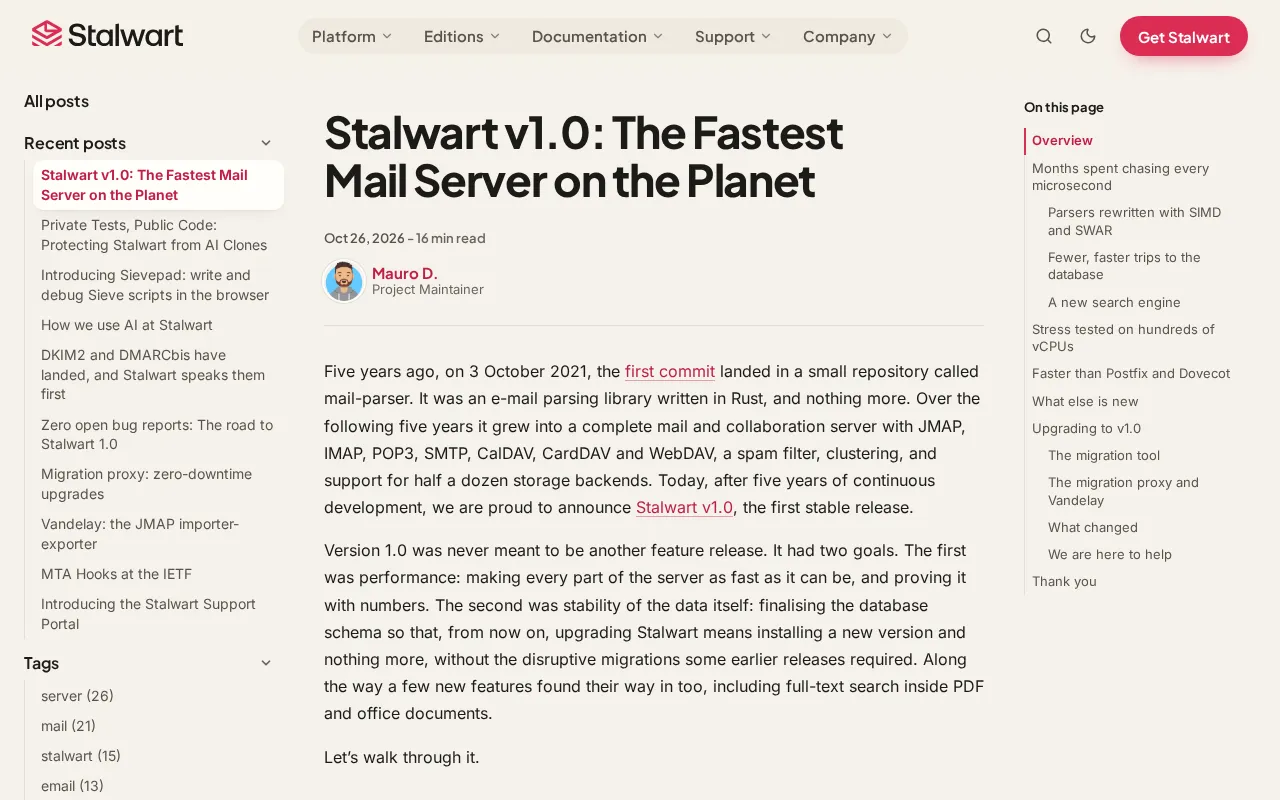
Stalwart v1.0 claims to be the world's fastest mail server with its Rust all-in-one architecture, sparking community interest and cautious discussion.
Stalwart v1.0 released with the tagline "the world's fastest mail server," sparking discussion on Hacker News. It rewrites the entire mail stack in Rust, integrating SMTP, IMAP, JMAP, and anti-spam capabilities into a single binary to reduce inter-process communication and configuration sync overhead. The article notes that mail server performance has long been underestimated, and traditional solutions largely inherit single-machine-era designs. Community discussion focuses on verifiable performance data, real-workload behavior, compatibility, and migration costs rather than marketing slogans. The author views v1.0 as a starting point worth watching, with production migration requiring caution.
Stalwart v1.0 Released: Claimed to Be the World's Fastest Mail Server
In the mail server space—long dominated by established projects like Postfix, Exim, and Dovecot—a new project called Stalwart recently sparked discussion on Hacker News. Its v1.0 release officially debuted with the tagline "the world's fastest mail server," taking a fundamentally different route from classic solutions in both technology choices and architectural design.
Why "Fast" Deserves to Be Called Out Separately
Mail server performance is often underestimated. Most people only care about whether sending and receiving works smoothly, rarely noticing the complexity behind the mail protocol stack: SMTP session management, IMAP indexing, anti-spam filtering, TLS handshakes, concurrent connection maintenance—each becomes a bottleneck as user scale grows. Traditional mail servers were mostly born in the single-machine era, with text-file-based configuration and scalability relying on stitching together external components.
Stalwart chose to rewrite the entire mail stack in Rust, unifying SMTP, IMAP, JMAP, and anti-spam capabilities into a single process. This combination of "all-in-one + modern language" is the foundation for its bold performance claims. Judging from the buzz on Hacker News, the developer community has always shown strong interest in such rewrite-style infrastructure projects—eager to see it deliver on performance promises, yet wary of whether it's just another benchmark champion.
Several abbreviations in the mail protocol stack deserve elaboration. SMTP (Simple Mail Transfer Protocol) handles mail delivery and relay, serving as the channel for server-to-server and client submission; IMAP (Internet Message Access Protocol) lets clients access and sync mailboxes on the server, with its indexing and sorting capabilities directly affecting search experience in large mailboxes; JMAP (JSON Meta Application Protocol) is a newer mail access protocol that carries data in JSON and supports more efficient sync and push, regarded as a modern alternative to IMAP. Anti-spam filtering typically involves sender authentication mechanisms like SPF, DKIM, and DMARC, along with content scoring rules. Traditionally these capabilities were spread across different daemons; Stalwart converges them into the same process—precisely the technical premise of its performance claims.
Architectural Trade-offs: All-in-One and Rust
Stalwart's design philosophy can be summarized in two points. First, a single binary carries all core mail service functionality, reducing overhead from inter-process communication and configuration synchronization. Second, Rust serves as the implementation language, leveraging its memory safety guarantees and zero-cost abstractions to achieve more stable latency under high concurrency.
For operators, this architecture means less component stitching and a simpler deployment path, but it also raises new considerations: does the all-in-one design enlarge the failure domain? Is the Rust ecosystem mature enough for mail protocol implementations? At the v1.0 stage, there are no long-term production answers to these questions—only time will tell.
The "zero-cost abstraction" mentioned is one of Rust's core design principles, meaning that high-level language features (such as generics, iterators, and traits) compile to machine code whose performance is no worse than hand-written low-level code, allowing developers to avoid trading off expressiveness against runtime efficiency. Complementing this are ownership and borrow checking, which eliminate data races and dangling pointers at compile time, making long-running high-concurrency network services less prone to memory-related crashes. For a mail server that must maintain large numbers of long-lived SMTP and IMAP connections simultaneously, these features mean more predictable tail latency and lower memory usage—but also require the team to have corresponding Rust engineering experience.
Community Concerns and Unanswered Questions
The discussion around Stalwart v1.0 on Hacker News was modest in scale but representative in direction. What followers care about is not marketing slogans but verifiable details: how performance data was measured, how it performs under real workloads compared to mature solutions like Postfix, how high migration costs are, and whether it supports common authentication and filtering extensions.
In other words, the "fastest" label is merely a hook; what really determines adoption is compatibility, stability, and operational friendliness. For teams considering replacing their existing mail systems, v1.0 should be viewed as a starting point worth watching rather than a signal to migrate immediately. Mail systems carry communication records and account systems—migration risk far exceeds that of ordinary web services.
Potential Impact on the Mail Infrastructure Landscape
The mail server market has lacked fresh blood for years. Stalwart's emergence at least demonstrates two things: modern systems programming languages are penetrating traditional infrastructure domains; and the value of all-in-one architecture in simplifying deployment is being reassessed. If subsequent versions prove stability in production environments and gradually fill interoperability gaps with mainstream solutions, it has a chance to become a pragmatic choice for small-to-medium-scale deployments.
But it's also worth noting that mail protocol compatibility is an extremely heavy burden—any new implementation needs polishing across numerous edge cases. v1.0 is a clear milestone, but there's still a long way to go before "fastest" transforms from a slogan into consensus.
One-line Summary
Stalwart v1.0 claims to be the world's fastest mail server with its Rust-based all-in-one architecture, sparking community interest and cautious discussion.
Paragraph Summary
Stalwart v1.0 released with the tagline "the world's fastest mail server," sparking discussion on Hacker News. It rewrites the entire mail stack in Rust, integrating SMTP, IMAP, JMAP, and anti-spam capabilities into a single binary to reduce inter-process communication and configuration sync overhead, achieving more stable latency under high concurrency. The article notes that mail server performance has long been underestimated, the protocol stack is highly complex, and traditional solutions largely inherit single-machine-era designs. Community discussion focuses more on verifiable performance data, real-workload behavior, compatibility, and migration costs rather than marketing slogans. The author views v1.0 as a starting point worth watching, with production migration requiring caution—whether it can deliver on its promises remains to be seen.
Related articles

How Do Cursor, Claude, and ChatGPT Actually Work? A Full Breakdown of the AI Tech Stack
Starting from real-world use of Cursor, Claude, and ChatGPT, this article breaks down the AI tech stack layer by layer: agent loops and the MCP protocol, pretraining and reinforcement learning, tokens and quantization, RAG retrieval and model routing, streaming output, and GPU infrastructure—helping you understand what each layer of an AI product does.

Gemini 4 First Test: Strong Value for Money, but Generation Quality Still Trails Competitors
Gemini 4 first test: ranks eighth on Agent Arena, enters the Pareto frontier at about two-thirds the price of 6 Sol, but 3D generation quality and stability trail Sonnet 5.5 and GPT 6.1 Sol, with weak game controllability.
Google Gemini 4 Carbon Tops the Benchmarks, API Pricing Targets Kimi
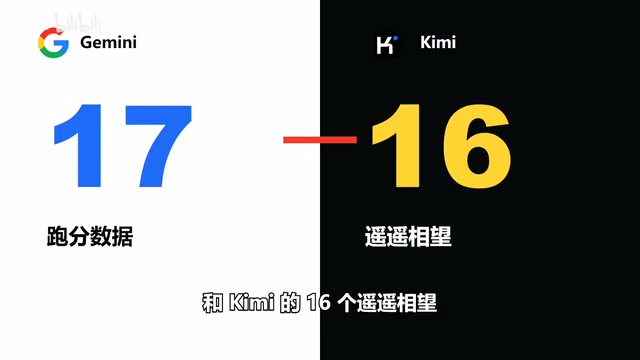
Google releases Gemini 4 Carbon, topping many of 17 benchmarks across general, coding, multimodal, long context, and cybersecurity, with API output pricing below Kimi K3.1 Pro and priority access for cybersecurity personnel.