Stanford Faces Backlash Over AI-Altered Student Photos Used in Advertising

Stanford's housing department allegedly used AI to swap students' racial features in ads, sparking debate over authenticity and consent.
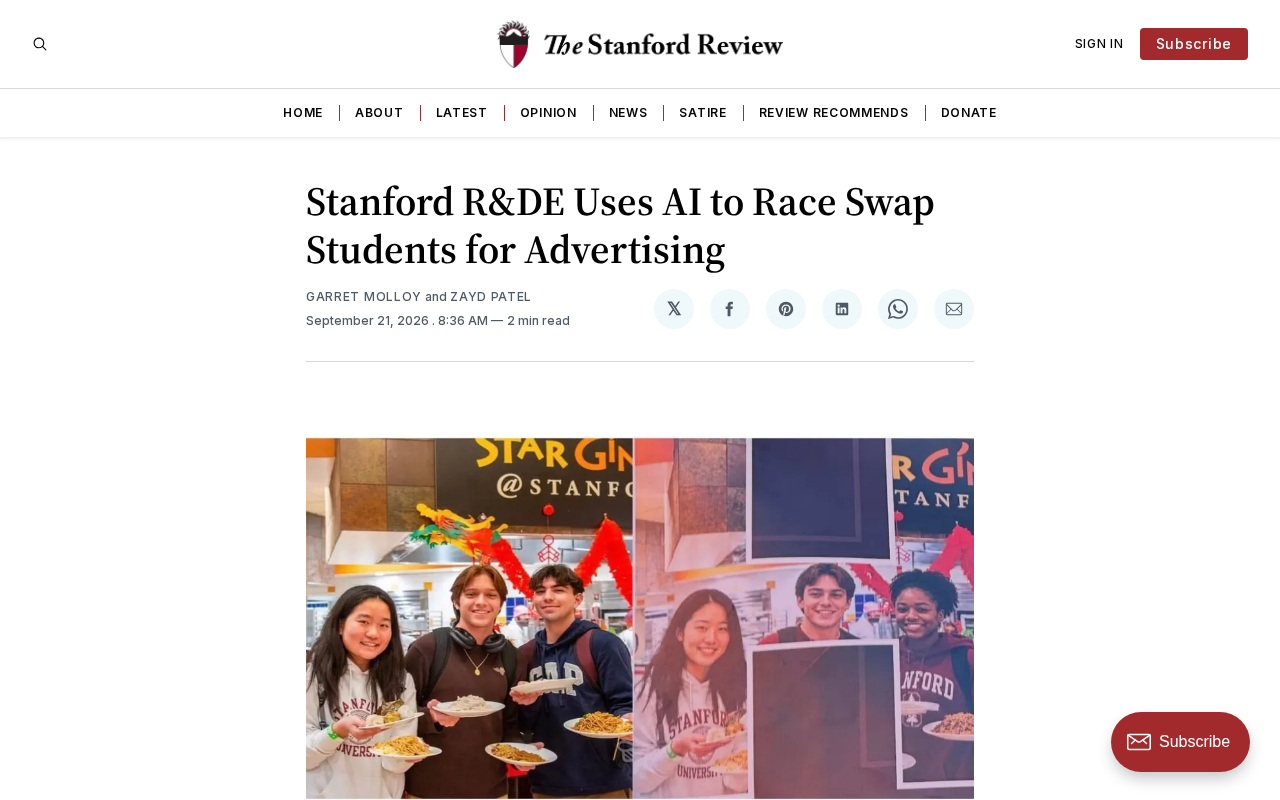
Stanford University's Residential & Dining Enterprises (R&DE) has been accused of using generative AI to alter students' racial features in official promotional materials, drawing widespread discussion on Hacker News. The controversy centers on two issues: authenticity — the AI-crafted "diverse campus" may not reflect actual student demographics — and informed consent, as it's unclear whether affected students authorized such alterations. Critics have called this "diversity washing," arguing that algorithmically fabricating inclusivity both misleads applicants and undermines the genuine value of diversity. The incident highlights the broader challenge institutions face in defining ethical boundaries for AI use as generative tools become increasingly accessible.
Overview
Stanford University's Residential & Dining Enterprises (R&DE) department has been accused of using AI technology to alter student photos in its promotional materials — specifically by changing students' skin tones and racial features to achieve so-called "diversity representation." The controversy sparked heated discussion on Hacker News, where the post received 56 upvotes and 42 comments.
The practice in question, commonly referred to as "race swapping," involves using generative AI tools to modify real photographs of individuals, transforming the apparent ethnicity of the subject to that of another race. When applied to official institutional marketing materials, this raises a host of sensitive issues around authenticity, informed consent, and representation.
The Core Controversy: Authenticity and Informed Consent
Based on available information, the backlash isn't primarily about AI technology itself — it's about the context and manner in which it was applied. University promotional materials are typically expected to reflect the genuine reality of campus life, and prospective students and their families treat them as reliable windows into the campus environment.
When an institution uses AI to artificially alter the racial characteristics of individuals in photographs, at least two distinct concerns arise. The first is an authenticity problem — the "diverse campus" being presented may not reflect the actual student population, but rather an algorithmically fabricated appearance. The second is a consent problem — whether the students whose photos were altered were aware of and agreed to such changes to their appearance remains unclear.
This kind of practice is easily read as "diversity washing": a superficial, performative gesture designed to project a politically acceptable image in marketing materials, which may ultimately obscure rather than reflect the institution's genuine commitment to diversity.
Informed consent carries specific legal and ethical weight in this context. Students who enroll or participate in university photo shoots typically sign image usage agreements, but the scope of such agreements is generally limited to use of their likeness "as-is" — it does not typically extend to substantive alterations of physical appearance. U.S. states vary in how strongly they protect the Right of Publicity; California's laws are relatively strict, and if a subject can demonstrate that their image was materially altered and used for commercial purposes without authorization, there is theoretically legal recourse. Beyond the legal dimension, altering a student's face to appear as a different ethnicity — even with ostensibly "positive" diversity intentions — constitutes a unilateral rewriting of that individual's identity, which fundamentally conflicts with their right to self-representation.
The Ethical Boundaries Behind the Misuse of Technology
Generative AI's capabilities in image editing have advanced rapidly in recent years, making it technically trivial to alter a person's skin tone or facial features. This is precisely why the ethical boundary between "what's possible" and "what's appropriate" has never been more important.
Using AI to modify a person's perceived race in advertising and promotional contexts crosses several lines worth taking seriously:
- Misleading audiences: Promotional materials should be grounded in authentic content. AI-driven race swapping may constitute a form of deception toward prospective students and families.
- Objectifying individuals: Treating real students' images as freely adjustable "assets" strips them of their subjectivity and dignity.
- Undermining the meaning of diversity: Genuine diversity comes from real, lived representation within a community. Algorithmically "generating" diversity is a deeply ironic subversion of that very value.
For an institution with Stanford's level of public influence, its choices in AI application carry significant precedent-setting weight — and are therefore subject to greater public scrutiny.
From a technical standpoint, today's mainstream AI image editing tools — including Adobe Firefly, Stable Diffusion's inpainting functionality, Midjourney, and others — can already precisely replace a person's skin tone, hair texture, and facial bone structure using text prompts or local masking, while leaving the background and pose intact. Tasks that once took professional retouchers hours can now be completed in seconds. This drastically lowered barrier dramatically increases the risk of casual misuse: decision-makers may execute what is fundamentally a racially charged manipulation without pausing for serious ethical reflection. Compounding the problem, existing AI content detection tools remain limited in their ability to accurately identify this type of "partial AI modification of real photographs," which further undermines the possibility of external oversight.
Community Discussion Reflects Broader Concerns
That Hacker News — a community primarily made up of technology professionals — engaged with this story at all signals that the misuse of AI in real-world contexts has become a widely shared concern within the tech community. The 42-comment thread indicates strong collective interest in the question of how institutions should use generative AI responsibly.
This incident should be understood within a broader context: as AI image generation and editing tools become ubiquitous, organizations across the spectrum — from news outlets to commercial advertisers to educational institutions — are grappling with where to draw the line on AI use. Any application of AI that lacks transparency and informed consent, regardless of intent, risks triggering a crisis of trust.
"Diversity washing" is a critical term that has emerged in recent years, derived from the concept of "greenwashing." It refers to institutions using superficial symbolic gestures to project an image of inclusivity, rather than pursuing genuine systemic structural change. Researchers who study institutional diversity have noted that such practices are harmful not only because they deceive audiences, but because they crowd out substantive conversations about real diversity challenges — and can foster a sense of alienation among actual minority members, who may feel instrumentalized as props for the institution's image. For universities specifically, the ethnic composition depicted in admissions marketing materials is already subject to federal Department of Education compliance scrutiny. Beyond the AI photo controversy itself, this reflects a long-standing structural tension in higher education between performative compliance and authentic transformation.
Conclusion
The controversy surrounding Stanford's R&DE is, at its core, a case study in how to balance "technical capability" with "institutional responsibility." AI can effortlessly alter the racial appearance of a person in a photograph — but whether institutions should do so, and how to deploy such technologies within a framework of transparency and consent, are the questions that truly demand answers.
For any organization considering the use of generative AI in its communications and marketing, this incident serves as a cautionary reminder: the convenience of technology cannot be used as a justification for bypassing ethical review. Authenticity and respect for individuals must always come first.
(Note: This article is based on publicly available discussion on Hacker News. The full details of the incident and Stanford's official response have yet to be fully verified.)
Related articles

"Black October": Did AI Uncover 3% of All Critical Vulnerabilities Ever?
A Reddit post claims 3% of all critical software vulnerabilities ever were found in the past month, dubbed 'Black October.' We break down the statistical issues, how AI-assisted code auditing accelerates discovery, and how developers should respond.

Microsoft Project Gecko: Using AI to Bridge Language Gaps for African Farmers
Microsoft's Project Gecko launches PharmaChat, letting African farmers ask questions in their native language and get precise video clips and farming book chapters via AI. The project also releases three interactive manuals to advance inclusive AI.

Musk's Space Dominance: How Starlink Throttling Undermines Ukraine's Defense
SpaceX's Starshield throttling disabled Ukraine's high-speed interceptor drones, exposing how Musk's private control over low Earth orbit communications affects battlefield dynamics and national security, and highlighting the risks of commercial space militarization and space governance dilemmas.