Startories: The AI Engine That Mines B2B Customers on Reddit and X

Startories uses AI to monitor public platforms like Reddit and X, capture B2B buying signals, and automate outreach.
Startories is an AI sales development tool on Product Hunt that monitors public discussions on Reddit, X, Product Hunt, directory sites, and search engines to identify fresh buying signals. It matches them against user-defined ICPs, identifies decision-makers, verifies emails, and initiates personalized cold outreach based on original signals. It compresses tasks traditionally done by SDRs into an automated workflow. Its advantage is discovering existing demand rather than creating it, suited for early-stage SaaS and small teams with clear ICPs relying on cold outreach. However, public discussions as a data source carry risks of noise and misjudgment, and cold outreach compliance and perception issues remain unaddressed. The product is early-stage, with only 15 votes and ranking 19th, and its actual conversion results lack external validation.
The pain point in B2B customer acquisition often isn't a lack of channels—it's timing. When a potential customer posts on Reddit complaining about a tool, or asks on X for alternatives, they're in a window of peak purchase intent—but most companies have no idea. Startories, a recent arrival on Product Hunt, aims to use AI to turn this "demand in the making" into actionable sales leads.
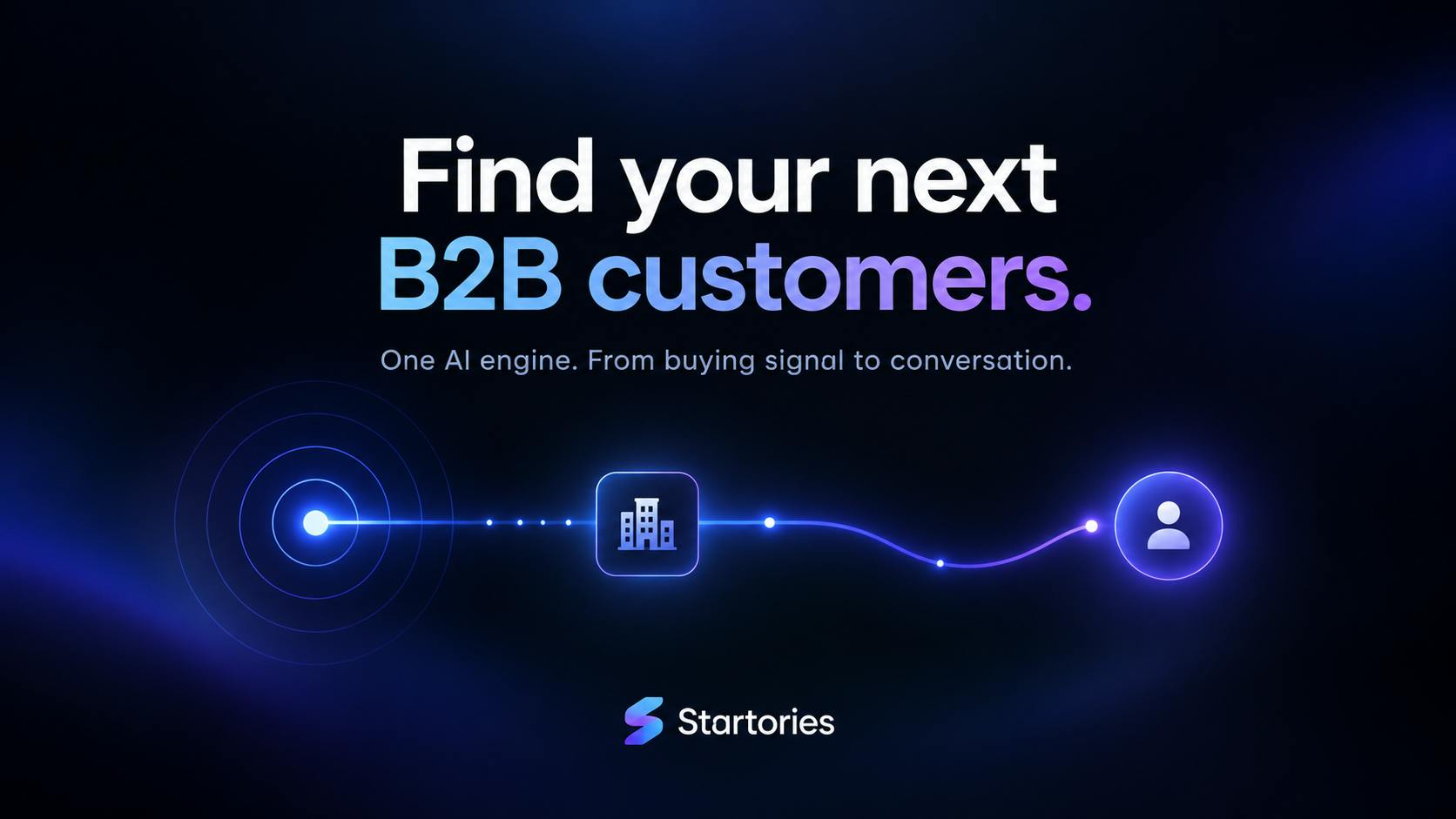
Product Positioning: From Waiting for Customers to Actively Hunting
Startories' official positioning is to "capture B2B buyers who are actively seeking solutions." Unlike the traditional inbound marketing logic—build a website, run ads, wait for form fills—it focuses its attention on public discussion venues outside company websites.
According to its Product Hunt page, this engine continuously monitors Reddit, X (formerly Twitter), Product Hunt, various directory sites, and search engines to identify fresh buying signals. Once it detects that a company is discussing or searching for relevant solutions, the system compares it against the user-defined Ideal Customer Profile (ICP) and filters out matching targets.
The key difference in this approach is that it doesn't create demand—it discovers demand that already exists. For B2B products with high deal values and long decision chains, capturing early signals is often more valuable than late-stage advertising reach.
ICP (Ideal Customer Profile) is a core concept in B2B sales, referring to the typical characteristics model that a company outlines for its target customers based on historical deal data and strategic direction—usually including dimensions such as industry, company size, revenue range, tech stack, geographic location, and decision-maker role. The role of the ICP is to help sales and marketing teams concentrate limited resources on the customer segments most likely to convert, avoiding the inefficiency of broad-brush prospecting. In a signal-driven sales development process, the ICP acts as a filter: the subjects of public discussions captured by the system must be compared item by item against the predefined ICP characteristics, and only companies with sufficiently high match scores proceed to the next step of decision-maker identification and outreach. The clearer and more specific the ICP definition, the higher the quality ceiling of the resulting leads; conversely, a vague ICP will cause a large amount of noise to be misjudged as business opportunities.
Workflow: An End-to-End Pipeline from Signal to Email
Startories' capability chain covers multiple stages of sales development and can be broken down into four steps:
Signal capture: Cross-platform monitoring of public discussions to identify high-intent expressions such as "looking for recommendations," "seeking alternatives," and "complaining about existing tools."
ICP qualification: Matching captured company information against the user's predefined customer profile to filter out irrelevant subjects.
Decision-maker identification and email verification: Finding key decision-makers within target companies and verifying the validity of their email addresses to reduce bounce rates.
Personalized outreach: Initiating personalized contact based on the original signals captured, rather than sending mass template emails.
This pipeline essentially compresses multiple tasks that would otherwise need to be done manually by SDRs (Sales Development Representatives) into an automated workflow. The product's category tags on Product Hunt—Email Marketing, Marketing, and Artificial Intelligence—also confirm that its focus is on "AI-driven email marketing and outreach."
SDR (Sales Development Representative) is a front-line role in B2B sales organizations, primarily responsible for prospecting, qualification, and initial outreach, handing off qualified opportunities to AEs (Account Executives) to close. A traditional SDR's daily work includes finding potential customers on LinkedIn, industry forums, and databases, verifying their company background and decision-maker identity, validating email addresses, and writing personalized opening emails. This role is labor-intensive, highly repetitive, and its effectiveness depends heavily on individual experience. The automation chain described by Startories essentially uses AI to take over the most time-consuming parts of the SDR process—signal discovery, ICP matching, and email verification—allowing sales teams to focus their energy on conversations and closing. This is also the underlying logic behind the recent surge of "AI SDR" tools.
Design Trade-offs Worth Noting
Using "public discussions" as a data source is a controversial but interesting choice.
The upside is the real-time nature and authenticity of the signals—when someone asks for help on Reddit, their description of needs is usually more specific and less polished than a form submission. The downside is noise: discussions on public platforms don't necessarily correspond to real corporate purchasing budgets, and a single complaint from an individual developer could be misjudged as a B2B opportunity. The system's ICP matching capability directly determines the ceiling on lead quality.
Another implicit challenge is compliance and perception. Initiating cold email outreach based on public signals has markedly different acceptance levels across markets. While email verification helps, it doesn't solve the question of "whether the recipient wants to receive this email." The product page doesn't elaborate on the compliance boundaries of its data sources, which may be something users need to assess themselves in practice.
Cold outreach refers to sales emails sent proactively without the recipient's prior consent, and is one of the primary methods of B2B sales development. Its compliance varies significantly across jurisdictions: the U.S. CAN-SPAM Act permits cold emails but requires unsubscribe mechanisms and truthful sender information; the EU's GDPR sets stricter legal basis requirements for processing personal data, and sending marketing emails to personal addresses typically requires consent or a legitimate interest assessment. In practice, the success of cold outreach depends not only on legal boundaries but also on perception—whether the recipient feels the email is relevant to their situation and whether they feel intruded upon. Opening lines written based on public discussion signals tend to get more responses than template emails because they reference needs the recipient has actually expressed—but this also means that if a signal is misjudged, the email will seem especially out of place.
Market Position and Target Audience
In terms of product form, Startories is closer to a "signal-driven sales development tool" than a traditional marketing automation platform. It suits teams that already have a clear ICP definition and whose sales process relies on cold outreach—especially early-stage SaaS, consulting services, and tool-based products.
For teams that rely on brand advertising or content inbound, its value diminishes; but for small teams with limited budgets that can't build a full SDR team, automating signal discovery and initial qualification may be a cost-effective entry point.
The product is currently independently launched by Lionel Lakson, with 15 votes, ranking 19th on Product Hunt, and 3 comments—a small-scale project at an early stage. This means product maturity, data coverage breadth, and actual conversion results still lack sufficient external validation, and early adopters should be prepared to test ROI on their own.
A Category in the Making
Startories is not alone. A wave of tools has emerged around the idea of "capturing purchase intent in public discussions," all with the core logic of structuring buying signals from social media and forums. Whether this direction succeeds depends on two variables: the accuracy of signal identification, and whether outreach content can truly be personalized rather than mass-sent under a different guise.
At a time when AI has driven the cost of content production close to zero, buyers' immunity to templated outreach is rising in tandem. Tools can help you find people faster, but whether you can win them over remains a question that can't be fully outsourced to an algorithm.
One-line Summary
Startories uses AI to monitor public platforms like Reddit and X, capture B2B buying signals, and automate outreach.
Paragraph Summary
Startories is an AI sales development tool launched on Product Hunt. Its core idea is to monitor public discussions on Reddit, X, Product Hunt, directory sites, and search engines to identify fresh buying signals like "looking for recommendations" or "seeking alternatives," then compare them against user-defined ICPs to filter matching companies, identify decision-makers, verify emails, and initiate personalized cold email outreach based on the original signals. It compresses multiple tasks traditionally done manually by SDRs into an automated workflow. Its advantage lies in discovering existing demand rather than creating it, making it suitable for early-stage SaaS and small teams with clear ICPs that rely on cold outreach. However, public discussions as a data source carry risks of noise and misjudgment, and the compliance and perception issues of cold outreach are not explicitly addressed by the product. The product is currently at an early stage, with only 15 votes and a ranking of 19th, and its actual conversion results still lack external validation.
Related articles

Amphibious Transforming Drone: Beyond 100x Power Savings, What Are the Real Needs?
Is the amphibious transforming drone just a gimmick? Starting from the 100x power difference of the M4 Morphobot, explore real application scenarios and thesis topic ideas, analyzing boundary conditions where pure drones and pure ground robots both fail.

Warhound Raises $200 Million: Genetically Engineered "War Dogs" Paired with Anduril Gear
Warhound raises $200M, backed by Ben Lamm and Palmer Luckey, to genetically engineer dogs for military and law enforcement use and equip them with Anduril gear. This article analyzes its technology direction, funding logic, and ethical controversy.

Claude API Comes to Google Cloud: IAM Integration and SDK Access Guide
Anthropic hosts the full Claude API on Google Cloud with IAM-controlled permissions and unified billing. This guide covers the Vertex AI and Anthropic-hosted entry points, IAM role configuration, and SDK access.