STaSBO: A New LLM-Driven Bayesian Optimization Framework for Strategy Planning and Configuration Selection
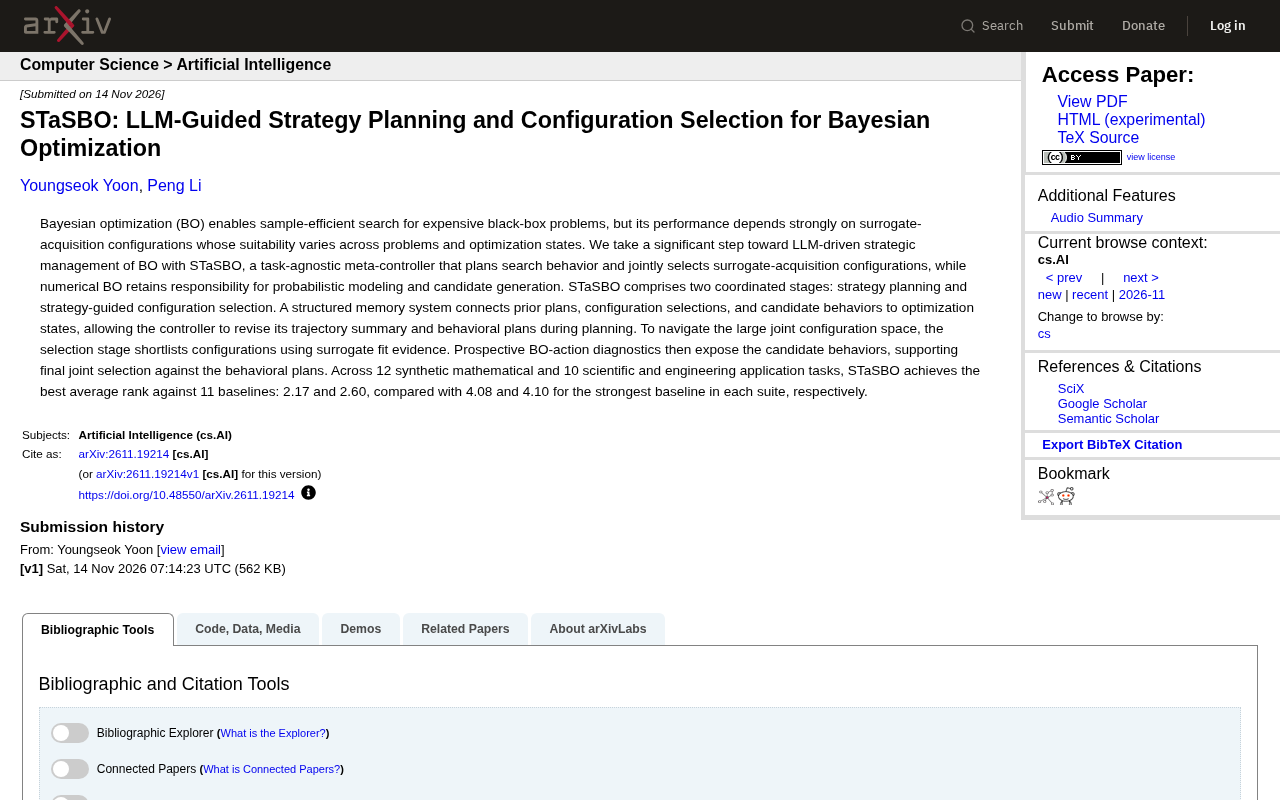
STaSBO uses LLMs as the strategic layer for Bayesian optimization, significantly leading on multiple benchmarks.
STaSBO introduces LLMs into Bayesian optimization's strategic management layer as a task-agnostic meta-controller for high-level planning, while numerical BO components handle modeling and candidate generation. Its two-stage architecture combines strategy planning via structured memory with strategy-guided configuration selection using surrogate-fit pre-screening and prospective BO-action diagnostics. It achieves average ranks of 2.17 and 2.60 on 12 synthetic and 10 application tasks, beating the strongest baselines (4.08 and 4.10), though LLM inference cost and generalization limits need further evaluation.
Bayesian optimization (BO) is a sample-efficient search method for expensive black-box problems, but its performance depends heavily on the combination of surrogate model and acquisition function, and the optimal configuration often varies with the problem and optimization state. Traditional approaches either rely on manual experience with fixed configurations or use automated methods that search inefficiently through the configuration space. The recently proposed STaSBO framework brings large language models (LLMs) into the strategic management layer of BO, using a task-agnostic meta-controller to jointly decide on strategy planning and configuration selection, achieving performance significantly better than existing methods across multiple benchmark tasks.
Why Does Bayesian Optimization Need LLM-Driven Strategic Management?
The core challenge of Bayesian optimization is that the choice of surrogate model (e.g., Gaussian process) and acquisition function (e.g., EI, UCB) has a huge impact on optimization efficiency, yet no universally optimal configuration exists. For example, some problems suit highly exploratory configurations, while others require exploitative configurations for fast convergence. As optimization progresses, the same problem may also need different strategies at different stages. Existing automated BO methods (such as automatic configuration selection) typically focus only on static configurations or dynamic adjustment based on simple heuristics, lacking global understanding of the optimization trajectory and strategic-level planning capability.
LLMs have shown potential in sequential decision-making and complex pattern understanding, but having an LLM directly generate candidate points or replace numerical optimization is unrealistic. STaSBO's entry point is this: let the LLM handle high-level strategic planning (e.g., "should we focus on exploration or exploitation now?"), while leaving probabilistic modeling and candidate generation to mature numerical BO components. This division of labor leverages the LLM's reasoning strengths while preserving BO's sample efficiency.
Acquisition functions are key components in Bayesian optimization that determine the next evaluation point. They construct a scalar function based on the surrogate model's predictions (mean and uncertainty) and maximize it to balance exploration (high-uncertainty regions) and exploitation (high-predicted-mean regions). Common acquisition functions include expected improvement (EI), upper confidence bound (UCB), and probability of improvement (PI); their exploration-exploitation trade-off strengths differ, so they perform differently across optimization stages and problem landscapes. The surrogate model is a probabilistic approximation of the expensive black-box function; the Gaussian process is the most commonly used, providing predictive mean and variance and capturing priors such as smoothness and periodicity through the kernel function. The choice of surrogate model (e.g., Gaussian process vs. random forest) together with the kernel choice determines the model's inductive bias about the objective function, directly affecting the reliability of the acquisition function. Thus, the surrogate model-acquisition function combination essentially defines a search strategy whose suitability depends heavily on problem structure and optimization state.
STaSBO's Two-Stage Architecture: Strategy Planning and Configuration Selection
STaSBO consists of two coordinated stages: strategy planning and strategy-guided configuration selection.
Stage One: Strategy Planning
The core of the planning stage is a structured memory system. This system associates prior plans, configuration choices, and candidate behaviors with optimization states, enabling the meta-controller to review the effects of historical decisions and revise trajectory summaries and behavior plans during planning. Specifically, based on the current optimization state (e.g., number of evaluated points, current best value, surrogate model fit) and historical patterns in memory, the controller generates a behavior plan—for example, "prioritize exploring high-uncertainty regions in the next several iterations."
Stage Two: Strategy-Guided Configuration Selection
The configuration selection stage must choose, from a large joint configuration space (combinations of surrogate model type, kernel function, acquisition function, etc.), the configuration that best matches the behavior plan. STaSBO adopts a two-step strategy: first, it uses surrogate model fitting evidence to pre-screen configurations and narrow the candidate range; then, through prospective BO-action diagnostics, it exposes the candidate behaviors that candidate configurations may produce, supporting final joint selection aligned with the behavior plan. This design avoids exhaustive search in a huge space while ensuring that the selected configuration's behavior is consistent with the planning intent.
Prospective BO-action diagnostics is an ex-ante analysis method for evaluating the potential behavior of candidate configurations: without actually running a full optimization loop, it uses the surrogate model to simulate the next evaluation point that a candidate configuration might select and observes that point's position in the predicted mean-variance space, thereby judging whether its behavioral tendency leans toward exploration (high-variance regions) or exploitation (high-mean regions). This diagnostic elevates configuration selection from "static attribute matching" to "behavioral effect matching," enabling the meta-controller to screen for behaviorally consistent configurations according to the current behavior plan (e.g., "focus on exploration next") without incurring the expensive cost of real evaluations.
Experimental Performance: Leading Advantage Across Task Benchmarks
STaSBO was evaluated on 12 synthetic mathematical tasks and 10 science and engineering application tasks, compared against 11 baseline methods. Results show that STaSBO achieved the best average rank on both task suites: average rank 2.17 on synthetic mathematical tasks and 2.60 on application tasks, while the strongest baseline achieved average ranks of 4.08 and 4.10 on the two suites, respectively. This gap indicates that LLM-driven strategic management can more effectively adapt to different problems and optimization states, thereby improving sample efficiency.
One detail: STaSBO is a task-agnostic meta-controller that does not rely on domain-specific prior knowledge, giving it strong generalization potential. However, the paper does not discuss computational overhead and LLM inference cost in detail; practical deployment requires weighing performance gains against additional overhead.
Average rank is an aggregate metric commonly used in automated hyperparameter optimization and algorithm configuration literature: run all methods independently on each task, rank them by performance (e.g., number of evaluations needed to reach a target value or final best value), then average each method's rank across all tasks. Compared with average performance values, average rank mitigates bias from performance scale differences across tasks, but it can also obscure a method's extreme performance on individual tasks. Therefore, interpreting rank advantages requires considering the specific task distribution and statistical significance tests.
Multi-Source Perspectives and Limitations
According to analyses of related work by Bilibili creators and YouTube channels, the role of LLMs in automated experimental design and optimization is shifting from "direct generation" to "strategic guidance," and STaSBO is a representative work in this trend. Multiple sources agree that decoupling LLMs from numerical optimizers is currently the more pragmatic technical path. However, some viewpoints note that LLM planning quality depends on prompt design and the effectiveness of the memory system, and performance on highly unstructured problems still needs verification.
Overall, STaSBO provides a structured strategic management framework for LLM-driven Bayesian optimization, achieving leading rankings on multiple benchmarks through joint decision-making in strategy planning and configuration selection. Future work could further explore reducing LLM call overhead, extending memory mechanisms, and handling higher-dimensional configuration spaces.
One-line Summary
STaSBO uses LLMs as the strategic management layer for Bayesian optimization, significantly outperforming on multiple benchmarks.
Paragraph Summary
STaSBO brings large language models into the strategic management layer of Bayesian optimization as a task-agnostic meta-controller responsible for high-level strategy planning, while leaving probabilistic modeling and candidate generation to numerical BO components. Its two-stage architecture includes strategy planning and strategy-guided configuration selection: the former uses a structured memory system to associate historical decisions with optimization states and generate behavior plans; the latter first pre-screens configurations using surrogate model fitting evidence, then uses prospective BO-action diagnostics to ensure candidate behaviors align with the plan. On 12 synthetic mathematical tasks and 10 application tasks, STaSBO achieved average ranks of 2.17 and 2.60, significantly better than the strongest baselines' 4.08 and 4.10, demonstrating the sample-efficiency advantages of LLM-driven strategic management, though LLM inference overhead and generalization boundaries still require further evaluation.
Related articles

Gemini 4 Hydrogen Released: A 2.5x Faster Everyday AI Model
Google releases Gemini 4 Hydrogen, claiming 2.5x the speed of Gemini 3.8 Flash, with four-tier thinking control, a million-token context, and Orchestrator multi-model collaboration. API pricing is $1.50 per million input tokens.

Gemini 4 Hydrogen Hands-On: Google's Fastest and Cheapest AI Model
Hands-on with Gemini 4 Hydrogen: the fastest, cheapest model in the Gemini 4 family. We break down the Carbon/Argon/Hydrogen split, API pricing traps, free-tier limits, and the cost trade-offs of four thinking levels—with a real bug-debugging demo.

Gemini 4 Hydrogen vs Sonnet Comparison Test: Uses Only 1% of Weekly Quota, Performance on Par
Hands-on test: Gemini 4 Hydrogen vs Sonnet on the same CRUD task—Hydrogen used only 1% weekly quota with comparable performance and better UI details, while Anthropic's model used 7%. Developer says daily tasks don't require expensive models.