StateGuard: Adding Transactional Rollback and Audit Capabilities to LangGraph Nodes

StateGuard brings transactional invariant validation and Saga compensation to LangGraph, covering gaps in native checkpoint reliability.
LangGraph's native checkpointing only handles state persistence — it can't block invalid state writes or undo external API calls. StateGuard fills this gap with four modules: a `@guarded_node` decorator for pre-commit invariant validation with Saga compensation, a `StateGuardCheckpointer` wrapper for global rule enforcement, a LIFO Saga undo stack for reversing side effects, and rolling Z-score drift detection with SQLite audit logging for observability.
When building complex LangGraph applications, an easy-to-overlook problem gradually comes into focus: LangGraph's built-in Checkpointer excels at state persistence, but it cannot prevent nodes from writing corrupted state to checkpoints — and it certainly won't execute compensating actions to undo already-made API calls when a business invariant is violated.
An open-source library called StateGuard (stateguard-core) was created specifically to fill this gap. It adds a reliability layer on top of LangGraph, bringing the battle-tested concept of database transactions into Agent workflows.
The Blind Spots of LangGraph Checkpoints
LangGraph provides multiple checkpoint implementations such as MemorySaver and AsyncSqliteSaver for saving and restoring state during graph execution. This mechanism solves the problem of "state persistence," but it implicitly trusts every node's output — as long as a node returns a result, the checkpoint accepts it unconditionally.
The problem is that in real-world scenarios, a node's output may violate critical constraints: values out of valid ranges, missing required fields, negative monetary amounts, and so on. Once these "dirty states" are written to a checkpoint, downstream nodes continue executing on false premises, compounding the errors at every step.
Even trickier are side effects. If a node makes external API calls during execution (e.g., placing an order, charging a payment, sending a notification), LangGraph itself has no mechanism to undo those already-completed external actions when a subsequent validation fails. State can be rolled back, but the real world cannot.
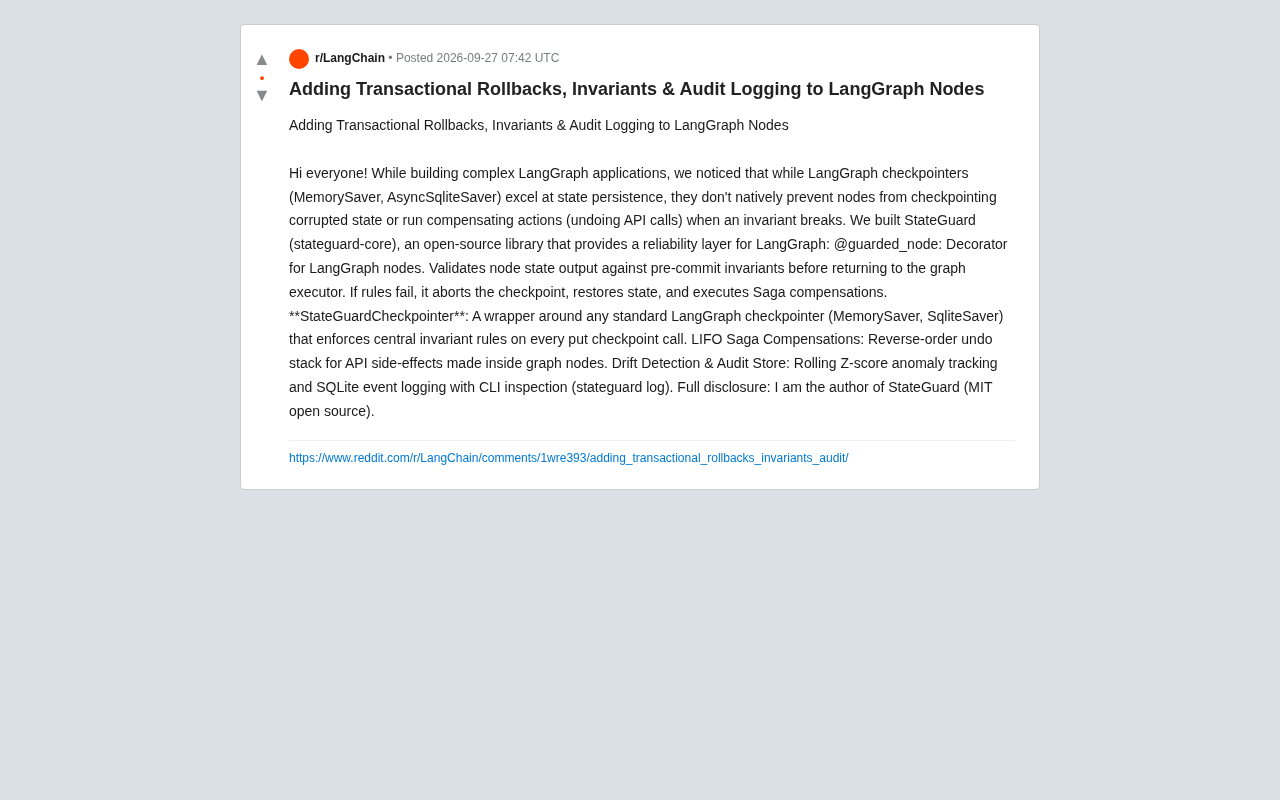
StateGuard's Four Core Capabilities
StateGuard systematically introduces the concept of "transactional" behavior into LangGraph nodes, built around four main components.
The @guarded_node Decorator
This is the most developer-facing entry point. Once a LangGraph node is decorated with @guarded_node, the node's state output goes through pre-commit invariant validation before being returned to the graph executor.
If any validation rule fails, the decorator aborts the checkpoint write, restores state to what it was before validation, and triggers Saga compensating actions. In other words, bad state never gets a chance to contaminate the graph's execution chain — validation, rollback, and compensation all close the loop within the boundary of a single node execution.
The StateGuardCheckpointer Wrapper
If the decorator is per-node protection, then StateGuardCheckpointer is the gatekeeper at the global level. It wraps any standard LangGraph checkpoint (MemorySaver, SqliteSaver, etc.) and enforces centralized invariant rules on every put checkpoint call.
This design enables incremental adoption: developers don't need to replace their existing persistence solution — just wrap it with this one layer, and all checkpoint writes will pass through unified rule validation, consolidating reliability policies from scattered node logic into a single place.
LIFO Saga Compensation: Undoing External Side Effects
StateGuard's approach to handling external side effects is inspired by the Saga pattern from distributed transactions. It maintains a last-in, first-out (LIFO) undo stack: every time a node produces an API side effect, the corresponding compensating action is pushed onto the stack.
When an invariant violation requires a rollback, StateGuard executes the compensating actions in reverse order, undoing previous calls one by one. This reverse-order design respects dependency relationships — the last operation often depends on earlier ones, so it must be undone first. For complex Agent workflows involving multiple external calls, this mechanism dramatically reduces the risk of inconsistency between state and the real world.
The Saga pattern originated in a 1987 database paper by Hector Garcia-Molina and is a classic approach for handling long-running transactions in distributed systems. Unlike traditional ACID transactions in databases, operations spanning multiple services cannot rely on a single global lock to guarantee atomicity. Saga decomposes a long transaction into a series of ordered local transactions, each paired with a corresponding "compensating transaction." If any step fails, the system executes the compensating transactions for all completed steps in reverse order, restoring each service to a consistent state. Saga comes in two coordination styles: Orchestration, driven by a central coordinator and suited for well-defined workflows; and Choreography, which relies on event-driven, decentralized collaboration. StateGuard's LIFO undo stack is essentially a simplified implementation of orchestrated Saga — the node acts as the local transaction executor, and the decorator acts as the coordinator, triggering the compensation sequence when an invariant violation is detected. It's worth noting that compensating transactions are semantically "logical undos" rather than physical rollbacks. For example, reversing a funds transfer means initiating a reverse transfer of equal amount, not rewinding the database in time — so the idempotency and reliability of compensating actions still require careful design by the developer.
Drift Detection and Audit Storage
Beyond transactional rollback, StateGuard also focuses on runtime observability, handled by two modules.
Drift Detection uses rolling Z-score anomaly tracking. By continuously monitoring the statistical distribution of state metrics, the system can identify abnormal deviations from normal ranges and issue warnings before problems escalate into failures. This is especially valuable for long-running Agent applications where state accumulates over time.
Audit Storage records key events to SQLite and provides a stateguard log command-line tool for developers to review after the fact. Every validation check, rollback, and compensation leaves a traceable record, transforming Agent behavior from a "black box" into an auditable event stream. In production environments requiring compliance reviews or incident post-mortems, this capability is indispensable.
Z-score is a standardized statistical measure of how far a data point deviates from the mean, calculated as
(observed value − mean) / standard deviation. An absolute value above 2 or 3 is typically considered anomalous. A "rolling Z-score" dynamically updates the mean and standard deviation within a sliding time window, allowing the baseline to evolve over time and preventing historical data from overly biasing current judgments. In an Agent runtime context, monitorable state metrics include node execution latency, the magnitude of changes in certain field values, and external API call frequency. When a metric's rolling Z-score exceeds a preset threshold, the system flags a "drift" and triggers an alert. This method requires no precise pre-definition of anomaly boundaries, making it particularly suitable for complex business states where the full range of valid values is hard to enumerate — though it does require a warm-up period to accumulate sufficient samples. When the window contains too few data points, the reliability of statistical conclusions decreases accordingly.
Implications for Agent Engineering Practice
StateGuard reflects a clear trend: as frameworks like LangGraph are applied to increasingly complex, increasingly production-ready scenarios, the community's demand for reliability, transactional guarantees, and observability is rising fast. Early Agent frameworks focused primarily on "can it run at all," while the focus is now shifting toward "what happens when something goes wrong."
Migrating concepts like transactions, invariants, and audit logs — accumulated over decades in the database world — into the LLM Agent domain is a pragmatic engineering path. StateGuard is open-sourced under the MIT license, and the author has transparently disclosed their identity. For teams seeking reliability guarantees for their LangGraph applications, it offers a concrete reference implementation worth exploring.
Note that this article is based on the project author's own description on Reddit; actual effectiveness and stability should be evaluated and verified against real-world projects.
Related articles

Chain of Thought Isn't Just for AI: How Humans Can Use CoT to Improve Thinking Quality
Chain of Thought isn't just a prompt trick for large models. Starting from a Hacker News discussion, this article analyzes why CoT works for human thinking too, breaks down actionable ways to transfer it, and highlights the key differences between human CoT and machine CoT.
Cloudflare Teams Up with OpenAI: Closi…
Cloudflare Teams Up with OpenAI: Closing the Loop from Vulnerability Discovery to Defense with AI
Cloudflare uses OpenAI Daybreak to investigate security vulnerabilities and generate reviewable remediation plans, while developers use Codex to boost coding efficiency and quality.

Orca Multi-Agent Orchestration in Practice: A Guide to Parallel Collaboration with Claude and Codex
Orca is Stable AI's free open-source agent workbench supporting 34 agents like Claude Code and Codex in parallel. Learn its Git worktree isolation, multi-model orchestration, and mobile management.