StateWeave: Testing AI Agents with Sandboxed App Clones

StateWeave creates stateful clone sandboxes of common SaaS apps for traceable, scored AI agent testing.
StateWeave is a sandbox tool for AI agent evaluation that clones the state and interfaces of apps like Slack, Gmail, and Salesforce, solving the unreliability of mock environments and the risk of real ones. It supports natural-language scenario descriptions with cross-app data seeding, fault injection like outages and 401 errors, and scored reports showing failed checks and API call chains, aiming to bring agent testing from demo level to engineering level.
StateWeave: Testing AI Agents with Sandboxed App Clones
Evaluating AI agents has always been a thorny problem: testing in real environments is risky and expensive, while simulated environments are often unrealistic. StateWeave, a new tool on Product Hunt, tries to resolve this contradiction—it creates stateful clone sandboxes of the apps you use (Slack, Gmail, Salesforce, etc.), letting agents run in near-realistic workflows and receive traceable scoring results.
Why Agent Testing Needs "Working Clones"
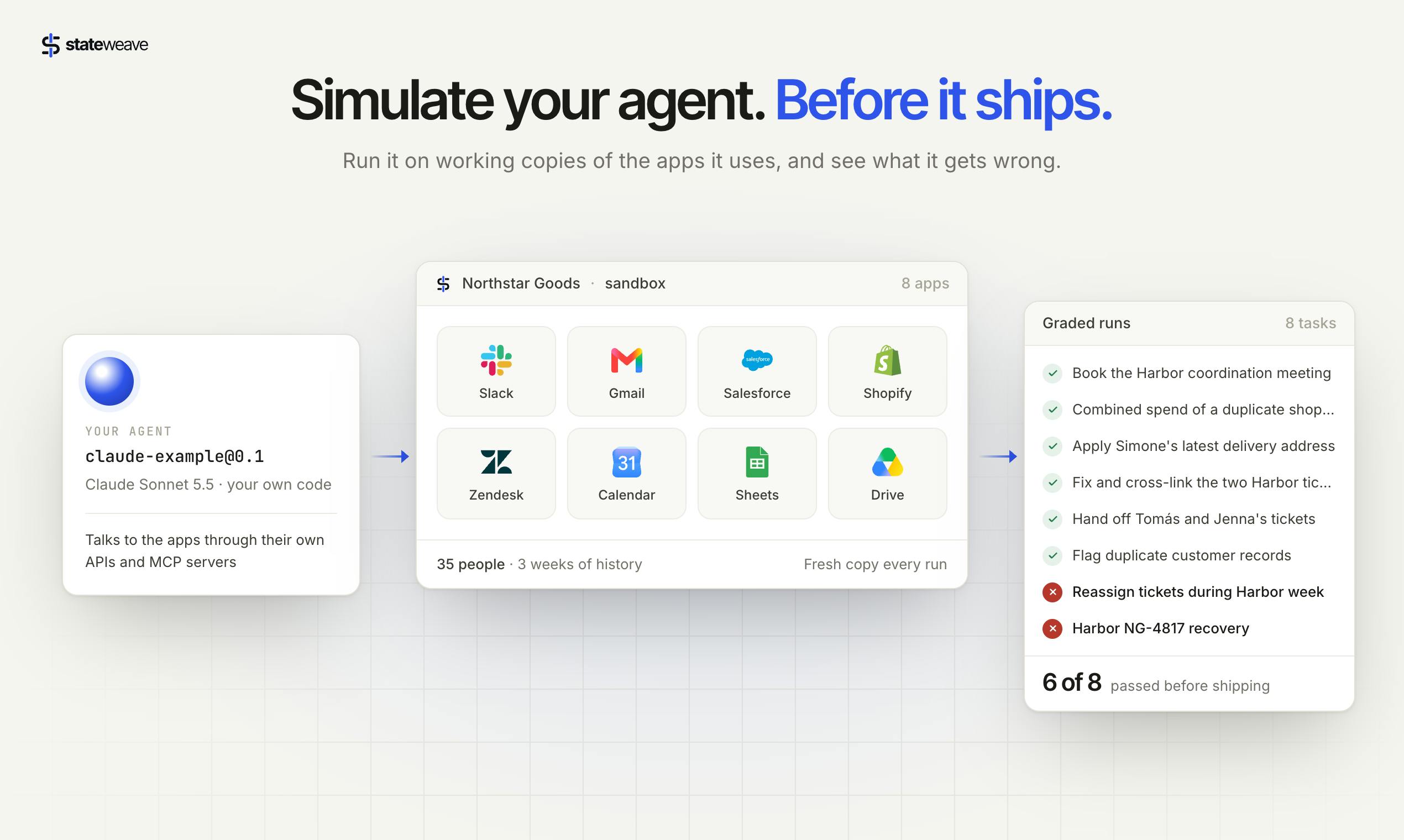
Traditional agent testing typically relies on mock APIs or simplified simulators, but such environments lack the real apps' state and behavioral logic. An agent that passes in a mock environment may fail on real Slack due to message history, channel permissions, or rate-limiting policies. StateWeave's approach is to directly clone the real apps' state and interfaces, so agents face APIs, MCP servers, and UIs consistent with the production environment.
According to its Product Hunt page, StateWeave supports stateful clones of Slack, Gmail, Salesforce, Shopify, Zendesk, Google Calendar, Sheets, Drive, WhatsApp, and Teams. This means agents can execute tasks in a complete environment containing historical messages, documents, orders, and calendar events, rather than doing unit tests against a blank database.
MCP (Model Context Protocol) servers are an open protocol proposed by Anthropic to standardize how AI models connect to external tools and data sources. In agent scenarios, MCP servers act as an adaptation layer between the model and the apps: the model discovers available tools, calls APIs, and receives structured responses via the MCP protocol. StateWeave's cloned MCP servers mean the tool-calling interfaces the agent uses in the sandbox are fully identical to production, including tool names, parameter schemas, and return formats, thereby avoiding "passes in sandbox, fails in production" problems caused by protocol differences.
Scenario Description and Data Seeding
StateWeave lets users describe a test scenario in natural language, then automatically seeds consistent data across all related apps. For example, you can describe "a customer complains about an order delay in Slack while also submitting a ticket in Zendesk," and StateWeave will generate the corresponding messages and tickets in Slack and Zendesk, keeping the timeline and entity associations consistent.
This cross-app data consistency is difficult to achieve when setting up test environments manually. For agent workflows that require multi-app collaboration (such as automated customer service or sales lead follow-up), StateWeave provides a repeatable way to initialize. Each run uses a fresh copy, avoiding state contamination between tests.
Fault Injection and Scoring Runs
StateWeave supports fault injection, such as service outages and 401 authentication errors. This lets developers verify an agent's fault tolerance under abnormal conditions, rather than only testing the happy path. After a run, StateWeave provides a scored run report showing which checks failed and the specific API calls behind the failures.
This "scoring run" mechanism upgrades test results from a simple pass/fail binary to a diagnosable call-chain trace. Developers can see which step the agent called which interface, what response it received, and thereby locate the root cause.
Fault Injection originates from chaos engineering practices, referring to deliberately introducing faults (such as network latency, service unavailability, or authentication failures) in a controlled environment to observe system behavior. For agent testing, the value of fault injection lies in verifying fault tolerance and recovery: for example, when the Gmail API returns a 401, does the agent retry, degrade, or report an error to the user, rather than silently failing? The 401 authentication errors and service outages supported by StateWeave are the two most common types of external dependency faults; the former tests credential management logic, the latter tests timeout and retry strategies.
Significance for Agent Development Workflows
StateWeave sits at the intersection of SaaS, developer tools, and AI, and its value lies in pushing agent testing from "demo level" to "engineering level." Many agent products currently shine in demos but lack systematic regression testing. The sandbox clones, scenario seeding, and fault injection provided by StateWeave constitute a repeatable testing infrastructure.
Of course, there may still be subtle differences between cloned apps and real apps, such as edge behaviors of third-party integrations or API changes in specific versions. Whether StateWeave can keep up with updates to each app's interfaces will determine its long-term reliability. But from a product perspective, it hits a key gap in getting agents into production: validating agent behavior with real workloads in a safe, controllable environment.
For teams building cross-app agents, StateWeave is worth watching. It currently has 77 votes and ranks 9th; discussion is not particularly heated, but the direction is clear—making agent testing no longer a matter of luck.
One-line Summary
StateWeave creates stateful clone sandboxes of common SaaS apps, letting AI agents undergo traceable, scored testing in near-realistic environments.
Paragraph Summary
StateWeave is a sandbox tool for AI agent evaluation. By cloning the state and interfaces of apps like Slack, Gmail, and Salesforce, it solves the problems of unrealistic traditional mock environments and the high risk of real environments. It supports describing test scenarios in natural language and seeding consistent data across apps, can inject faults such as service outages and 401 errors, and generates scored reports after runs showing failed checks and specific API call chains. Its positioning is to push agent testing from demo level to engineering level, providing repeatable regression testing infrastructure for cross-app agents.
Related articles

RePlan-VLA: Progress-Aware Replanning Breakthrough for Long-Horizon Robotic Manipulation
The RePlan-VLA framework converts VLA models' short-horizon capabilities into reliable long-horizon execution through progress-aware adaptive replanning, improving success rates by 21.9% and 10.4% on RoboCasa365 and CALVIN, and validating real-world deployment on a Franka Research 3 robot.

Geometric Bridge Flow Matching: A New Breakthrough in Blind Rigid Motion Correction
Geometric bridge flow matching enables blind rigid motion correction in head CBCT, achieving 37.1 dB PSNR and 0.27 mm RPE on simulated data in ~9.1 minutes, outperforming existing methods.

Google Releases Gemini 4 Hydrogen: 2.5x Faster Without Sacrificing Intelligence
Google releases the lightweight Gemini 4 Hydrogen: 2.5x faster task completion, AA Intelligence Index of 54 beating its flagship sibling, 7.3s single-step on Agent Arena faster than Claude and GPT rivals, four thinking levels with pay-as-you-need pricing, now available across AI Studio and more.