StateWeaver: Multi-Agent Collaboration Solves State Consistency Challenges in Long Video Generation

StateWeaver uses active states and hierarchical collaboration to solve the cross-shot consistency challenge in long video generation.
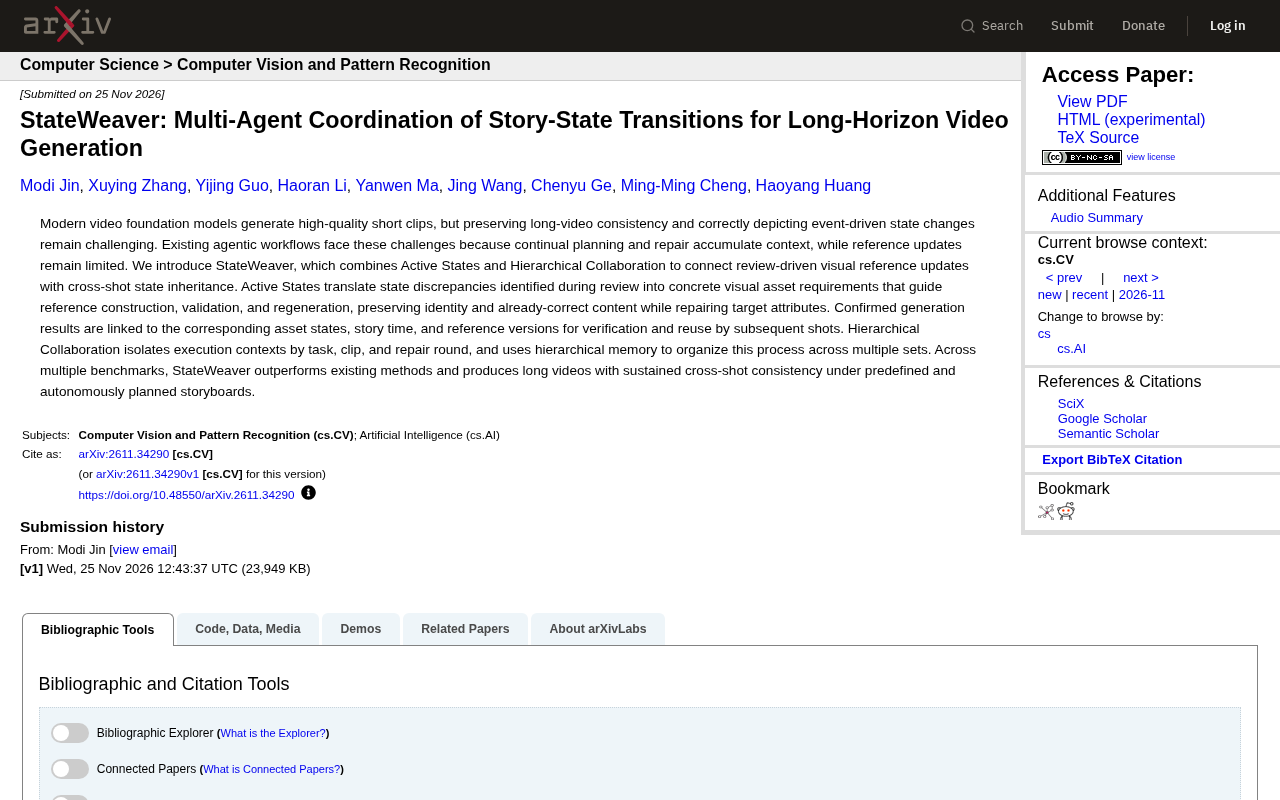
StateWeaver is a multi-agent collaboration framework for long video generation, targeting cross-shot consistency drift and event-driven state change distortion in existing video foundation models at long durations. Its core mechanisms are Active States (translating review-detected discrepancies into visual asset requirements for precise repair and reuse) and Hierarchical Collaboration (isolating execution contexts and organizing multi-set processes with hierarchical memory to avoid context bloat). It outperforms existing methods across multiple benchmarks.
Long video generation has always been a thorny problem: existing video foundation models can produce high-quality short clips, but once the duration is extended, cross-shot visual consistency and event-driven state changes tend to break down. StateWeaver, from academia, proposes a multi-agent collaboration framework that, through two key mechanisms—"active states" and "hierarchical collaboration"—surpasses existing methods across multiple benchmarks, achieving sustained cross-shot consistency in long videos.
The Core Pain Points of Long Video Generation: State Drift and Context Bloat
Modern video foundation models perform impressively when generating short clips, but when facing long videos, two problems recur. The first is cross-shot consistency: the appearance, clothing, and identity features of the same character are prone to drift across different shots. The second is event-driven state changes: as the story progresses, characters undergo state transitions such as getting injured, changing outfits, or moving between scenes, and the model needs to accurately "remember" and "present" these changes rather than simply copying the previous frame.
Existing agent workflows attempt to solve these problems but fall into new dilemmas. The continuous planning and repair process keeps accumulating context, leading to declining execution efficiency; at the same time, the reference image update mechanism is limited and struggles to keep up with the dynamic evolution of story states. The StateWeaver researchers tackled exactly these two bottlenecks and redesigned the way multiple agents collaborate.
Video foundation models typically refer to generative models pretrained on large-scale video data (such as those based on diffusion models or autoregressive Transformer architectures). They learn the spatiotemporal distribution within short clips, hence their excellent performance on second-level generation. However, such models have limited context windows and lack explicit long-term state representations. When the task is extended to minute-level, multi-shot sequences, the model can only rely on local conditions, causing character appearance and scene states to drift at shot transitions. This is the technical root of the "state drift" problem—it is not a matter of image quality, but of the model lacking a persistent cross-shot memory mechanism.
Active States: Translating "Review Feedback" into "Visual Asset Requirements"
The first core mechanism of StateWeaver is Active States. During video generation, the review stage identifies state discrepancies—for example, a character's wound is in the wrong position, or the clothing color does not match the plot. The traditional approach is to directly regenerate the entire shot, but this often destroys the parts that were already correct.
Active States takes a more refined approach: it translates the state discrepancies found during review into specific visual asset requirements, guiding the construction, validation, and regeneration of reference images. This way, the system can preserve character identity and already-correct content, repairing only the targeted attributes. In other words, it achieves "precision surgical" correction rather than "starting over from scratch."
Confirmed generation results are bound to the corresponding asset states, story time, and reference versions for subsequent shot validation and reuse. This binding mechanism ensures that state information is traceable and inheritable across shots, laying the foundation for cross-shot state consistency.
Reference images play the role of "visual anchors" in video generation, typically injected into the generative model as image conditions or identity embeddings to lock in character appearance, clothing, and scene style. In traditional workflows, reference images are often set once at the beginning and never updated, so they cannot reflect state changes brought about by plot progression (such as injuries or outfit changes). The key innovation of Active States is turning reference images from static inputs into dynamically maintainable "assets": review feedback triggers asset requirements, and after validation, assets flow back as new reference conditions, allowing reference images to evolve in sync with story states.
Hierarchical Collaboration: Isolating Execution Contexts and Organizing Multi-Set Processes with Hierarchical Memory
The second core mechanism is Hierarchical Collaboration. Long video generation involves a large number of tasks, segments, and repair rounds. If all agents share the same context, information quickly bloats and interferes with itself. StateWeaver's approach is to isolate execution contexts by task, segment, and repair round, letting each agent work in a relatively clean environment.
On this basis, the system uses hierarchical memory to organize the collaboration process across multiple sets. Different memory levels carry information at different granularities, which avoids disordered context accumulation while ensuring that necessary information can be passed between levels. This design keeps the multi-agent system orderly throughout long workflows rather than descending into chaos.
Context isolation draws on the sandbox concept from multi-agent systems and operating systems: each agent holds only the minimal context needed to complete its own subtask, avoiding contamination of reasoning by irrelevant history. Hierarchical memory is similar to multi-level caches in computer architecture—higher-level memory stores global states across segments (character profiles, story timelines), while lower-level memory stores local details within segments, retrieved on demand rather than transmitted in full. Combined, these two make context size grow approximately linearly rather than exponentially with task depth, which is the key engineering technique that enables long-workflow multi-agent collaboration to run continuously.
Performance: Comprehensive Leadership Across Multiple Benchmarks
According to the paper abstract, StateWeaver outperforms existing methods across multiple benchmarks, generating long videos with sustained cross-shot consistency under both predefined storyboard and autonomously planned storyboard settings. This means that whether it is a manually designed storyboard script or a model-autonomously planned storyline, StateWeaver can maintain high visual coherence.
One detail worth noting: the paper specifically emphasizes maintaining consistency "under both predefined and autonomously planned storyboards," which covers two typical scenarios in practical applications: controlled generation where creators provide detailed storyboards, and more open-ended automated narrative generation.
Implications for Long Video Generation Workflows
StateWeaver's approach reveals a trend: the bottleneck of long video generation is shifting from "single-frame quality" to "state management." As foundation models produce increasingly better image quality, how to make the system remember story progression, manage character states, and coordinate multiple generation tasks becomes the key factor determining the usability of long videos.
The active states mechanism provides a "difference-driven" repair paradigm—not full regeneration, but precise asset updates based on review feedback. Hierarchical collaboration addresses the classic challenge of context management in multi-agent systems. The combination of the two offers a reference architecture for the design of future long video generation systems.
Of course, the practical effectiveness of this framework also depends on the accuracy of the review stage and the quality of reference image updates. The paper abstract does not disclose specific quantitative improvement margins or computational costs; these details require consulting the full text for evaluation.
One-line Summary
StateWeaver uses two key mechanisms—active states and hierarchical collaboration—to solve the cross-shot consistency challenge in long video generation.
Paragraph Summary
StateWeaver is a multi-agent collaboration framework for long video generation, addressing the cross-shot consistency drift and event-driven state change distortion that occur in existing video foundation models at long durations. Its core mechanisms are twofold: first, Active States, which translates state discrepancies found during review into specific visual asset requirements, guiding the construction, validation, and regeneration of reference images to achieve precise repair rather than full regeneration, and binds confirmed results to asset states and story time for subsequent reuse; second, Hierarchical Collaboration, which isolates execution contexts by task, segment, and repair round, and uses hierarchical memory to organize multi-set collaboration processes, avoiding context bloat. The framework outperforms existing methods across multiple benchmarks, maintaining sustained cross-shot consistency under both predefined and autonomously planned storyboards.
Related articles

Garmin Forerunner 265S Drops to Lowest Price of the Year: A Balanced Choice for Small-Wristed Runners
Garmin Forerunner 265S drops to $300, its lowest price of the year. This small-wrist-friendly running watch features an OLED touchscreen, good battery life, and was called a balanced choice in testing.
Minipg: Packaging PostgreSQL into a Single Executable File
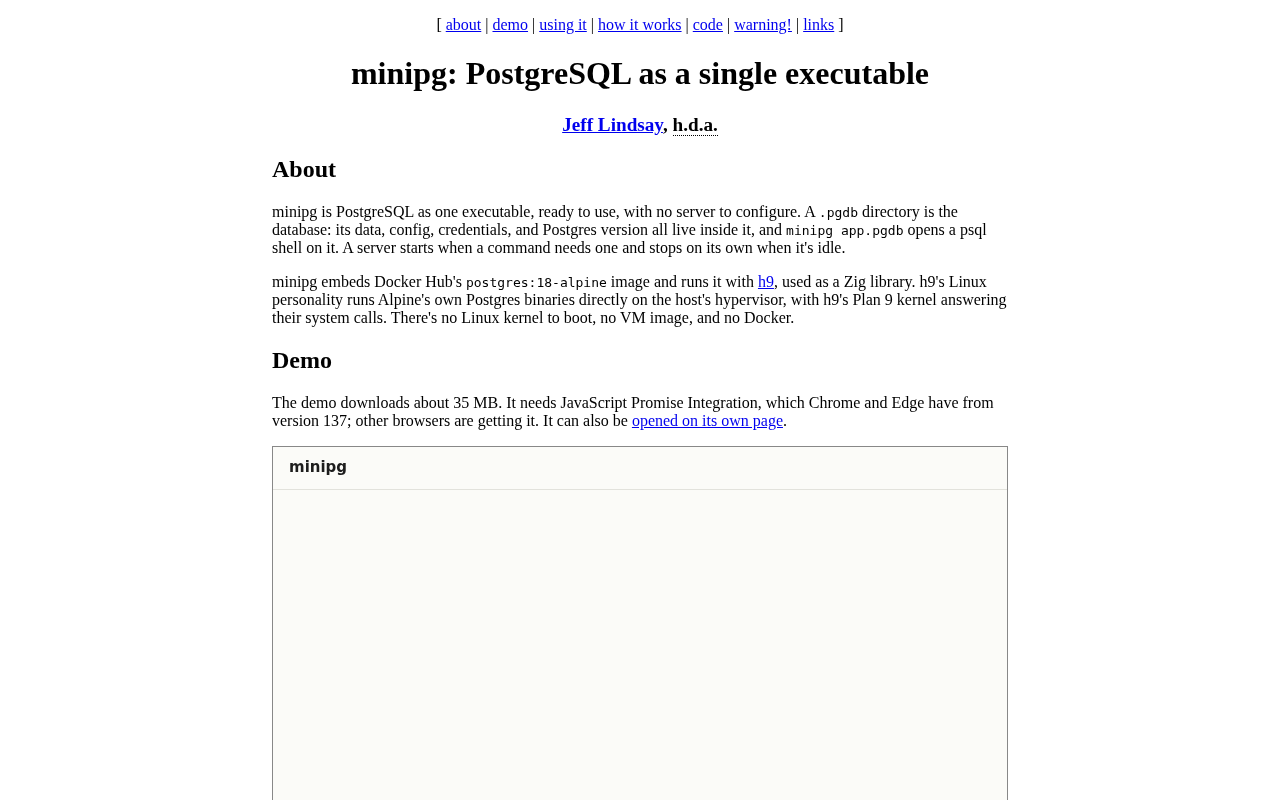
Minipg packages PostgreSQL into a single executable that runs without dependencies. We analyze its technical approach, use cases, and limitations, exploring how single-file databases impact development and deployment.

Will AI End Our Careers?
Hacker News buzzes over 'AI may end our careers.' This article analyzes the real basis of this anxiety, the difference between task replacement and occupational reshaping, and response strategies for tech professionals.