Static Analysis + LLM: Code Change Impact Analysis F1 Boosted to 33.3%

Paper builds a manually annotated CIA dataset and proposes katIA combining static analysis with LLM refinement, achieving CE-matching F1 of 33.3%.
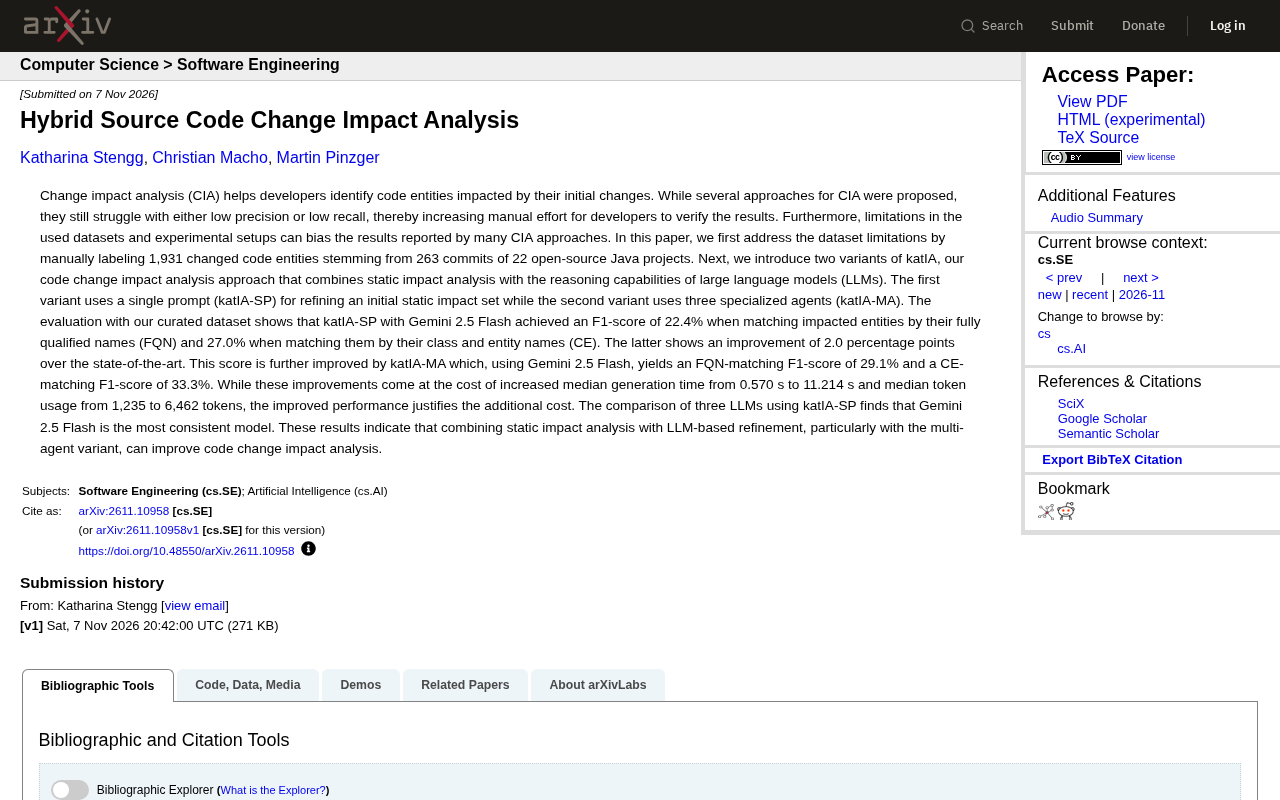
This paper addresses the precision-recall trade-off in code change impact analysis (CIA) with improvements at both the dataset and algorithm levels. The authors manually annotate 1,931 code entities from 263 commits across 22 open-source Java projects to counter dataset bias in existing CIA evaluations. They propose katIA, combining static impact analysis with LLM refinement, offering a single-prompt variant katIA-SP and a three-agent variant katIA-MA. Using Gemini 2.5 Flash, katIA-MA achieves FQN-matching F1 of 29.1% and CE-matching F1 of 33.3%, improving over the prior best method, though median generation time rises from 0.570s to 11.214s and token consumption from 1,235 to 6,462. The authors argue that reduced false positives save enough manual verification time to offset inference overhead, but real-time scenarios still need optimization.
The Longstanding Problem of Code Change Impact Analysis: Precision and Recall Hard to Achieve Simultaneously
After developers submit code changes, they need to determine which code entities (classes, methods, fields, etc.) are affected by the modification. Change Impact Analysis (CIA) was created precisely for this purpose, but existing methods have long been caught in a dilemma: high-precision methods miss many true impacts, while high-recall methods generate many false positives, forcing developers to spend significant effort manually verifying results.
A more insidious problem lies in the evaluation itself. Many CIA studies use datasets and experimental setups with biases, so the reported metrics may not reflect true performance. This paper from arXiv tackles both the dataset and algorithm levels simultaneously, attempting to provide a more reliable improvement path.
Change Impact Analysis (CIA) is a classic problem in software maintenance: when a developer modifies a piece of code (such as a method or field), they need to find which other entities across the codebase might be affected—for example, locations that call the method, subclasses that inherit from the class, modules that depend on the field, etc. Traditional methods fall into static analysis (propagating impact along call graphs and dependency graphs) and dynamic analysis (based on runtime traces). The former tends toward high recall but many false positives, while the latter has higher precision but severe misses. Evaluating CIA methods typically uses precision (the proportion of reported affected entities that are truly affected) and recall (the proportion of truly affected entities that are reported), along with their harmonic mean F1 score. Since developers must verify each reported entity one by one, false positives directly translate into manual cost—making the balance between precision and recall the core contradiction in making CIA practical.
Fixing the Dataset First: Manual Annotation of 1,931 Code Entities
The first step of the paper is to build a more trustworthy evaluation foundation. The authors manually annotated 1,931 changed code entities from 263 commits across 22 open-source Java projects. This scale is uncommon in CIA research—manual annotation means each entity's actual affected status was judged rather than relying on heuristic rules to automatically generate labels.
The importance of datasets is often underestimated. If the "ground truth" of the test set itself is biased, even the most sophisticated algorithms can only be compared on a flawed foundation. The authors explicitly state that this is a direct response to the dataset limitations of existing CIA methods.
FQN (Fully Qualified Name) refers to an entity name that includes the complete package path, such as com.example.service.UserService.findById, which uniquely identifies a code entity and avoids ambiguity between classes or methods with the same name in different packages. CE (Class + Entity name) matching compares only the class name to which the entity belongs and the entity's own name, ignoring prefix information such as package paths. The reason for using the CE criterion is that different projects or refactored code may change package structures, but what developers care about is often "whether this method in this class is affected." FQN matching would judge results that should count as hits as misses due to package name differences, thereby underestimating method effectiveness; CE matching is more lenient and closer to actual usage scenarios. The paper reports both criteria precisely to demonstrate the method's performance differences under different levels of strictness.
katIA's Two Approaches: Single-Prompt and Multi-Agent
Building on the dataset, the authors propose a method called katIA, whose core idea is to combine static impact analysis with the reasoning capabilities of large language models: first generate an initial impact set using static analysis, then let the LLM refine the results.
The paper presents two variants. katIA-SP uses a single prompt to complete the refinement, offering simplicity and low overhead. katIA-MA splits the task into three specialized agents working collaboratively, with a more complex process but more thorough reasoning. This hybrid architecture of "static analysis as the foundation, LLM as the finisher" essentially uses the LLM to compensate for static analysis's semantic blind spots, rather than letting the LLM guess the impact scope from scratch.
Multi-Agent here refers to decomposing the refinement task among multiple LLM instances with specialized roles, each with its own prompt and responsibility (e.g., filtering candidate entities, supplementing missed entities, validating final results), then forming a complete process through message passing or result aggregation. Compared to single-prompt approaches, the advantage of multi-agent is that each stage has a lighter reasoning burden and clearer role constraints, reducing omissions or hallucinations caused by a single prompt asking the model to "do too many things at once"; the cost is multiple rounds of calls, multiplying token consumption and latency. The paper's katIA-MA splits into three specialized agents precisely to trade division of labor for more thorough reasoning, which also explains why its F1 improvement comes with generation time rising from sub-second to over ten seconds.
Experimental Data: Multi-Agent Pushes CE-Matching F1 to 33.3%
Evaluation uses two matching criteria: matching by fully qualified name (FQN), and matching by class name plus entity name (CE). The latter is relatively lenient and closer to what developers actually care about—"whether this class/method is affected."
Using Gemini 2.5 Flash, katIA-SP achieves an FQN-matching F1 of 22.4% and a CE-matching F1 of 27.0%, the latter representing a 2.0 percentage point improvement over the then-best method. katIA-MA further improves to FQN 29.1% and CE 33.3%.
The cost is equally clear: median generation time rises from 0.570 seconds to 11.214 seconds, and median token consumption increases from 1,235 to 6,462. The authors' judgment is that the performance improvement is sufficient to offset the additional cost—considering that CIA results ultimately must be verified one by one by developers, the time saved from reducing false positives could indeed exceed the inference overhead.
Model Comparison: Gemini 2.5 Flash Most Consistent
Comparing three LLMs under the katIA-SP framework, Gemini 2.5 Flash performs most stably. This conclusion has reference value for practical model selection: in refinement-type tasks, output consistency and stability are often more important than single-run peak performance, because what developers need is predictable result quality.
Some Observations
A CE-matching F1 of 33.3% is not high on an absolute scale, indicating that code change impact analysis remains an open problem. However, this work offers two noteworthy signals: first, it brings the quality issue of evaluation datasets to the forefront, with the manually annotated 1,931 entities providing a cleaner benchmark for future research; second, it validates the hybrid paradigm of "static analysis + LLM refinement"—not letting the LLM replace program analysis, but letting it correct program analysis output. This division of labor yields more obvious benefits in the multi-agent variant.
For engineering practice, the multi-agent approach's second-level latency is acceptable in offline analysis or CI pipelines, but for real-time suggestions within an IDE, cost and latency still need further reduction.
One-line Summary
This paper builds a manually annotated CIA dataset and proposes the katIA method combining static analysis with LLM refinement, achieving a CE-matching F1 of 33.3%.
Paragraph Summary
This paper addresses the difficulty of simultaneously achieving precision and recall in code change impact analysis (CIA) by proposing improvements at both the dataset and algorithm levels. The authors first manually annotate 1,931 code entities from 263 commits across 22 open-source Java projects, responding to the hidden risk of dataset bias in existing CIA evaluations. Building on this, they propose the katIA method, which combines static impact analysis with large language model refinement, offering a single-prompt variant katIA-SP and a three-agent collaborative variant katIA-MA. Using Gemini 2.5 Flash, katIA-MA achieves FQN-matching F1 of 29.1% and CE-matching F1 of 33.3%, improving over the previous best method, but median generation time increases from 0.570 seconds to 11.214 seconds and token consumption from 1,235 to 6,462. The authors believe that the manual verification time saved by reducing false positives can offset the inference overhead, but real-time scenarios still require optimization.
Related articles

ChatGPT Plus Subscription Pitfall Guide: Go/Plus/Pro Tier Comparison and Quick Activation
A complete ChatGPT Plus subscription guide based on a Bilibili tutorial: from registering an account, comparing Go/Plus/Pro tiers, to the practical steps for quickly completing your subscription.

GPT-6.2 Sol/Astra Released! A Step-by-Step ChatGPT Plus Subscription Guide and Tier Comparison
GPT-6.2 Sol/Astra is out—here's a ChatGPT Plus subscription guide: register an account, compare Go/Plus/Pro tiers, and subscribe in a minute.

Comparing Three Channels for Subscribing to GPT Plus in China: Is Website Top-Up the Easiest?
How to subscribe to GPT Plus in China? This article compares website top-up, credit card, and mobile top-up channels—process, cost, and risk—with steps and tips to help you choose wisely.