SteerGR: Sparse Autoencoders Enable Controllable Game Recommendations
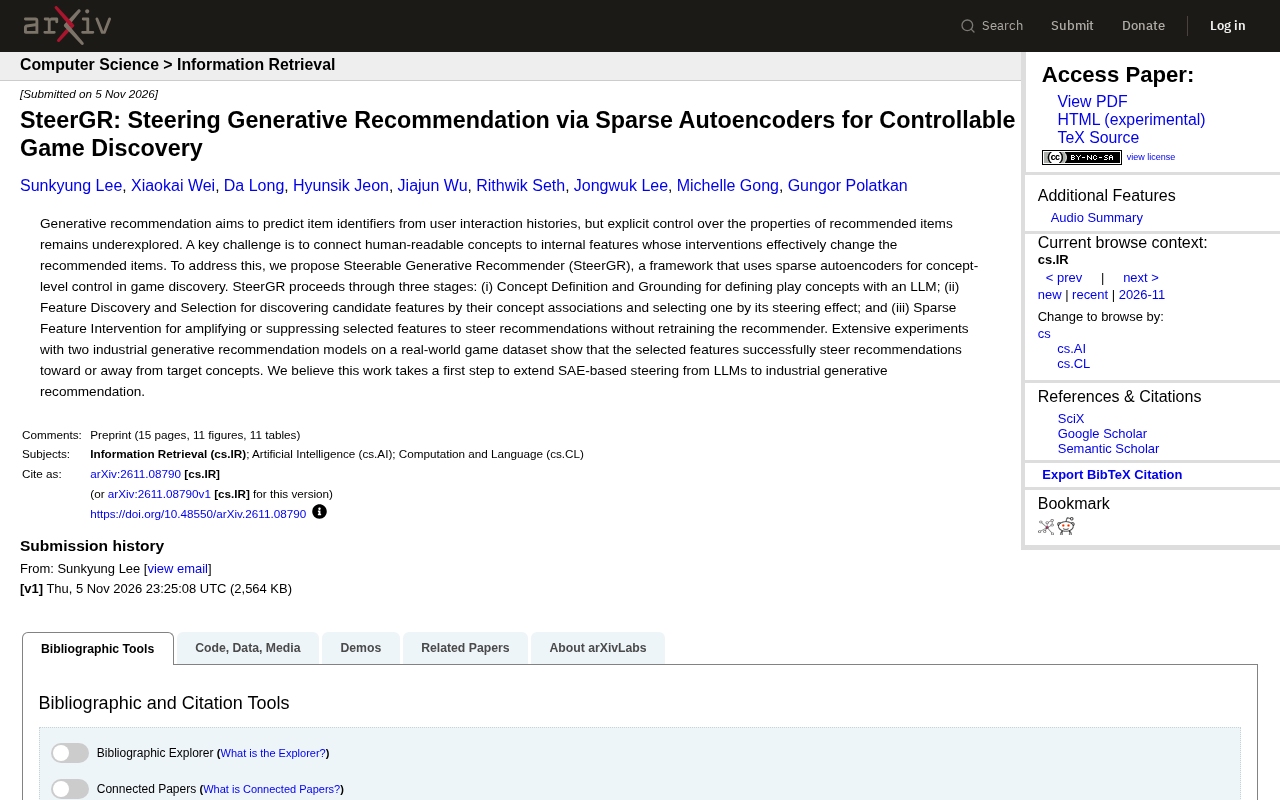
SteerGR is the first to apply SAE steering to generative recommendation, enabling concept-level control.
SteerGR proposes a sparse autoencoder (SAE)-based framework for concept-level control of generative recommendation without retraining. It uses LLMs to define and anchor game-play concepts, discovers and screens concept-related features via intervention experiments, then amplifies or suppresses selected features to steer results. Experiments on a real game dataset across two industrial models confirm feasibility.
Generative recommendation systems match user interests by predicting item identifiers, but how to explicitly control the specific attributes of recommendation results remains an open problem. SteerGR proposes a framework based on sparse autoencoders (SAEs) that connects human-readable concepts with the model's internal features, thereby achieving concept-level manipulation without retraining the recommendation model.
Why Do We Need Controllable Recommendations?
Traditional generative recommendation models learn patterns from users' historical interactions and output sequences of item IDs. This paradigm performs excellently in terms of accuracy, yet it lacks fine-grained control over the attributes of recommended content. For example, a game platform may want to recommend "casual puzzle" games, or deliberately avoid "heavy pay-to-win" games, but the model's internals have no direct switches corresponding to these semantic concepts.
The core insight of SteerGR is that concept-related features lie hidden within the internal representations of generative recommendation models, and that finding and adjusting these features can steer the direction of recommendations. This follows the same line of thinking as feature manipulation via SAEs in large language models (LLMs), but it had not previously been validated in industrial-grade generative recommendation systems.
Sparse Autoencoder (SAE) is a neural network architecture consisting of an encoder and a decoder. The intermediate layer's dimensionality is typically much larger than the input dimensionality, but constraints such as L1 regularization or top-k activation force only a small number of neurons in the intermediate layer to be activated, thereby learning a sparse, disentangled representation of the input data. In interpretability research, SAEs are used to decompose the dense, polysemantic activation vectors inside large models into a large number of nearly monosemantic sparse features, each of which often corresponds to a human-understandable concept (such as "legal terminology" or "negative sentiment"). This property allows researchers to manipulate model outputs by amplifying or suppressing specific features without modifying the original model weights. SteerGR draws on exactly this idea, decomposing the internal representations of the recommendation model through an SAE to find feature directions corresponding to game-play concepts.
SteerGR's Three-Stage Framework
SteerGR breaks the entire pipeline down into three operational stages, each targeting a specific challenge.
Stage One: Concept Definition and Anchoring
LLMs are used to define game-play concepts (such as "cooperative," "competitive," and "open world") and to associate these concepts with item description texts. This step solves the problem of "how human concepts map to items," providing semantic anchors for subsequent feature discovery.
Anchoring here refers to establishing correspondences between abstract human concepts and concrete item description texts. For example, for the concept "cooperative," the LLM identifies keywords or phrases such as "multiplayer collaboration," "team missions," and "voice communication" from game descriptions and uses these description texts as positive samples, while selecting descriptions unrelated to the concept as negative samples. These texts are then fed into the recommendation model's text encoder to obtain the corresponding representation vectors, thereby "anchoring" the concept to a specific region in the model's internal representation space. The key to this step is leveraging the LLM's semantic understanding capabilities to automatically construct concept-item associations, reducing manual annotation costs and providing supervision signals for the subsequent search for relevant features in the SAE feature space.
Stage Two: Feature Discovery and Selection
Candidate features related to the concept are discovered inside the model, and then intervention experiments are used to evaluate each feature's steering effect, ultimately selecting the features with the most significant impact on recommendation results. The key to this stage is that candidate features are not manually specified but are automatically mined from concept associations and then filtered by effectiveness.
Intervention experiments play a central role in feature selection. Specifically, for each candidate feature, researchers artificially amplify (e.g., multiply by a coefficient greater than 1) or suppress (multiply by a coefficient between 0 and 1) the activation value corresponding to that feature during model inference, and then observe the degree of change in the recommendation results. The steering effect is typically quantified by changes in the frequency or ranking of the target concept in the recommendation list. Only those features whose intervention significantly changes the recommendation direction are retained. This screening approach based on causal intervention is more capable than mere correlation analysis of ensuring that the selected features have actual control over the recommendation results, while also avoiding the subjectivity of manually specifying features.
Stage Three: Sparse Feature Intervention
The selected features are amplified or suppressed, thereby pushing recommendation results toward or away from the target concept without retraining the recommendation model. Thanks to the sparsity of the SAE, the intervention affects only a small number of relevant features, avoiding damage to overall recommendation quality.
Experimental Validation: Results on a Real-World Game Dataset
The research team conducted experiments on two industrial-grade generative recommendation models using a real-world game dataset. The results show that the selected features can successfully steer recommendation results toward or away from the target concepts. This means that platform operators can achieve rapid adjustment of recommendation strategies through simple feature interventions, without expensive model retraining.
Interestingly, this is the first time that SAE-based steering techniques have been extended from LLMs to industrial generative recommendation scenarios. Although the experimental scale is limited, the results demonstrate the feasibility of concept-level control in recommendation systems.
Significance and Limitations
SteerGR provides a new path toward controllability in recommendation systems: combining interpretability with control, enabling operators to directly adjust recommendation results using natural-language concepts. However, the current method relies on LLMs for concept definition and feature association, and the scope of concept coverage and the granularity of intervention still require further exploration. In addition, the generalization ability of sparse feature intervention across different recommendation model architectures also needs more validation.
From a broader perspective, this work hints at the enormous potential of combining generative recommendation systems with interpretable AI tools (such as SAEs). In the future, similar methods may be applied to more scenarios such as content platforms and e-commerce recommendations, making recommendation results both accurate and controllable.
One-line Summary
SteerGR is the first to apply SAE steering techniques to generative recommendation, achieving concept-level manipulation.
Paragraph Summary
SteerGR proposes a framework based on sparse autoencoders (SAEs) aimed at achieving concept-level control over generative recommendation results without retraining the recommendation model. The framework is divided into three stages: using LLMs to define game-play concepts and anchor them to item descriptions; discovering concept-related candidate features inside the model and screening out the features with the most significant steering effects through intervention experiments; and amplifying or suppressing the selected features to push recommendation results toward or away from the target concepts. Experiments on a real-world game dataset show that the method can successfully steer recommendation direction on two industrial-grade generative recommendation models, validating the feasibility of concept-level control. Although concept coverage and cross-model generalization still require further research, this work provides a new idea for combining interpretability and controllability in recommendation systems.
Related articles

Seven Years of Evolution: How Far Has the Foldable Come From the First Generation?
From the first foldable to today's latest models, what has seven years changed? Shallower creases, higher brightness, thinner bodies, and smoother software migration—has the foldable crossed the chasm from enthusiasts to ordinary users? This article discusses the question based on a video comparison.

When Did Humans Start Eating Salt? A 10,000-Year History of Salt
When did humans start eating salt? From salt use at the dawn of agriculture 11,000 years ago to ancient seawater evaporation and rock salt mining, and on to the salt trade, salt taxes, and Gandhi's Salt March, this article traces salt's key role in human civilization.
Microsoft Paza Research: How African Language Speech Recognition Breaks Through Architecture and Data Bottlenecks
Microsoft's Paza research evaluates 53 speech models across 39 African languages, revealing architecture choice matters more than pre-training coverage, 200-300 hours is the practical data threshold, and language typology deeply influences recognition performance.