Stella: Your Emotional Wellbeing AI Companion That Helps You Talk Things Through

Stella enters the emotional wellbeing space with "helping you talk things through," using voice and iMessage channels to lower the barrier to confiding.
Stella on Product Hunt positions itself as an emotional wellbeing AI friend, not a therapy tool. Its core difference is the starting point: instead of requiring emotion labels or CBT-style structured flows, it first catches a vague narrative, then helps users shift perspective, find wording, or choose a small action. It offers iOS voice chat and iMessage text, the latter embedded in a high-frequency communication context, significantly reducing the burden of opening a dedicated emotional app. The business model is free download plus subscription, which raises paywall concerns for vulnerable users. Stella clearly states it doesn't replace professional therapy, with clear boundaries, but the unique value of an "AI friend" still needs validation through conversation quality. Product Hunt: 70 upvotes, 19th place—moderate attention.
The emotional wellbeing space is being redefined by AI. A product called Stella has appeared on Product Hunt, positioned as "your emotional wellbeing AI, a friend who helps you sort through your thoughts." It doesn't package itself as a therapy tool, but rather tries to fill a more everyday gap: when you have something to say but haven't figured out what it is yet, find someone who won't judge you and talk it through first.
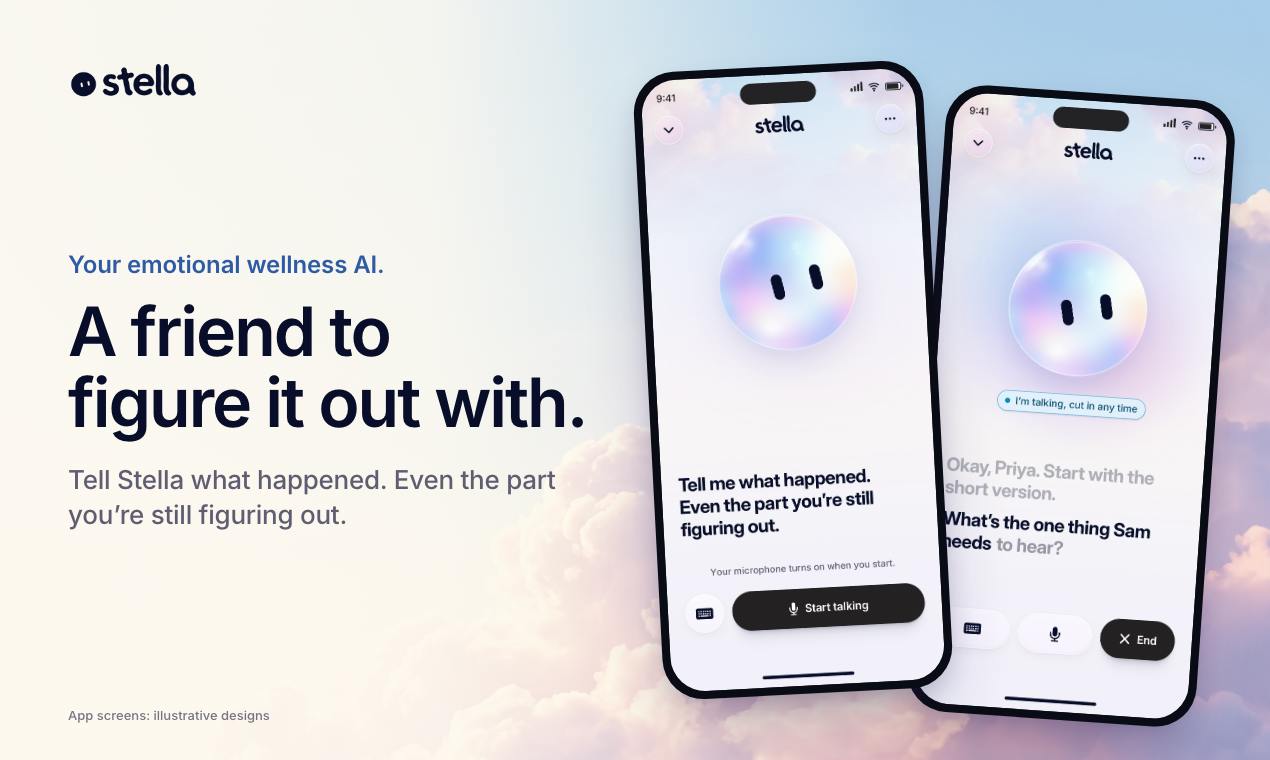
A design that starts from "I can't explain it"
Stella's entry point is very direct: tell it what happened, including the parts you haven't figured out yourself. Users can describe "what's on their mind" by voice or text, then choose the next step—look at it from another perspective, find the right wording to start a conversation, or pick a small action when ready.
This design approach is worth noting. Most emotional AI products guide users into structured flows (mood journals, CBT exercises, guided meditation), while Stella's starting point is the act of "telling" itself. It doesn't require you to label your feelings first, but instead catches that vague narrative and then helps you break it down. For people who aren't used to writing mood journals and aren't ready to see a counselor, this barrier is low enough.
CBT (cognitive behavioral therapy) is one of the most commonly cited methodologies in emotional wellbeing products, with a core assumption that it's not the event itself but one's interpretation of it that shapes emotion. Standard CBT exercises typically ask users to identify automatic negative thoughts in the moment, then restructure cognition through steps like evidence testing and alternative explanations, with typical formats including thought records, behavioral activation, and exposure exercises. When productized, this often manifests as structured guided flows: pick an emotion label, rate its intensity, then fill in the situation-thoughts-evidence columns. Such flows work well for users who already have some self-awareness and are willing to invest time in writing, but for people in the midst of emotional turmoil who can't even articulate "what happened" in an organized way, the upfront structural requirement is itself a barrier. By placing "telling" before structure, Stella is in effect doing funnel front-loading: catch the vague narrative first, then gradually guide the breakdown—the exact reverse of the traditional CBT self-help tool path.
Dual channels: voice and iMessage
Stella offers two ways to use it: voice conversation in the iOS app, or text chat with "Text Stella" via iMessage.
The iMessage channel is a particularly distinctive aspect of this product. It embeds AI conversation into a communication context users already use frequently, reducing the psychological burden of "opening an app specifically to process emotions." In a way, this is close to the original experience of confiding in a friend—just send a message, no appointment or preparation needed. The voice channel suits users for whom "speaking is easier than writing," as emotional expression often comes more naturally in speech.
The product significance of the iMessage channel lies in bypassing the "startup cost" of a standalone app. Behavioral design often notes that each additional step (unlocking, finding the icon, waiting for loading, selecting a feature) reduces the probability that users complete their intention; and emotional confiding is precisely one of the behaviors whose intention is most fragile and easily interrupted. Putting the entry point in a system-level messaging app means users can send a message directly in the moment emotion surges, without switching into the mental frame of "I'm using a mental health tool," which reduces the pressure of self-labeling. Similar approaches have precedents overseas, such as crisis intervention services offering psychological support via text message, and some AI companion products choosing SMS or WhatsApp as their primary entry point. However, the iMessage channel also brings limitations: context management across multi-turn conversations, state synchronization between voice and text sessions, and distribution risks from platform policy changes are all engineering and compliance issues that such "parasitic entry points" must face long-term.
Free download, subscription required for continued use
Stella is free to download, but continued use requires a subscription. This pricing structure is increasingly common in consumer AI apps: lower trial costs with free download, and filter for users with genuine ongoing needs via subscription. For emotional wellbeing products, subscriptions also have their rationale—this kind of companionship takes time to build, and the value of a single use is limited.
However, the subscription barrier is a double-edged sword for emotional wellbeing products. Those who need support are often in vulnerable states, and the paywall may stand exactly at the moment of greatest need. Stella explicitly states on its page that it "is not therapy and cannot replace professional care," which is both a compliance requirement and a boundary statement: it serves everyday emotional sorting, not clinical intervention.
The subscription model of consumer AI apps typically faces a structural contradiction: inference costs grow linearly with depth of use, while users' willingness to pay does not grow in sync. The cost curve for emotional wellbeing products is even steeper—high-quality companionship requires long-context memory and multiple back-and-forth exchanges, with token consumption per session far higher than a single Q&A query. Thus "free download + subscription to unlock continued use" is in effect a cost-screening mechanism: convert high-frequency heavy users into payers while keeping light users in the free tier to sustain word-of-mouth. But the特殊性 of emotional wellbeing scenarios is that usage frequency often correlates highly with fluctuations in psychological state rather than stable daily habits, meaning renewal willingness will rise and fall with emotional cycles, making revenue predictability weaker than tool-type products. Common compromises in the industry include pay-per-use, limited free quotas, and B2B distribution through partnerships with enterprises or insurers; Stella's current choice of a pure subscription path will face more direct scrutiny on retention.
Clear boundaries, but positioning still needs validation
Stella's self-positioning is restrained—a "friend" rather than a "therapist." This boundary is drawn cleverly: it avoids the complexity of medical compliance and reduces the difficulty of managing user expectations. But the "friend" analogy also raises a question: where exactly is the unique value of an AI friend?
Human friends have memory, stances, and shared life context, while AI's advantages lie in being available anytime, non-judgmental, and able to discuss the same matter repeatedly. Stella's product description emphasizes "seeing from another perspective," which may be its differentiation—not giving you answers, but helping loosen stuck thinking. Whether this companionship can sustain long-term subscriptions remains to be seen in its actual conversation quality. On Product Hunt, 70 upvotes and 19th place show it has drawn attention, but 2 comments also reflect limited early discussion.
Emotional wellbeing AI is a fiercely competitive and sensitive direction. Stella chooses to enter through "helping you talk things through," avoiding the minefield of diagnosis and treatment and taking a lighter, more everyday route. Whether this path works depends on whether it can truly become a conversation partner people are willing to return to again and again.
The compliance boundaries of emotional wellbeing AI products mainly revolve around "whether it constitutes a medical device or psychological therapy service." In the US, the FDA regulates products claiming to treat, diagnose, or alleviate disease as medical devices; if a product is used only for general wellness and self-management, it is usually not classified as a medical device, but marketing language must avoid disease-related claims. This is why such products generally state prominently on their pages that they "are not therapy and cannot replace professional care," and trigger referral resources when users express self-harm or crisis content. In the Chinese market, similar products must also consider the labeling requirements for AI-generated content under the Provisions on the Administration of Deep Synthesis of Internet Information Services, as well as qualification issues potentially involved in providing mental health-related services. For products like Stella positioned as "everyday emotional sorting," boundary statements are not just for liability exemption but also define the scope of capability at the product design level: it doesn't promise efficacy, so it doesn't bear clinical responsibility, but correspondingly, it will also struggle to enter payer (insurance, corporate EAP) reimbursement systems, limiting its commercialization ceiling.
One-line Summary
Stella enters the emotional wellbeing space with "helping you talk things through," using dual voice and iMessage channels to lower the barrier to confiding.
Paragraph Summary
Stella, launched on Product Hunt, positions itself as an emotional wellbeing AI friend rather than a therapy tool. Its core difference lies in the starting point: it doesn't require users to first label emotions or enter a CBT-style structured flow, but instead catches a vague narrative first, then helps users shift perspective, find wording, or choose a small action. The product offers two channels—iOS voice conversation and iMessage text chat—the latter embedded in a high-frequency communication context, significantly reducing the psychological burden of "opening an emotional app specifically." The business model is free download plus subscription, a structure that raises paywall controversies for users in vulnerable states. Stella explicitly states it does not replace professional therapy, with clear boundaries, but the unique value of an "AI friend" still needs validation through conversation quality. On Product Hunt, 70 upvotes and 19th place indicate moderate attention.
Related articles
Claude Pro Doesn't Include API Access? Max and Team Plans Now Add API Credits Explained
Claude Pro has no API access; API is billed separately. But Max and Team plans now include monthly API credits: Max 5x $100, Max 20x $200, Team up to $500 per seat. This article details each tier's credits, how to claim them, and the impact on developers.

Testing the 350K-Star REA in an Isolated Environment: 4-Second Install, but Watch Out for Two Pitfalls
Isolated lab test of the 350K-star open-source reverse-engineering tool REA: 4-second install, 15 seconds to list a screenshot tool's outbound addresses, 565 communication channels mapped, while exposing two pitfalls—user-level settings writes and 31 high-risk tool permissions—plus three safety rules.
Reverse Engineering + AI Agents: The T…
Reverse Engineering + AI Agents: The Technical Truth Behind Cloning Adobe Apps in Weeks
A developer used AI Coding Agents for reverse engineering to build 7 open-source Adobe alternatives in weeks. We explore how it works, the MCP Server that hit 100K stars in 6 days, and the real technical and legal limits.