Stenograf: A Locally-Run Private AI Meeting Notes Tool
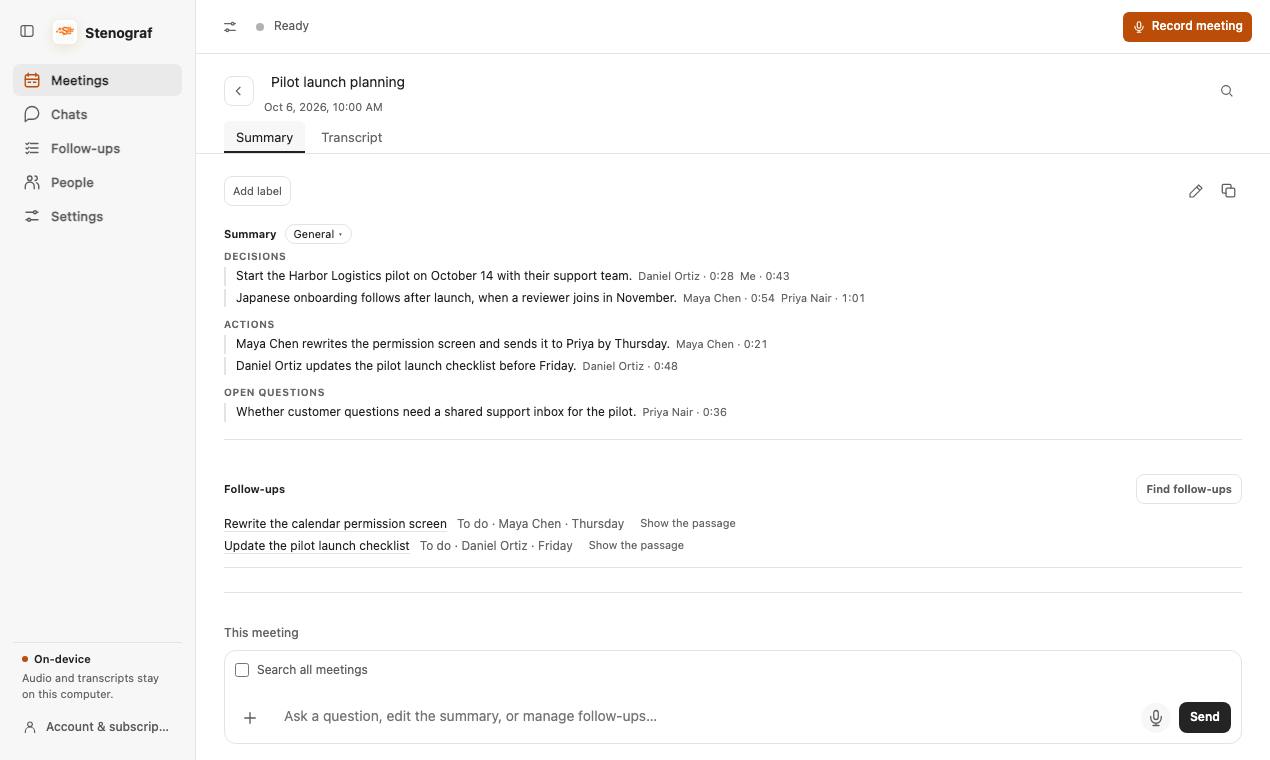
Stenograf keeps meeting recording, transcription, summary, and cross-meeting Q&A entirely local, trading compute for privacy.
Stenograf is a meeting notes tool that received 74 votes on Product Hunt with a "fully local" approach: no bot joins the meeting; it captures call audio directly on a Mac or Windows machine and transcribes locally, with recordings and transcripts never uploaded to a server. It also offers summaries and cross-meeting Q&A with traceable cited transcript snippets, positioning itself as a searchable meeting knowledge base. The article notes that localization brings privacy benefits but also trade-offs—processing speed and model capability may lag behind cloud solutions, cross-device sync is up to users, and system-level audio capture carries compatibility risks with some meeting software. Whether its differentiation holds depends on whether transcription accuracy and Q&A experience can approach cloud products.
Meeting notes have long been a fiercely contested battleground for productivity tools, but most solutions either rely on cloud processing or require a meeting bot to join the call. Stenograf, which recently appeared on Product Hunt, tries a different path: keeping recording, transcription, summarization, and search all on the user's own computer.
Local recording without a meeting bot
Stenograf's core selling point is straightforward—it doesn't inject a bot into your meetings. It records call audio directly on the local Mac or Windows machine, then transcribes it locally. The official description emphasizes that both the recording and the full transcript stay on the local device and are never uploaded to a server.
This design speaks to a common privacy concern. Handing meeting content to a third-party cloud service means sensitive discussions, customer information, and internal decisions may all leave your device. Stenograf pulls the processing chain back to the local machine, at least architecturally reducing the points where data can leak out.
Meeting bots are the common form of cloud-based meeting notes tools: a virtual participant joins a video meeting under a third-party account, records the audio, and uploads it to the cloud for transcription. This approach depends on the meeting host granting the bot permission to join, and it exposes the recording activity in the participant list. By bypassing this path, Stenograf must rely on OS-level audio capture interfaces (such as macOS Core Audio and Windows WASAPI loopback recording) to capture system output audio directly rather than joining the meeting. This explains the compatibility risks mentioned later: some meeting software uses exclusive audio mode or encrypted audio streams, where loopback recording may fail or require additional authorization.
Transcription, summarization, and cross-meeting search
Beyond basic transcription, Stenograf also offers summarization and search capabilities. Users can ask questions about past meetings, and the system returns answers with cited transcript snippets so the original context can be verified. This kind of "citation-grounded Q&A" is quite practical in meeting scenarios: compared with a summary with no sources, an answer that can jump back to the original words is more trustworthy.
In terms of product positioning, what it aims to be is not a single-meeting recording tool but a searchable meeting knowledge base. Cross-meeting questioning means users can ask "what did we decide when we discussed the budget last time" without manually digging through a particular recording.
"Citation-grounded QA" is the application of retrieval-augmented generation (RAG) in the meeting domain: the system first splits historical transcripts into snippets and builds a vector index; when a user asks a question, it retrieves relevant snippets, then has the language model generate an answer based on those snippets with sources marked. The role of the citation mechanism is to reduce model hallucination—when an answer can be traced back to specific original words, users can verify it themselves. The difficulty of cross-meeting search lies in the lack of structured metadata (speakers, topics, timelines) in transcript text, and retrieval quality depends heavily on segmentation strategy and the level of localized deployment of embedding models.
The costs and trade-offs of localization
The privacy advantage of local operation usually comes with trade-offs. Local transcription and summarization depend on device compute, so processing speed and model capability may fall short of cloud solutions; cross-device syncing of meeting notes also needs to be solved by users themselves. The Product Hunt page does not elaborate on these details, and whether the actual experience is smooth depends on how well the local models perform.
Another uncertainty is the recording method. Not relying on a meeting bot means it may achieve this through system audio capture, which may have compatibility differences under some meeting software or system permission settings.
Local transcription typically relies on speech recognition models running on the device, such as the Whisper series and their quantized compressed versions, while summarization and Q&A rely on small language models capable of local inference (in the 7B to 14B parameter range). The accuracy and semantic understanding of such models are generally lower than those of large cloud models, and inference speed is limited by memory bandwidth and GPU compute; Apple Silicon's unified memory architecture has a relative advantage in this scenario, while low-spec Windows laptops may experience noticeable latency. In addition, local models take up several GB of storage space, and version updates also need to be managed manually by users—operational costs that cloud solutions do not have.
Market position
Stenograf received 74 votes and 35 comments on Product Hunt, ranking 20th, and is categorized under Productivity, Meetings, and Artificial Intelligence. This level of traction is not explosive, but the meeting notes space itself is fiercely competitive, with cloud solutions already occupying the mainstream mindshare. Stenograf's differentiator is "local + privacy," and whether it can win over data-sensitive user groups depends on whether its transcription accuracy and Q&A experience can approach the level of cloud products.
For teams that need to handle sensitive meeting content, or individual users who simply don't want their meeting data to leave their computers, Stenograf offers an approach worth watching.
One-line Summary
Stenograf keeps meeting recording, transcription, summarization, and cross-meeting Q&A all on the local machine, trading compute for privacy.
Paragraph Summary
Stenograf is a meeting notes tool that received 74 votes on Product Hunt, taking a "fully local" approach: instead of injecting a bot into meetings, it captures call audio directly on the local Mac or Windows machine and transcribes it locally, with neither recordings nor transcripts uploaded to a server. Beyond basic transcription, it also offers meeting summaries and cross-meeting questioning, with answers accompanied by traceable transcript citations, positioning itself as a searchable meeting knowledge base. The article notes that while localization brings privacy advantages, it also comes with costs—processing speed and model capability may fall short of the cloud, cross-device syncing must be handled by users themselves, and system-level audio capture carries compatibility risks with some meeting software. Whether its differentiation holds depends on whether transcription accuracy and the Q&A experience can approach cloud products.
Related articles
 Tech Frontiers
Stylome Bot Slammed as Useless Junk: Why Do AI Detection Tools Keep Failing?
Reddit users test the Stylome AI detection bot: Gemini-rewritten text judged human-written, consistently low confidence. An analysis of AI text detection's technical dilemmas, privacy concerns, and credibility crisis in community governance.
 Tech Frontiers
When AI Becomes a Productivity Divide: Clarity or "AI Psychosis"?
A civil engineer's deep use of agentic AI boosted efficiency but bred contempt for peers who refuse to learn. Is this clarity or AI psychosis? An analysis of the cognitive and psychological challenges behind the AI productivity divide.
 Tech Frontiers
Opus 5.5 Benchmark Scores Climb, Community Says Its "Weights Are Blessed"
Reddit community discusses Opus 5.5's rising scores on the Benchmaxxing Bench, with users describing its performance as "weights are blessed." This article interprets the community reaction and cautions against conflating benchmark scores with real capability.