StepBack: Step-Level Error-Localized Resampling Cuts Reasoning Tokens by 41%

StepBack uses step-level first-error localization and local resampling to match self-consistency accuracy while saving up to 41.26% of tokens.
StepBack is an efficient test-time reasoning method that addresses the high token overhead of self-consistency (SC) caused by repeated complete sampling. Its pipeline: sample a small set of draft trajectories, use lightweight signals to locate the most likely first erroneous step in each, resample only that step and its suffix while keeping the correct prefix, then majority-vote the candidate answers. On seven math reasoning and multi-hop QA benchmarks, it matches SC's average accuracy while cutting tokens by up to 41.26%. Unlike early stopping and adaptive sampling, it exploits intra-trajectory error structure for fine-grained resource allocation and can stack with methods like Adaptive Consistency. Its effectiveness depends on first-error localization precision, with validation currently focused on math reasoning and multi-hop QA.
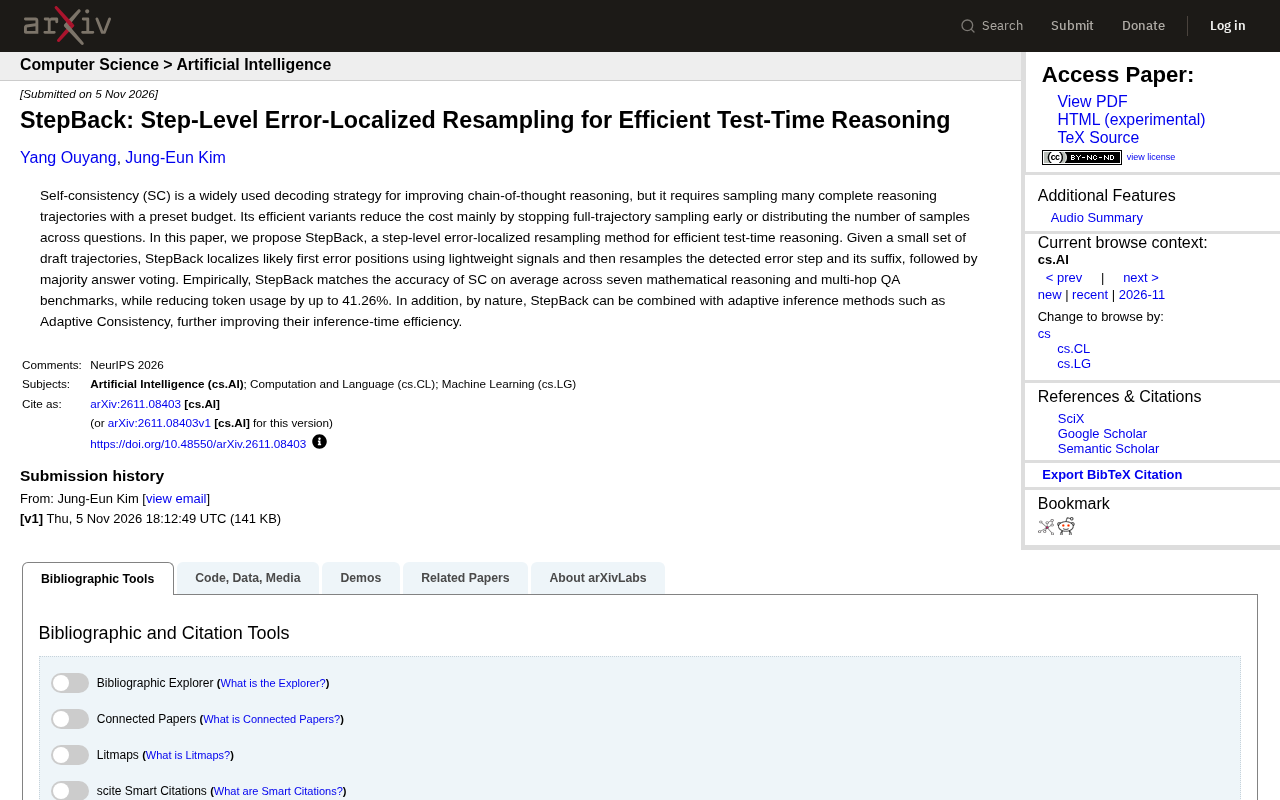
Chain-of-Thought (CoT) reasoning helps large models perform better on complex problems, but at the cost of soaring inference expense. Self-consistency (SC) improves accuracy by sampling complete reasoning trajectories multiple times and voting, yet it requires a large sampling budget set in advance. How to reduce token overhead while maintaining accuracy is the core efficiency problem of test-time reasoning. A recent paper titled "StepBack: Step-Level Error-Localized Resampling for Efficient Test-Time Reasoning" proposes a step-level error-localized resampling method that matches the average accuracy of SC on multiple benchmarks while cutting token usage by up to 41.26%.
Limitations of Existing Efficient Reasoning Approaches
Self-consistency is expensive because it samples every candidate trajectory all the way to the end. Existing efficient variants mainly reduce cost from two angles: early stopping the sampling of an entire trajectory, and adaptively allocating the number of samples based on problem difficulty. These methods reduce "how many trajectories to sample" or "how long to sample," but they do not make targeted use of the error structure within a trajectory.
In other words, when a reasoning trajectory goes wrong at some intermediate step, the subsequent steps have often already deviated from the correct answer, and fully sampling the remainder of that trajectory is a waste. This is precisely the starting point of StepBack: rather than resampling the whole trajectory, first locate the step most likely to be wrong and resample from there.
Self-consistency itself is an ensemble strategy that requires no additional training and relies solely on multiple samplings and voting at inference time, with its accuracy gain saturating as the number of samples increases. This means that once the sampling budget reaches a certain threshold, the marginal benefit of continuing to add complete trajectories drops rapidly, while token cost rises linearly. Early stopping strategies typically set a confidence threshold or a maximum number of steps, truncating a trajectory early once its intermediate answer stabilizes; adaptive sampling dynamically decides the number of samples based on problem difficulty or model uncertainty. Both types of methods act on the external dimension of trajectories and do not examine the error distribution step by step within a trajectory. StepBack's angle is precisely to fill this gap: it treats a trajectory as a decomposable sequence of steps and exploits the causal dependencies between steps to regenerate only the suffix after an error occurs, thereby correcting the result while preserving the correctness of the prefix.
The Core Mechanism of StepBack
The StepBack pipeline can be broken down into three stages.
1. Locating the first error with a small set of draft trajectories
The method first samples a small set of draft trajectories, then uses lightweight signals to locate the most likely "first error position" in each trajectory. This step does not require an additional heavy model or full verification, making it low-cost; its purpose is to find the step most worth repairing.
Locating the "first error position" relies on lightweight signals, which typically include step-level log probabilities, answer consistency across draft trajectories, semantic coherence scores between steps, or rules/small models that quickly check intermediate conclusions. Their common feature is that their computational overhead is far lower than full resampling or calling a large verifier. The reason for locating the first error rather than an arbitrary error is the error accumulation effect in reasoning chains: everything after the first erroneous step is built on that erroneous premise, and repairing subsequent steps while keeping the erroneous prefix usually cannot correct the final answer. Thus, first-error localization shrinks the resampling scope to the minimal necessary suffix, avoiding both generation from scratch and repeated patching across multiple error points. The small size of the draft trajectories also keeps the token cost of the localization stage itself manageable, so it does not offset the subsequent savings.
2. Resampling the erroneous step and its suffix
After locating the erroneous step, StepBack resamples only that step and its subsequent suffix, rather than regenerating the entire trajectory from scratch. In this way, the correct reasoning in the prefix is preserved, and token overhead is concentrated on the part that truly needs correction.
3. Majority answer voting
After resampling, the method performs majority answer voting on the candidate answers, following the aggregation approach of self-consistency, but the trajectories participating in the vote have undergone error localization and local repair.
This "locate first, then locally resample" design shifts computational resources from spreading across the whole trajectory to the error-dense region, which is the key difference from early stopping and sample allocation strategies.
Majority voting is the aggregation core of self-consistency, and its effectiveness depends on the diversity of candidate answers. In StepBack, the trajectories participating in the vote are not all independently and fully sampled; instead, they are a mixture of "original draft trajectories" and "repaired trajectories after resampling the suffix of the erroneous step." This introduces a noteworthy trade-off: repaired trajectories may share the same prefix, resulting in lower answer diversity than fully independent sampling, thereby weakening the error-correction capability of voting. StepBack maintains a certain level of diversity by retaining multiple draft trajectories and localizing and resampling each separately. In addition, voting is usually performed only on the final answer string and does not involve merging reasoning paths, so the aggregation cost is very low and does not become a new overhead bottleneck.
Experimental Results: Matching SC Accuracy with 41.26% Token Savings
The paper evaluates on seven mathematical reasoning and multi-hop QA benchmarks. The results show that StepBack matches the accuracy of SC on average while cutting token usage by up to 41.26%.
The significance of this result is that the efficiency gain does not come at the expense of accuracy; rather, it reduces inference overhead at the same accuracy level. For scenarios that require deploying reasoning models at scale, such savings directly translate into cost.
Can Be Combined with Adaptive Reasoning Methods
The paper also notes that StepBack can in principle be combined with adaptive reasoning methods (such as Adaptive Consistency) to further improve inference-time efficiency. This means it is not an isolated alternative but more of a component that can be embedded into existing efficient reasoning pipelines—adaptive methods decide "how many to sample," while StepBack decides "where to resample from."
Practical Implications
From an engineering perspective, the value of StepBack lies in spending the reasoning budget where it matters most. The redundancy of traditional self-consistency mainly comes from repeated sampling of complete trajectories, whereas step-level error localization offers a finer-grained way to allocate resources. For mathematical and multi-hop QA tasks with long reasoning chains and a high cost per erroneous step, this idea is especially fitting.
Of course, the method's effectiveness depends on the precision of the lightweight signals in locating the first error; when localization is inaccurate, resampling may land on an erroneous prefix. The paper's experiments cover two types of tasks, mathematical reasoning and multi-hop QA, and performance on other reasoning forms still requires more validation. But based on existing results, StepBack offers a noteworthy direction for optimizing the efficiency of test-time reasoning: not sampling less, but resampling smartly.
One-line Summary
StepBack uses step-level first-error localization and local resampling to match self-consistency accuracy while saving up to 41.26% of tokens.
Paragraph Summary
StepBack is an efficient method for test-time reasoning aimed at solving the excessive token overhead caused by multiple complete samplings in self-consistency (SC). Its core pipeline has three steps: first sample a small set of draft trajectories and use lightweight signals to locate the most likely first erroneous step in each trajectory; then resample only that erroneous step and its subsequent suffix, preserving the correct prefix; finally perform majority voting on the candidate answers. On seven mathematical reasoning and multi-hop QA benchmarks, StepBack's average accuracy is comparable to SC, with token usage reduced by up to 41.26%. Unlike efficient variants such as early stopping and adaptive sampling, it exploits the internal error structure of trajectories for fine-grained resource allocation and can be stacked with methods such as Adaptive Consistency. Its effectiveness depends on first-error localization precision, and current validation is concentrated on mathematical reasoning and multi-hop QA.
Related articles
 Tech Frontiers
Google Omni 1.2 Flash: 15-Second AI Video at Just $0.07 per Second
Google DeepMind releases Gemini Omni 1.2 Flash: 15-second video, 720p at $0.07/sec (30% cheaper), multi-turn editing without regeneration, draft upscaling to 4K.
 Tech Frontiers
No AI Ghostwriting: Writer's Quarter Reinvents Novel Writing with a Visual Workbench
The Writer's Quarter is an AI-free novel writing and planning tool that unifies character building, story planning, and manuscript writing in one visual workbench. This article analyzes its positioning, target users, and differentiated value amid the rise of AI writing tools.
 Tech Frontiers
Fleeep: A Unified Inspiration Collection Notes App for Creatives
Fleeep is a notes app for creatives that unifies screenshots, bookmarks, saved posts, and inspiration into one calm, cross-device, offline-capable space. This article analyzes its positioning, differentiation, and target users.