Stiro: An AI Onboarding and Customer Success Agent for SaaS
Stiro uses an AI agent to walk users through operations inside real SaaS products, reducing repetitive how-do-I tickets.
Stiro is an AI onboarding and customer success agent for SaaS, ranked #14 on Product Hunt. Its core difference lies not in answering but in executing: when users get stuck, Stiro completes the steps alongside them in the real product for them to watch, rather than just offering documentation or chat Q&A. Integration is extremely lightweight—just one script tag. On security, it draws a clear red line: send, spend, and delete operations must be handed back to the user for confirmation, with AI autonomy limited to reversible, low-risk guidance actions. The product focuses on reducing repetitive how-do-I ticket volume and freeing up customer success teams' time. Public data is currently limited, and actual guidance success rate and boundary reliability still await validation through real deployments.
SaaS products' "how-do-I" tickets have long been an invisible tax on customer success teams: a user gets stuck at some step, fires off a "how do I do this?" message, and support staff have to repeatedly take screenshots, record screen captures, and write out step-by-step instructions. Stiro, a new product ranked #14 on Product Hunt, attempts to keep these tickets at bay with an AI agent—not by showing users tutorials, but by walking them through the process directly inside the real product.
Understanding Stiro in One Sentence: An AI Agent That "Hand-Holds" Inside the Real Product
Stiro positions itself as an AI onboarding and customer success agent for SaaS. Its biggest differentiator lies not in "answering" but in "executing": when a user gets stuck or makes a request, Stiro completes the steps alongside the user inside your real product, with the user watching the entire time. This goes a step further than traditional help center documentation or chatbots—users don't need to switch back and forth between "reading instructions" and "operating the product," keeping the learning curve to a minimum.
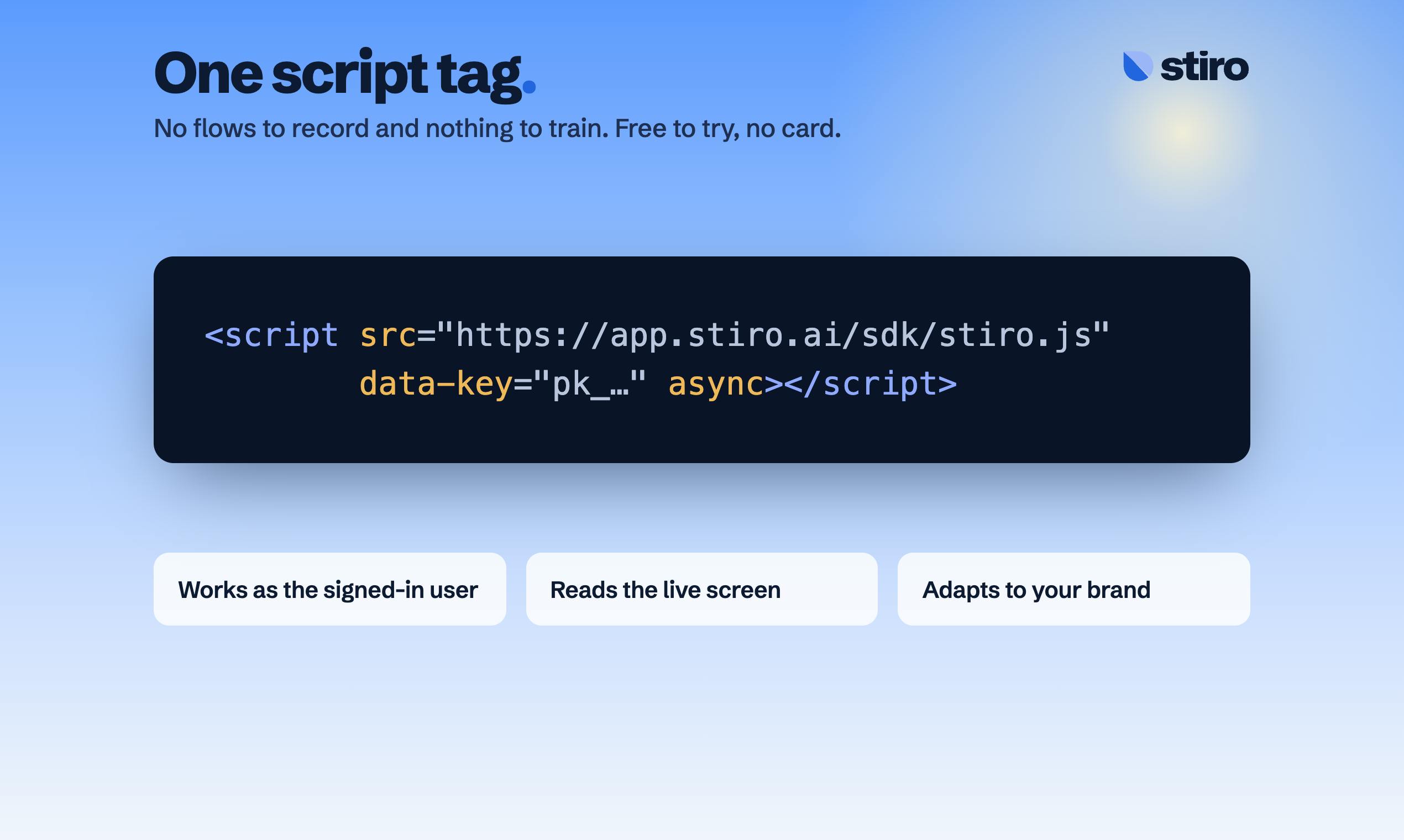
The integration approach is also deliberately lightweight: just add a single script tag to your SaaS. For small and mid-sized teams without dedicated frontend resources, this low-intrusion integration means a shorter time to deployment.
Script tag is the most basic resource-inclusion mechanism in web development, taking the form <script src="..."></script>. When the browser encounters this tag, it downloads and executes the specified JavaScript file. A SaaS product only needs to insert one line pointing to Stiro's hosted script into its page template, and Stiro can load and run in the user's browser without any changes to the backend or database structure. This integration approach is a typical frontend SDK/embedded component pattern, consistent with how tools like Intercom and Hotjar are integrated. Its advantages are fast deployment and minimal intrusion into existing code; the trade-off is that the script runs within the user's session, so permissions and data access scope must be strictly constrained—which is precisely the technical context behind Stiro's emphasis on operational boundaries.
Security Boundaries: Send, Spend, and Delete Operations Must Be Handed Back to the User
When an AI agent directly operates in a production environment, the most likely concern is permissions and risk. Stiro draws a clear line here: any action involving sending, spending, or deleting is handed back to the user to confirm and execute themselves.
This design choice deserves recognition. It limits the AI's autonomy to "reversible, low-risk" guidance actions, while leaving irreversible operations or those involving funds/external communication to human decision-making. For SaaS vendors, this both reduces the probability of incidents and makes it easier to pass internal security reviews—after all, letting a third-party script click buttons on users' behalf inside your product is inherently something that requires careful handling.
Tiered operational permissions for AI agents is a core issue in the design of agent-based products. The industry typically classifies the actions an agent can perform into three risk tiers: read-only or reversible guidance actions (such as highlighting buttons or filling in sample text), external actions requiring confirmation (such as sending messages or submitting forms), and irreversible actions or those involving assets (such as payments or deleting data). By handing the latter two categories back to the user for confirmation, Stiro essentially adopts a "human-in-the-loop" confirmation mechanism—the AI drives the process forward but pauses at key junctures to request human authorization. This design both conforms to the principle of least privilege and gives SaaS vendors clear boundaries to rely on during security reviews.
Clear Goal: Reducing "how-do-I" Ticket Volume
Stiro's value proposition is highly focused: Built to cut how-do-I tickets. These tickets are characterized by high volume, repetition, and low per-ticket handling cost—but a staggering total that chronically consumes customer success teams' time.
Replacing manual step-by-step guidance with an AI agent theoretically delivers two benefits: first, instant response—users don't have to wait for a human reply; second, the support team is freed from repetitive labor to focus on higher-value customer engagement work. However, the original text does not provide specific ticket-reduction percentages or customer case data, so actual results still need to be verified through real deployments.
how-do-I tickets refer to support requests where users ask "how do I use this feature," as distinct from bug reports or billing issues. These tickets typically account for a substantial share of total SaaS support volume; they are highly standardized and can be covered by documentation or guidance, yet each still requires human response time. Common industry countermeasures include help centers, in-product tours, and the AI Q&A chatbots that have emerged in recent years. Stiro's difference lies in upgrading "answering" to "acting on the user's behalf," which in theory can cover those users who can't even follow documentation and need to see a demonstration before they can get started—thereby intercepting tickets before they are ever created.
Market Position and Observations
A result of 74 upvotes, 3 comments, and a #14 ranking on Product Hunt indicates the product has garnered some attention, but discussion volume is still early-stage. Its category tags are User Experience, SaaS, and Artificial Intelligence, placing it squarely in the warming赛道 of "AI-empowered SaaS customer experience."
From a product-form perspective, Stiro takes a pragmatic route: rather than chasing the grand narrative of general-purpose agents, it targets the specific scenario of "in-product onboarding," lowers the integration barrier with a script tag, and resolves trust issues through operational boundary design. For SaaS teams with high customer support costs and relatively complex product操作 paths, this approach is worth watching. What will truly determine how far it can go is the guidance success rate in real user behavior after integration, and whether that "send/spend/delete" red line is reliable enough.
One-line Summary
Stiro uses an AI agent to walk users through operations inside real SaaS products, reducing repetitive how-do-I tickets.
Paragraph Summary
Stiro is an AI onboarding and customer success agent for SaaS, ranked #14 on Product Hunt. Its core difference lies not in "answering" but in "executing": when users get stuck, Stiro completes the operational steps alongside them in the real product for them to watch, rather than merely providing documentation or chat-based Q&A. Integration is extremely lightweight—just one script tag. On security, it draws a clear red line: send, spend, and delete operations must be handed back to the user for confirmation, with AI autonomy limited to reversible, low-risk guidance actions. The product goal is focused on reducing repetitive how-do-I ticket volume and freeing up customer success teams' time. Currently, public data is limited, and the actual guidance success rate and boundary reliability still await validation through real deployments.
Related articles

Multi-Agent Collaborative Development: Task Card-Driven Practices for Medium-to-Large AI Projects
A Bilibili creator shares a task card-driven, PM-orchestrated multi-Agent collaboration model with local-first repository state, so any Agent tool can take over a project anytime.
Cursor vs Copilot vs Claude Code: How Laravel Developers Should Choose
Compare Cursor, GitHub Copilot, and Claude Code for Laravel development: an AI-first editor, a plugin for existing editors, and a terminal agent for multi-file tasks and testing — plus workflow-based recommendations.
AgentScope Java Edition: A Practical Guide to Enterprise-Level Agent Frameworks
An in-depth analysis of Alibaba's AgentScope Java enterprise agent framework: contrasting client-side AI and server-side AI, explaining Java's natural advantages in high concurrency and distributed state management, and outlining a complete learning path from core principles to multi-agent collaboration.