Stop Learning to Code? Build a $4,900/Month Subscription App with AI No-Code Tools

AI no-code tools lower the software building barrier, enabling subscription Micro-SaaS for local businesses — but the cognitive barrier remains.
The article analyzes a viral short video advocating "stop learning to code." Its core claim: AI-driven no-code tools have turned software building from an exclusive engineering skill into a general capability, letting entrepreneurs ship products without a degree or coding. The video's specific path is building Micro-SaaS tools (appointments, memberships) for local businesses at monthly subscriptions, proposing 100 customers × $49/month = $4,900 MRR. The article acknowledges the model's value in lowering barriers and building reusable assets, while flagging execution challenges downplayed by short-video marketing. Ultimately, AI lowers the execution barrier — not the cognitive one.
The Programming Barrier Is Disappearing
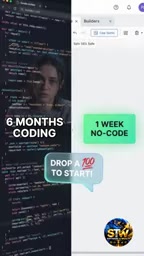
A short video circulating widely on YouTube has thrown out a rather provocative idea: stop learning to code. In the video, a content creator focused on entrepreneurs says bluntly — "Coders work for owners" — while smart entrepreneurs are using visual AI building tools to ship software without typing a single line of code.
The core logic of this argument isn't new — the No-Code and Low-Code movements have been developing for years. But AI's involvement has changed the nature of the game: in the past, no-code platforms required you to understand database structures and API call logic; now AI can handle those technical decisions for you — you just need to describe what you want.
The difference between No-Code and Low-Code lies in the level of abstraction and customizability. No-Code platforms (such as Bubble, Glide, Adalo) are configured entirely through visual drag-and-drop interfaces, requiring users to never touch any code syntax — ideal for business people quickly building MVPs. Low-Code platforms (such as Webflow, Retool, OutSystems) allow embedding a small amount of code (JavaScript, SQL, etc.) on top of the visual layer to push past template boundaries — suited for developers with some technical foundation. The shared logic of both is encapsulating underlying infrastructure — databases, servers, authentication, deployment — into reusable modules. AI's involvement changes the third layer: in the past, users still had to decide data table structures and API call sequences themselves; now large language models can generate data models and business logic directly from natural language descriptions, turning the "configurator" further into a "describer." This is precisely the technical foundation behind the video's argument.
"You Don't Need a Degree" — The Positioning of AI Building Tools
One message repeated throughout the video is: you don't need a degree. This statement targets a large group of people who have been intimidated by the idea of "learning to code" — they may have tried a Python intro course, given up when stuck on environment setup, or spent thousands on bootcamps yet still couldn't write a complete project.
The positioning of AI visual building tools is clear: transform "building software" from an exclusive engineering skill into a general capability. Drag-and-drop components, configure logic, connect data sources — with AI assistance, these operations can already generate prototypes just by describing requirements in natural language.
This direction itself deserves serious attention. AI programming assistants like GitHub Copilot and Cursor have already proven the feasibility of AI writing code, and the combination of no-code platforms plus AI pushes the barrier down yet another level. However, it's important to be clear-headed: tools simplify building, but they don't simplify understanding requirements or making product judgments. Knowing what to build, for whom, and how to make people pay for it — these capabilities AI cannot replace for you yet.
The Specific Path: Building Subscription Apps for Local Businesses
The video lays out a very specific business model: building subscription apps for local businesses.
The logic chain goes like this: local businesses (restaurants, gyms, beauty salons, repair shops, etc.) generally lack digital tools, but they have real needs — appointment management, membership systems, customer notifications, simple CRM. Custom development typically costs tens of thousands, but building an adequate version with AI no-code tools can compress the time cost to days or even hours.

Then charge a monthly subscription fee. Businesses don't need to pay a large upfront development fee, and you don't need to deliver from scratch each time — one template can be reused, with extremely low marginal cost. This is classic SaaS (Software as a Service) thinking, just narrowing the target from "all enterprises" to "local businesses in your city."
The feasibility of this model lies in the fact that: local businesses' digitalization needs have long been ignored by mainstream SaaS products. Micro-needs in vertical industries are exactly the gap markets that big companies won't bother with but individual developers can cover with AI tools.
Micro-SaaS is a concept that has gained popularity in the indie developer community in recent years, referring to small software products operated by one to a few people, focused on extremely narrow vertical scenarios, charged via subscription. Its difference from traditional SaaS is that it doesn't pursue generalization and large-scale fundraising, but instead targets gap markets that big companies are unwilling to enter because the market is too small or the customer lifetime value is too low. Appointment, membership, and notification systems for local businesses are typical scenarios. The key metrics for Micro-SaaS are not total users, but Monthly Recurring Revenue (MRR) and Churn Rate — if 100 customers lose 5 per month, you need continuous customer acquisition to maintain the $4,900 level. This also explains why the video emphasizes "template reuse": only when marginal delivery cost approaches zero can small-scale subscription revenue be sustainable.
Let's Do the Math: 100 Customers × $49 = $4,900/Month
The most eye-catching part of the video is this set of numbers:
Acquire 100 local businesses, each paying $49 per month → Monthly Recurring Revenue (MRR) = $4,900

$4,900 in monthly recurring revenue means approximately $58,800 in annual revenue (over 12 months). As a side hustle or small independent business, this number is indeed attractive — especially considering this model theoretically requires no employees and no office.
But between "calculable" and "achievable" lies a massive execution gap. 100 paying customers means you need to reach at least several hundred potential businesses, handling rejections, follow-ups, after-sales support, and feature iterations. The $49/month pricing also means you need considerable scale to generate meaningful income, and the acquisition and maintenance costs per customer are not zero.
The greatest value of this number model isn't how accurate it is, but that it reveals a mindset shift: from selling time (freelance coding) to building assets (reusable subscription products). The video's closing line — "Stop typing code. Start building assets" — encapsulates the core thesis of the entire piece.
Where This Logic Holds Up and Where to Be Cautious
Where it holds up: AI no-code tools have indeed dramatically lowered the barrier to building software; local businesses' digitalization needs do exist; and subscriptions do generate a healthier cash flow structure than one-time freelance work. For someone with sales ability who understands a particular local industry, this path is realistically viable.
Where to be cautious: As short-form video marketing content, the video naturally tends to simplify complexity and amplify revenue expectations. Several real issues go unmentioned — local businesses' willingness to pay and renewal rates, the no-code platform's own monthly fees and lock-in risk, differentiation pressure when similar competitors flood in, and the workload of after-sales support.
More fundamentally, the phrase "Stop learning how to code" creates a false dichotomy. A more accurate description is — programming is no longer the only path to building software products, but understanding technical logic is still a competitive advantage. You don't have to become a programmer, but you need to be able to communicate effectively with AI tools, judge the quality of generated results, and know where to find answers when things go wrong.
What AI lowers is the execution barrier, not the cognitive barrier. This distinction determines whether you're truly building assets with these tools, or just working for someone else in a different way.
Platform lock-in risk is an easily overlooked factor when evaluating no-code entrepreneurship. When you build a client's business system on a no-code platform, the platform's pricing adjustments, feature discontinuations, or even shutdowns will directly impact your clients. Most platforms charge based on number of apps, users, or traffic tiers — customer growth means your costs rise in tandem, and the $49/month pricing may be eroded by platform fees after scaling. Additionally, migration costs are extremely high — no-code outputs typically cannot be directly exported as standalone code, meaning you form a strong dependency on that platform. The mature approach is to confirm the platform's export and self-hosting policies early on, and prioritize tools that support standard databases (such as PostgreSQL) and open APIs, keeping core customer data in your own hands rather than entrusting it entirely to the platform.
One-line Summary
AI no-code tools lower the software building barrier, enabling entrepreneurs to build subscription Micro-SaaS for local businesses — but the cognitive barrier remains.
Paragraph Summary
The article analyzes a short video advocating "stop learning to code." Its core claim: AI-driven visual no-code tools have transformed "building software" from an exclusive engineering skill into a general capability, allowing entrepreneurs to build products without a degree or programming. The video's specific path is developing Micro-SaaS tools like appointment and membership systems for local businesses, charging monthly subscriptions, and proposes a revenue model of 100 customers × $49/month = $4,900 MRR. The article acknowledges the value of this model in lowering barriers, opening gap markets, and building reusable assets, while pointing out execution challenges downplayed by short-video marketing: customer acquisition costs, renewal rates, platform lock-in, and after-sales pressure. The ultimate conclusion is that AI lowers the execution barrier, not the cognitive barrier — understanding technical logic and product judgment remain irreplaceable competitive advantages.
Related articles

Anthropic IPO Countdown: The Compute Cost Ledger Behind a $2 Trillion Valuation
Anthropic's IPO targets up to $2 trillion — double its Series H valuation. We break down the timeline, compute cost logic, and the key question investor day must answer.

Anthropic IPO Prospectus Revealed: Behind 12x Revenue Growth, the Twin Tests of Compute Costs and Customer Concentration
Anthropic filed its IPO prospectus: 2025 revenue up 12x to $4.6B, net loss $42B including $34B non-cash. Breaking down compute costs, $2T valuation logic, customer concentration risks, and founder control.

Xteink X4 Pro Review: A Mini E-Reader That Fits in Your Pocket, Now More Affordable
Xteink X4 Pro is a 4.26-inch mini e-reader, smaller and thinner than a 6-inch Kindle, magnetically attachable to phones, and cheaper than ever. We analyze its screen, design, use cases, and value.