Stop Using a Food Processor for Mashed Potatoes: A Kitchen Science Principle

Food processor and immersion blender blades rupture potato cells and release starch, making mashed potatoes gluey and unappetizing.
The article centers on advice from Cooking101 host Melissa: never use a food processor or immersion blender for mashed potatoes. High-speed blades rupture cooked potato cell walls, releasing free starch that gelatinizes into an irreversible gluey network—sticky and tough, unsalvageable with milk or butter. Melissa's sister's failed attempt illustrates this common misuse. Food processors suit homogenization tasks like soups and sauces, while mashed potatoes need gentle disruption via masher, fork, or ricer, plus mashing while hot and controlling cooking degree for a fluffy result.
Mashed potatoes are a Thanksgiving staple, but many people end up with a dish that's either lumpy or gluey. In a recent episode on the YouTube channel Cooking101, host Melissa offered a piece of advice so blunt it borders on harsh: never use a food processor or an immersion blender for your mashed potatoes.

It sounds like kitchen folklore, but there's a classic food science mechanism behind it.
Why blades are the enemy of mashed potatoes
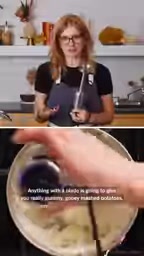
Pointing at the food processor's blades in the video, Melissa put it plainly: "You see those blades? Anything with a blade is going to give you really gummy, gooey mashed potatoes."

The key here is the integrity of the potato cells and how starch is released. Once potatoes are cooked, their cell walls have softened, and the interior is packed with starch granules that have absorbed water and swelled. When you use a potato masher or a ricer, the force is relatively gentle—most cells are "pressed open," and the starch remains trapped within the remnants of the cell walls, giving the final product a fluffy texture.
Blades, on the other hand, spin at high speed and cut, instantly rupturing vast numbers of cell walls and flinging free starch directly into the liquid. Once a large amount of starch leaches out and gelatinizes under heat, it forms a thick, paste-like network—the gluey texture Melissa keeps referring to. This change is irreversible; no amount of milk or butter will save it.
Starch gelatinization refers to the process in which starch granules absorb water and swell upon heating, then rupture and release amylose and amylopectin molecules, forming a viscous colloidal network. Potatoes contain about 15%–20% starch, and during cooking the starch granules inside the cells are already fully hydrated and swollen. If the cell walls remain intact, these swollen starch granules stay confined within the cells; when mashed, the cells separate from one another, yielding a fluffy texture. Once the cell walls are rapidly ruptured by blades, large amounts of starch molecules leach out and further gelatinize under residual heat and moisture, forming a continuous three-dimensional network that locks in free water—macroscopically manifesting as a gluey, tough texture. Notably, after cooling, the gelatinized starch network undergoes retrogradation, making the texture even firmer—which is why mashed potatoes that have been through a food processor are especially unpleasant once they cool down.
A cautionary tale from a family member
While testing mashed potato recipes, Melissa received a text from her sister Amy asking how to make mashed potatoes. After some questioning, it turned out the problem was the tool: her sister had used an immersion blender, and the result was a disaster.
"This is my sister's mashed potatoes—sorry, Amy, not trying to throw you under the bus," Melissa said with a laugh on the show. "It just makes mashed potatoes gluey and unappetizing."

What makes this anecdote so convincing is that it represents an extremely common scenario: anyone who has a food processor or immersion blender at home naturally thinks of using it to "save effort," only to ruin a whole pot of ingredients. The more powerful the tool, the higher the cost of misuse.
What these tools are still good for
Melissa doesn't dismiss the value of food processors and immersion blenders themselves—she explicitly says "they're great for a lot of things, just not mashed potatoes."
In kitchen practice, high-speed blades are suited to tasks that require homogenization: blending creamy soups, making sauces, mixing batters, whipping up hummus. These scenarios inherently aim for a fine, smooth texture, and starch gelatinization is actually a plus. Mashed potatoes are the exact opposite—they want "fluff," not "smooth."
The essence of choosing a tool is choosing a method of destruction. Want graininess and airiness? Use pressing. Want emulsification and homogenization? Use cutting. Confusing these two types of needs makes failure almost inevitable.
Homogenization refers to the process of using mechanical shear force to break two immiscible liquids (such as oil and water) into tiny droplets and disperse them evenly—typical examples are mayonnaise, vinaigrette, and creamy soups. The high-speed blades of immersion blenders and food processors generate a strong shear field, making them ideal tools for homogenization. Such tasks pursue a fine, stable, non-separating texture, which is exactly the opposite of the fluffy, grainy texture mashed potatoes seek. Understanding this makes it clear why the same machine excels at blending creamy soups but backfires on potatoes—it's not that the tool is bad, but that the task's goal doesn't match the tool's mechanism of action.
Alternatives and key techniques
If you don't have a dedicated potato masher on hand, a fork works too—it just takes longer. For a finer texture, use a ricer (potato press), which "squeezes" potatoes through small holes into thin strands, causing far less cell damage than blades.
There are also a few easily overlooked details in the process: cook the potatoes until a knife slides in easily, but don't boil them until they fall apart; mash them while hot so the butter and warm milk blend more easily; after mashing, return them to the pot over low heat briefly to help excess moisture evaporate. These steps, combined with the right tools, are what yield a result that's both fine and non-gluey.
The value of Melissa's episode isn't in offering some complicated recipe, but in stopping a high-frequency mistake with a single "never do this." Many kitchen failures aren't due to lack of skill, but because the tool was used in the wrong place.
One-line Summary
Food processor and immersion blender blades rupture potato cells and release starch, turning mashed potatoes gluey and unappetizing.
Paragraph Summary
The article centers on advice from Cooking101 host Melissa: never use a food processor or immersion blender for mashed potatoes. The reason is that high-speed blades rupture cooked potato cell walls, causing large amounts of free starch to leach out and gelatinize, forming an irreversible gluey network—the result is sticky and tough, and no amount of milk or butter can save it. Melissa's sister's failed attempt with an immersion blender illustrates this common misuse. The article points out that food processors are suited to tasks requiring homogenization, such as creamy soups and sauces, while mashed potatoes need gentle cell disruption via a masher, fork, or ricer. Combined with details like mashing while hot and controlling the cooking degree, you can achieve a fluffy, fine result.
Related articles
 Tech Frontiers
Google Omni 1.2 Flash: 15-Second AI Video at Just $0.07 per Second
Google DeepMind releases Gemini Omni 1.2 Flash: 15-second video, 720p at $0.07/sec (30% cheaper), multi-turn editing without regeneration, draft upscaling to 4K.
 Tech Frontiers
No AI Ghostwriting: Writer's Quarter Reinvents Novel Writing with a Visual Workbench
The Writer's Quarter is an AI-free novel writing and planning tool that unifies character building, story planning, and manuscript writing in one visual workbench. This article analyzes its positioning, target users, and differentiated value amid the rise of AI writing tools.
 Tech Frontiers
Fleeep: A Unified Inspiration Collection Notes App for Creatives
Fleeep is a notes app for creatives that unifies screenshots, bookmarks, saved posts, and inspiration into one calm, cross-device, offline-capable space. This article analyzes its positioning, differentiation, and target users.